



Data
The epidemiological surveillance system for asthma established by Santé publique France makes it possible to identify the populations affected by this disease and to study trends over time and regional disparities in its prevalence.
The prevalence of asthma in France
An increase in the prevalence of asthma among children
The national school-based health survey is conducted alternately among three grade levels: fifth grade, ninth grade, and kindergarten. Since 2012, it has been conducted every two years (i.e., every six years for each grade level surveyed). The results are presented by grade level. Regardless of the survey wave, the prevalence of wheezing in the past 12 months is approximately 10%, and the lifetime prevalence of asthma ranges from 10% to 16% depending on the grade level.
|
|
2005–2006 Survey |
2012–2013 Survey |
|---|---|---|
|
Symptoms in the past 12 months (%) |
||
|
Wheezing |
10.7 |
11.8 |
|
Asthma (%) |
||
|
Lifetime asthma |
9.8 |
11.0 |
|
|
2004–2005 Survey |
2007–2008 Survey |
|---|---|---|
|
Symptoms in the past 12 months (%) |
||
|
Wheezing |
8.5 |
10.1 |
|
Asthma (%) |
||
|
Lifetime asthma |
12.3 |
14.4 |
|
|
2003–2004 Survey |
2008–2009 Survey |
|---|---|---|
|
Symptoms in the past 12 months (%) |
||
|
Wheezing |
10.1 |
10.5 |
|
Asthma (%) |
||
|
Lifetime asthma |
13.4 |
15.7 |
Prevalence of asthma in adults
In the 2003 Ten-Year Health Survey, 4.4% of people aged 15 and older reported having had an asthma attack in the past 12 months, and 4.6% reported currently taking medication for asthma, resulting in a prevalence of current asthma of 6.0% (asthma attack in the past 12 months or current asthma treatment). The prevalence of wheezing in the past 12 months was 12.0%.
|
|
2003 Decennial Survey |
|---|---|
|
Symptoms in the past 12 months (%) |
|
|
Wheezing |
12.0 |
|
Asthma (%) |
|
|
Asthma attack in the past 12 months Current |
4.4 |
Using a broader definition of current asthma (an asthma attack or asthma symptoms in the past 12 months, as well as asthma reported in response to a more general question about current illnesses or health problems), the 1998 Health and Social Protection Survey estimated the prevalence of asthma in metropolitan France, across all age groups, at 5.8%, or approximately 3.5 million people, half of whom had persistent asthma.¹ In the 2006 survey wave, using a questionnaire slightly different from the one used in 1998, the prevalence of current asthma was estimated at 6.7%².
1 Com-Ruelle L, Crestin B, Dumesnil S. Asthma in France by Severity Level. No. 1290. Paris: Credes, 2000. Available at: http://www.irdes.fr/
2 Afrite A, Allonier C, Com-Ruelle L, Le Guen N. Asthma in France in 2006: prevalence and symptom control. Health Economics Issues Irdes No. 138. 2008. Available at: http://www.irdes.fr/
Work-related asthma
Higher incidence of occupational asthma in the agricultural and food industries
According to ONAP II data, the highest incidence of occupational asthma was observed in the primary sector (100.4 per 1,000,000 person-years), followed by the secondary sector (48.9 per 1,000,000 person-years) and the tertiary sector (22.7 per 1,000,000 person-years). Within these major sectors of activity, the incidence rates of occupational asthma ranged from 10.7 per 1,000,000 for other services (hotels, transportation, communications, finance) to 254.6 per 1,000,000 in the agricultural and food industries sector.
Flour was the most common causative agent (19%). In nearly 60% of cases, exposure to chemicals, particularly quaternary ammonium compounds and other cleaning products, was identified.
Prevalence of asthma among artisans and merchants
Among artisans and merchants, estimates of asthma risk by sector of activity revealed an increased risk:
among men and women working in bakeries and pastry shops or in passenger transportation by taxi. An increased risk was observed
among men working in the ambulance sector and in the fairground rides and amusement parks sector, and
among women working in driving schools.
A more interrupted career path among women with asthma
Women with asthma had a career path with more interruptions than women without asthma. The socioeconomic outcomes for women with asthma are less favorable than those for women without asthma.
Hospitalizations for asthma
Methods
PMSI data are analyzed regularly. This analysis focuses on:
hospital stays for asthma [stays coded J45 (asthma) or J46 (severe acute asthma) as the primary diagnosis according to the 10th revision of the International Classification of Diseases (ICD-10)];
hospital stays for acute respiratory failure associated with asthma [stays coded as J960 (acute respiratory failure) as the primary diagnosis and including an asthma code (J45 or J46) as an associated diagnosis].
The analysis of temporal trends in hospitalizations for asthma accounts for changes in the age and sex structure of the population by calculating standardized annual hospitalization rates.
Hospitalizations Predominantly Among Children
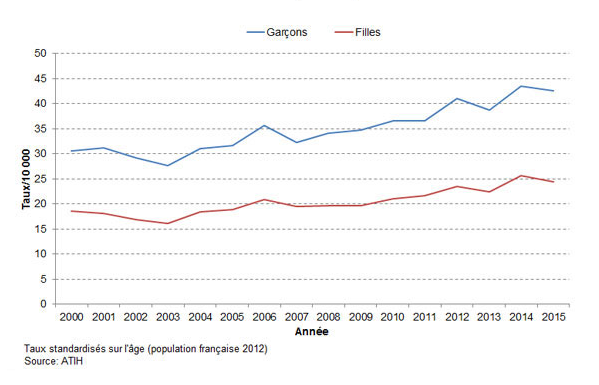
In France (excluding Mayotte) in 2015, 62,782 hospital stays for asthma were recorded, representing a crude hospitalization rate for asthma of 9.5 per 10,000 inhabitants. More than two-thirds of the stays involved children under the age of 15. Among children, the crude hospitalization rate was 33.1 per 10,000 (41.8 per 10,000 among boys and 24.0 per 10,000 among girls).
|
Number and crude hospitalization rates for asthma, France, 2015 |
||||
|---|---|---|---|---|
|
|
Men |
Women |
||
|
Age |
Number of hospital stays |
Rate per 10,000 |
Number of hospitalizations |
Rate per 10,000 |
|
0–1 year |
8,734 |
110.9 |
4,284 |
56.9 |
|
2–4 years |
9,965 |
81.2 |
5,666 |
48.2 |
|
5–9 years |
5,249 |
24.7 |
2,971 |
14.6 |
|
10–14 years |
2,226 |
10.5 |
1,452 |
7.2 |
|
15–19 years |
733 |
3.6 |
1,195 |
6.1 |
|
20–34 |
1,561 |
2.7 |
2,748 |
4.6 |
|
35–49 years |
1,655 |
2.6 |
2,836 |
4.3 |
|
50–64 years |
1,733 |
2.8 |
3,297 |
5.0 |
|
65 years or older |
1,813 |
3.4 |
4,664 |
6.6 |
|
All ages |
33,669 |
10.5 |
29,113 |
8.5 |
An increase in hospitalizations among children since 2004
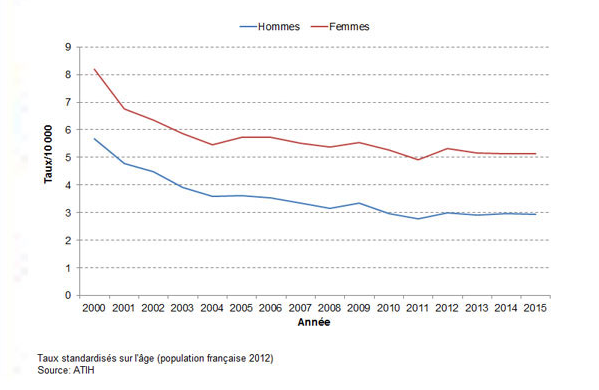
Among adults, the annual hospitalization rate for asthma, standardized by age and sex, declined sharply in the early 2000s. The decline has been less pronounced since 2004 (an average of -2.0% per year among men, -1.04% per year among women). Among children (age <15 years), a very clear increase has been observed since 2004 among both boys (+3.0% per year) and girls (+2.7% per year).
Regional Disparities
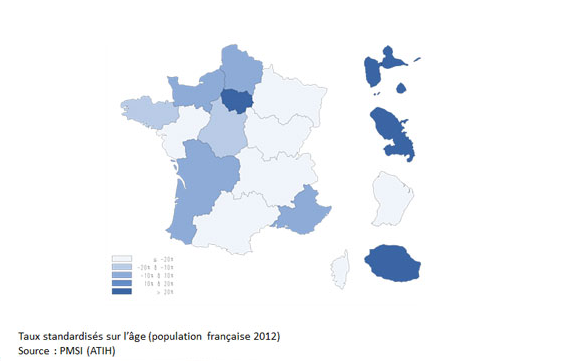
The Île-de-France region, Guadeloupe, Martinique, and Réunion were the regions most affected by hospitalizations for asthma. In contrast, French Guiana, Corsica, Auvergne-Rhône-Alpes, and Pays de la Loire were the least affected regions.
Hospitalizations for acute respiratory failure associated with asthma
In 2015, the annual hospitalization rates for acute respiratory failure associated with asthma were 0.9 per 10,000 children and 0.3 per 10,000 adults. Including these hospital stays in the analysis of trends in asthma hospitalization rates between 2000 and 2015 does not alter the results.
Readmissions for asthma, a relevant indicator for asthma surveillance
An initial analysis, based on data from the PMSI for 2002–2003 and 2004–2005, showed that readmissions for asthma are a relevant indicator for asthma surveillance, particularly regarding its management.
A more recent analysis, focusing on hospitalizations for childhood asthma, was conducted. Between 2002 and 2010, the proportion of children readmitted for asthma within the same year increased among children under the age of 5.
A study on children hospitalized for acute asthma
A one-year study (November 2006–November 2007) was conducted in 14 hospital departments among children aged 3 years or older, with the aim of describing hospitalizations for acute childhood asthma. Data on 727 hospitalizations were collected: history of asthma, its severity, usual treatment, asthma control in the month preceding hospitalization, and the severity of the exacerbation that led to hospitalization.
This study shows that one-quarter of hospitalizations for acute childhood asthma are related to first-time attacks. Among known asthmatics, asthma treatment is inadequate, suggesting that hospitalizations could be prevented by improving overall asthma management. However, not all hospitalizations can be explained by poor prior asthma control, and other risk factors for hospitalization should be investigated.
Asthma-related mortality
Methods
The data presented cover deaths occurring between 2000 and 2014 in France (excluding Mayotte) for which asthma is listed as the primary cause of death, codes J45 or J46 of the 10th revision of the International Classification of Diseases (ICD-10).
The analysis of mortality trends over time accounts for changes in the age structure of the population by calculating age-standardized rates.
In 2014, there were 851 deaths from asthma in France, representing a crude asthma mortality rate of 1.3 per 100,000 inhabitants.
|
|
Men |
Women |
||
|---|---|---|---|---|
|
Age |
Number |
Rate per 100,000 |
Number |
Rate per 100,000 |
|
0–14 years |
6 |
0.1 |
4 |
0.1 |
|
15–24 years |
7 |
0.2 |
4 |
0.1 |
|
25–44 years |
18 |
0.2 |
16 |
0.2 |
|
45–64 years |
67 |
0.8 |
60 |
0.7 |
|
65–84 years |
99 |
2.2 |
194 |
3.5 |
|
85 years or older |
84 |
14.2 |
292 |
21.9 |
|
All ages |
281 |
0.9 |
570 |
1.7 |
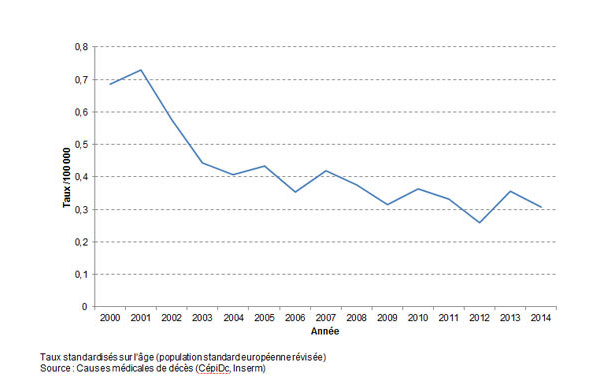
A Decline in Asthma Mortality
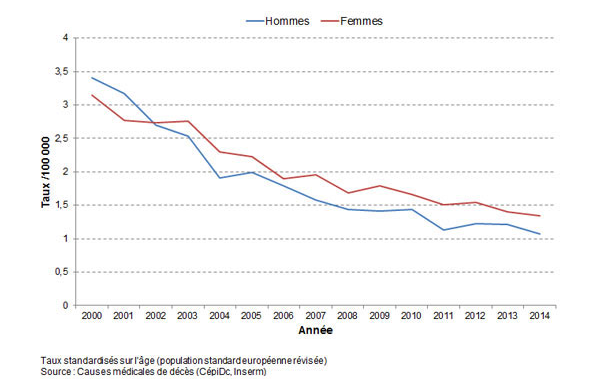
Between 2000 and 2014, asthma mortality rates declined among both men and women. Among children and adults under 45, they declined in the early 2000s.
Asthma-related mortality
The analysis of asthma-related mortality involves taking into account all deaths in which asthma is listed, whether as the primary cause or among multiple causes.
An analysis of asthma-related mortality was conducted using mortality data from 2000 to 2005. This analysis shows that the decline in asthma-related mortality (asthma as the primary cause of death) is more pronounced than that of asthma-related mortality, which supports a real reduction in mortality attributable to asthma.
Emergency care for asthma (SOS-medecins and emergency departments)
Methods
In 2004, a national surveillance network based on emergency departments, the OSCOUR® network (Organization for Coordinated Emergency Surveillance), was established. This network relies on the participation of computerized emergency departments that transmit data daily to Santé publique France in a standardized format known as the emergency department visit summary.
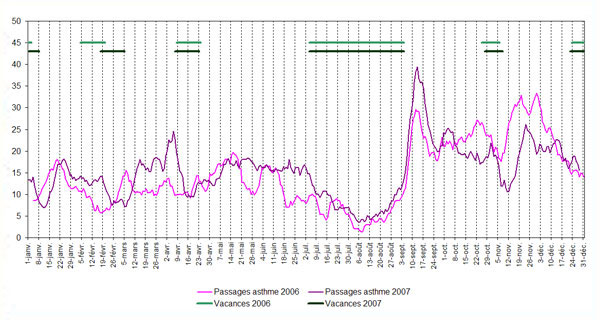
Data from the OSCOUR® network do not allow for the calculation of rates of emergency department use for asthma. However, they do allow for the documentation of significant seasonal variations in asthma exacerbations.
Key Figures
Data on asthma-related visits to emergency departments in the Île-de-France region that participated in this network in 2006 and 2007 show a spike in asthma-related visits among children in September.
Asthma and the Start of the School Year
2025
Asthma related to the start of the school year. Bulletin of October 21, 2025.
Asthma related to the start of the school year. Bulletin of October 14, 2025.
Asthma related to the start of the school year. Bulletin of October 7, 2025.
Asthma related to the start of the school year. Bulletin of September 30, 2025.
Asthma related to the start of the school year. Bulletin of September 23, 2025.
Asthma related to the start of the school year. Bulletin of September 16, 2025.
Asthma related to the start of the school year. Bulletin of September 9, 2025.
Asthma related to the start of the school year. Bulletin of September 2, 2025.
Asthma related to the start of the school year. Bulletin of August 26, 2025.
2024
Asthma related to the start of the school year. Bulletin of October 22, 2024.
Asthma related to the start of the school year. Bulletin of October 15, 2024.
Asthma related to the start of the school year. Bulletin of October 8, 2024.
Asthma related to the start of the school year. Bulletin of October 1, 2024.
Asthma related to the start of the school year. Bulletin of September 24, 2024.
Asthma related to the start of the school year. Bulletin of September 17, 2024.
Asthma related to the start of the school year. Bulletin of September 10, 2024.
Asthma related to the start of the school year. Bulletin of September 3, 2024.
Asthma related to the start of the school year. Bulletin of August 27, 2024.
Asthma related to the start of the school year. Bulletin of August 20, 2024.
2023
Asthma Health Surveillance - 2023 Back-to-School Season. Weekly Update of October 24, 2023.
Asthma Health Surveillance - Back-to-School 2023. Weekly Update of October 17, 2023.
Asthma Health Surveillance - 2023 School Year Start. Weekly Update of October 10, 2023.
Asthma Health Surveillance - Start of the 2023 School Year. Weekly Update of October 3, 2023.
Asthma Health Surveillance - Start of the 2023 School Year. Weekly Update for September 26, 2023.
Asthma Health Surveillance - Back to School 2023. Weekly Update for September 19, 2023.
Asthma Health Surveillance - Start of the 2023 School Year. Weekly Update for September 12, 2023.
Asthma Health Surveillance - Start of the 2023 School Year. Weekly Update for September 5, 2023.
Asthma Health Surveillance - Back-to-School 2023. Weekly Update for August 29, 2023.
Asthma Health Surveillance - Back to School 2023. Weekly Update for August 22, 2023.
Asthma Health Surveillance - Back to School 2023. Weekly Update of August 15, 2023.
2022
Asthma Health Surveillance - Start of the 2022 School Year. Weekly Update of October 18, 2022.
Asthma Health Surveillance - Back-to-School 2022. Weekly Update of October 12, 2022.
Asthma Health Surveillance - Back-to-School 2022. Weekly Update of October 4, 2022.
Asthma Health Surveillance - Back-to-School 2022. Weekly Update for September 28, 2022.
Asthma Health Surveillance - Back-to-School 2022. Weekly Update for September 20, 2022.
Asthma Health Surveillance - Back-to-School 2022. Weekly Update of September 13, 2022.
Asthma Health Surveillance - Back-to-School 2022. Weekly Update for September 6, 2022.
Asthma Health Surveillance - Back-to-School 2022. Weekly Update for August 29, 2022.
Asthma Health Surveillance - Back-to-School 2022. Weekly Update of August 25, 2022.
2021
Asthma Health Surveillance - Start of the 2021 School Year. Weekly Update of October 26, 2021.
Asthma Health Surveillance - Back to School 2021. Weekly Update of October 19, 2021.
Asthma Health Surveillance - Start of the 2021 School Year. Weekly Update of October 12, 2021.
Asthma Health Surveillance - Back to School 2021. Weekly Update of October 5, 2021.
Asthma Health Surveillance - Back to School 2021. Weekly Update for September 21, 2021.
Asthma Health Surveillance - Back-to-School 2021. Weekly Update of September 14, 2021.
Asthma Health Surveillance - Back-to-School 2021. Weekly Update of September 7, 2021.
Asthma Health Surveillance - Back-to-School 2021. Weekly Update of August 30, 2021.
Asthma Health Surveillance - Back to School 2021. Weekly Update for August 24, 2021.
Asthma Health Surveillance - Back to School 2021. Weekly Update of August 17, 2021.
2020
Asthma Health Surveillance - Back-to-School 2020. Weekly Update of October 20, 2020.
Asthma Health Surveillance - Back to School 2020. Weekly Update of October 13, 2020.
Asthma Health Surveillance - Back-to-School 2020. Weekly Update of September 29, 2020.
Asthma Health Surveillance - Back to School 2020. Weekly Update of September 22, 2020.
Asthma Health Surveillance - Back to School 2020. Weekly Update of September 15, 2020.
Asthma Health Surveillance - Back to School 2020. Weekly Update for September 8, 2020.
Asthma Health Surveillance - Back to School 2020. Weekly Update of September 1, 2020.
2019
Asthma Health Surveillance - Start of the 2019 School Year. Weekly Update of October 8, 2019.
Asthma Health Surveillance - Back to School 2019. Weekly Update of October 1, 2019.
Asthma Health Surveillance - Start of the 2019 School Year. Weekly Update for September 24, 2019.
Asthma Health Surveillance - Back to School 2019. Weekly Update of September 17, 2019.
Asthma Health Surveillance - Back-to-School 2019. Weekly Update for September 10, 2019.
Asthma Health Surveillance - Back-to-School 2019. Weekly Update of September 3, 2019.
Asthma Health Surveillance - Back-to-School 2019. Weekly Update of August 27, 2019.
Asthma Health Surveillance - Back-to-School 2019. Weekly Update of August 20, 2019.
In relation to

Air
thematic dossier
Air pollution affects the entire population. The levels of pollutants found in the atmosphere are linked to health risks, and any reduction in exposure to these pollutants would be beneficial.

thematic dossier
Work-related illnesses
Dues à des expositions professionnelles, les principales maladies en lien avec le travail sont surveillées par Santé publique France dans l’objectif d’élaborer, avec les partenaires, les...

COPD and chronic respiratory failure
thematic dossier
Chronic obstructive pulmonary disease is a chronic respiratory condition caused, in the vast majority of cases, by smoking. It has a significant impact on patients’ quality of life.