



Human biomonitoring: What is it for?
Human biomonitoring allows for the monitoring of exposure or early effects associated with the presence of chemicals in the body. It involves collecting biological samples such as blood, urine, hair, and breast milk, and measuring the levels of the substances of interest, known as "biomarkers." The measurement takes into account all sources of exposure, regardless of how the substances enter the human body, the location of exposure (home, workplace, etc.), the activity being performed, or the nature of the products consumed.
Conducted at the population level, human biomonitoring makes it possible to:
assess the degree of internal exposure of that population to chemical substances,
provide public health officials with information regarding population exposure to chemicals, their sources, and the predominant routes of exposure.
When repeated over time, biomonitoring helps assess the impact of public policies aimed at regulating the presence of chemicals. It is a valuable tool for proposing solutions to reduce the population’s exposure to chemicals, with a focus on prevention.
What is a biomarker used for?
A biomarker is a substance or indicator of biological activity that can be measured in the body and that may reflect environmental exposure, biological effects, diseases, or genetic predisposition. The term “biomarkers” encompasses exposure biomarkers, effect biomarkers, and susceptibility biomarkers (the body’s response).
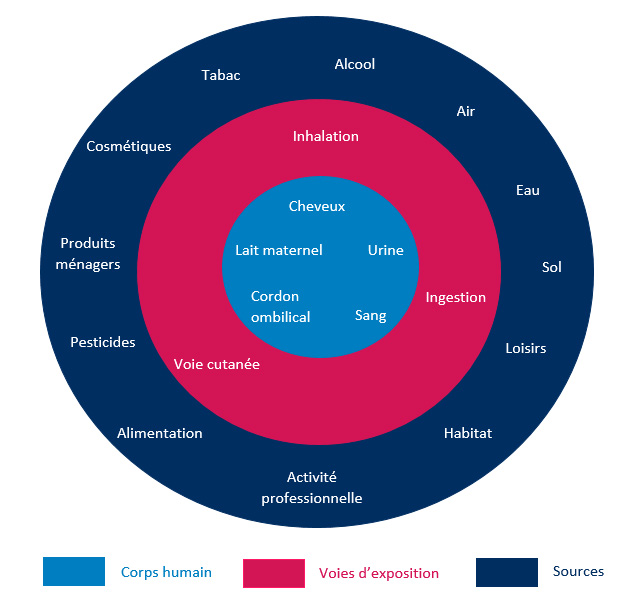
In the field of human biomonitoring, exposure biomarkers are the most commonly used. They allow for the measurement of the presence of a chemical substance or its metabolites in the body (in blood, urine, hair, breast milk, etc.). This measurement of exposure to chemicals present in the environment takes into account all sources (air, water, food, etc.) and routes of exposure (oral, respiratory, and dermal).
The term “concentration” is often used to refer to the levels of an exposure biomarker measured in the body.
Biological matrices (light blue) used to measure chemicals from various sources (dark blue) and exposure pathways (pink)
What is the role of Santé publique France?
As part of its missions to conduct epidemiological observation and monitor the health status of populations, Santé publique France leads and coordinates the French human biomonitoring program, which covers both the general population and occupational populations.
Our initial biomonitoring work was conducted as part of the 2006–2007 National Nutrition and Health Survey (ENNS), providing an initial assessment of the general French population’s exposure to certain environmental pollutants. It was the law resulting from the Grenelle Environment Forum (No. 2009-967 of August 3, 2009) that subsequently enabled France to establish a multi-year national biomonitoring program.
This program was designed to estimate the population’s exposure to various chemical substances and to improve understanding of the sources of these exposures. As part of the National Health and Environment Plan (PNSE) 2 and 3, the program has two components:
a cross-sectional study of the general population on the mainland: the Study on Health, Environment, Biomonitoring, Physical Activity, and Nutrition (Esteban),
a study of pregnant women at the time of delivery and newborns based on the Elfe cohort.
In addition to this work, Santé publique France conducts exposure studies that address specific questions regarding exposure to a particular pollutant or in connection with a local pollution situation.
The appropriateness of such studies, in terms of relevance and feasibility, must be assessed through a review process that ensures the validity of this choice, based on the guidelines titled “Use of Biomarkers in Situations of Local Pollution” (Dor, Fréry et al. 2012).
What is an exposure study?
Exposure studies and epidemiological studies are two complementary approaches that help us understand exposure to environmental pollutants and their effects on health.
Exposure studies: these allow for the estimation of exposure to pollutants within populations and the identification of the determinants of such exposures.
Epidemiological studies: These aim to investigate the links between these exposures and the occurrence of health effects or diseases.
When there is sufficient epidemiological, as well as toxicological and pharmacokinetic, knowledge, it is possible to define health thresholds with the goal of linking exposure levels to health risks at the population level. However, defining these thresholds is not part of Santé publique France’s mandate.
However, even in the absence of health thresholds, exposure studies allow for the measurement of exposures well before a potential health effect occurs. We can therefore choose to study the link between people’s exposure levels, their habits and behaviors, and pollutant concentrations in the environment. Understanding the factors that can influence exposure allows us to tailor exposure reduction measures and prevent potential health effects as part of primary prevention efforts.
From Exposure to Health Effects: Identifying Influencing Factors Through Exposure Biomarkers
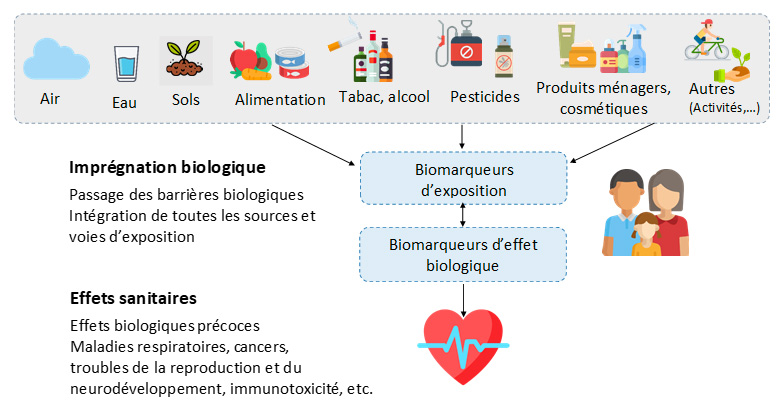
The bioaccumulation study is a necessary step in characterizing the potential transfer of an environmental pollutant into the human body, but it does not allow us to:
specify, for each individual, the exact source of any pollutant detected in their biological samples;
predict, for each individual, the risk of developing a disease based on the level of the pollutant measured at a given time T in their biological samples, as current scientific knowledge is generally insufficient for most pollutants present in the environment.
Both screening and population-based studies rely on the collection of biological samples from a population.
Screening: allows each individual to personally benefit from the results of the biological test, primarily through the possibility of appropriate medical care. It aims to identify a disease or an asymptomatic risk factor for a disease, with the goal of providing individualized care.
Exposure studies: involve measuring a pollutant in an exposed population to compare it with a reference population (the general population). This comparison can be facilitated by using exposure reference values established from biomonitoring studies in the general population, for the purposes of both targeted and individual prevention.