




Our Work
Epidemiological Surveillance of Congenital Anomalies
Epidemiological surveillance of congenital anomalies arose largely in response to the increase in cases of limb abnormalities caused by thalidomide, a drug widely prescribed to pregnant women between the 1950s and 1960s. Surveillance systems were subsequently established in several countries, often in the form of registries, to aid decision-making in the event of an alert and to detect abnormal trends.
Population-Based Registries of Congenital Anomalies
In France, the epidemiological surveillance of congenital anomalies relies on seven population-based registries, which are considered the gold standard in descriptive epidemiology for the geographic areas they cover, due to:
the quality of their data collection,
the medical validation of cases,
the standardization of data according to the criteria of the European EUROCAT network.
Santé publique France relies on these data as part of its missions to monitor health and support public policy.
This system may eventually be supplemented by the use of medical and administrative data from the National Health Data System (SNDS) to:
expand national coverage for certain congenital anomalies in areas not covered by a registry,
strengthen the geographic coverage of surveillance despite certain methodological limitations that need to be evaluated (detailed case identification, access to certain clinical variables).
Number of births registered in areas covered by a French registry of congenital anomalies that contributes to national and European surveillance (France, 2019–2021)
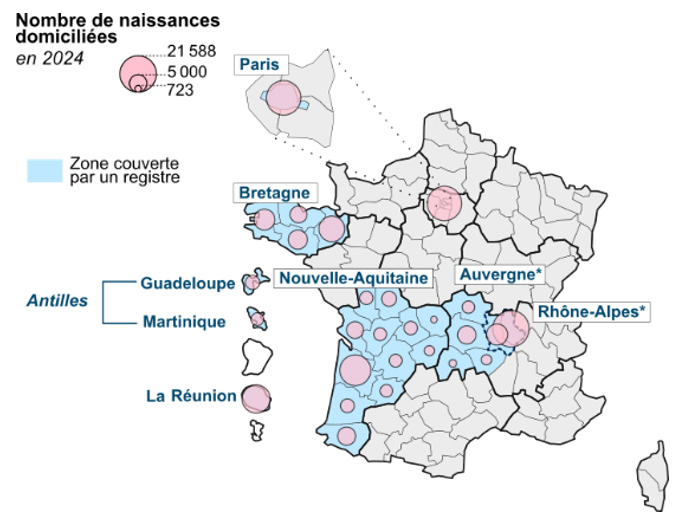
Characteristics of French congenital anomaly registries contributing to national and European surveillance (France, 2019–2021)
| French registries | Year Established | Average annual number of total births per registry (2019–2021) |
|---|---|---|
| French Antilles | 2009 | 8,264 |
| Auvergne | 1,983 | 12,099 |
| Brittany | 2011 | 31,740 |
| Reunion | 2001 | 13,360 |
| Nouvelle-Aquitaine | 2022 | 53,392 |
| Paris | 1,981 | 23,700 |
| Rhône-Alpes | 1973 | 54,621 |
This coverage will increase from 16.4% to nearly 23.6% of births by 2026, with the gradual rollout of the Nouvelle-Aquitaine registry.
Medical-Administrative Data
The National Health Data System (SNDS) is a medical-administrative database (BDMA) designed to facilitate studies, research, and evaluations of health data. It compiles, in a nearly exhaustive manner:
data on reimbursed healthcare services,
reasons for 100% coverage by the Health Insurance program for a long-term condition (ALD),
data on hospital stays,
medical causes of death,
data on disabilities, and a sample of data from supplemental health insurance providers (coming soon).
The SNDS and other BDMA databases could contribute to the surveillance of congenital anomalies. Studies are currently underway to assess the reliability of these databases and the feasibility of using them for this surveillance.
Learn more:
- snds.gouv.fr
- The National Health Data System (SNDS). Bull Epidemiol Hebd. 2025;(HS):117-23.
Eurocat: The European Registry for the Epidemiological Surveillance of Congenital Anomalies

Founded in 1979, the European EUROCAT network (European Registries of Congenital Anomalies) includes data from 43 population-based registries across 21 European countries, covering nearly 1.5 million births per year.
Main Objectives
The EUROCAT network has multiple missions, which aim, in particular, to describe trends over time at the European level through the analysis of data collected by the registries.
Identifying teratogenic exposures (factors causing birth defects) and assessing the impact of primary prevention measures and prenatal screening policies.
Continuous quality control of inclusion criteria for cases of congenital anomalies:
updating a list of minor anomalies to be excluded, and coding rules to harmonize the classification of congenital anomalies,
definition of subgroups of congenital anomalies and provision of algorithms for cases of multiple congenital anomalies.
Operations
Member registries submit pseudo-anonymized data annually. Eurocat centralizes, processes, and publishes this data in an annual surveillance report (available on its website) and provides aggregated data on prevalence and prenatal diagnoses, as well as monitoring reports on clusters and several key public health indicators.
In relation to

Tobacco
thematic dossier
Despite a slight decrease compared to 2015, tobacco remains responsible for more than 68,000 premature deaths in 2023—accounting for 11% of total mortality—making it still the leading cause of...

Alcohol
thematic dossier
Alcohol is deeply rooted in French culture. Its consumption remains a major cause of death and illness in France.

Pesticides
thematic dossier
Pesticides are widely used in France, primarily in agriculture, and the population is heavily exposed to them. Their effects on the health of the general population are still poorly understood.











