




Data
An increase in the number of births with at least one congenital anomaly
In 2022, the prevalence of cases with at least one major congenital anomaly (according to the EUROCAT classification) stood at 342.0 cases per 10,000 total births, or 1 case per 29 births. Trend analysis reveals a significant increase since 2012, with an average annual increase of 0.6%.
When considering pregnancy outcomes, the data are broken down as follows:
live births: the prevalence was 256.2 cases per 10,000 live births (approximately 75% of cases), remaining stable over the period;
voluntary termination of pregnancy (VTP) due to fetal anomaly: the prevalence was 80.9 cases per 10,000 total births, with an average increase of 1.0% per year between 2012 and 2020;
stillbirths: the prevalence was 7.4 cases per 10,000 total births, generally stable, with a one-time increase in 2022.
Trends in the prevalence of cases with congenital anomalies between 2012 and 2022 by pregnancy outcome (per 10,000 total births)
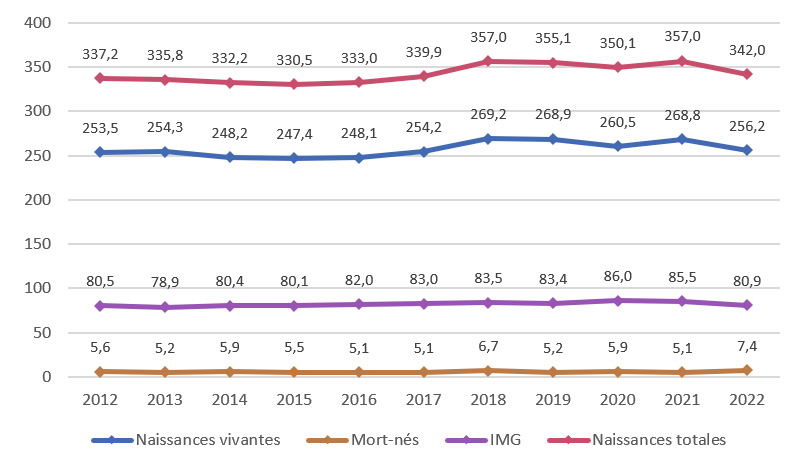
IMG = medical abortion
Source - Population-based registries of congenital anomalies: the Antilles, Auvergne, Brittany, Paris, and Réunion.
Heart, genetic, and limb abnormalities are the most common congenital anomalies
The most common congenital anomalies were:
cardiac anomalies (95.2 cases per 10,000 total births),
genetic anomalies (including chromosomal and other anomalies: 78.8 cases per 10,000 total births),
limb anomalies (including reduction anomalies, polydactyly, clubfoot, etc.: 70.3 cases per 10,000 total births).
The least common anomalies (prevalence <10 cases per 10,000 total births) included:
anomalies of the ear, face, and neck,
respiratory anomalies
eye anomalies.
Prevalence of cases with congenital anomalies among all births, by type of anomaly
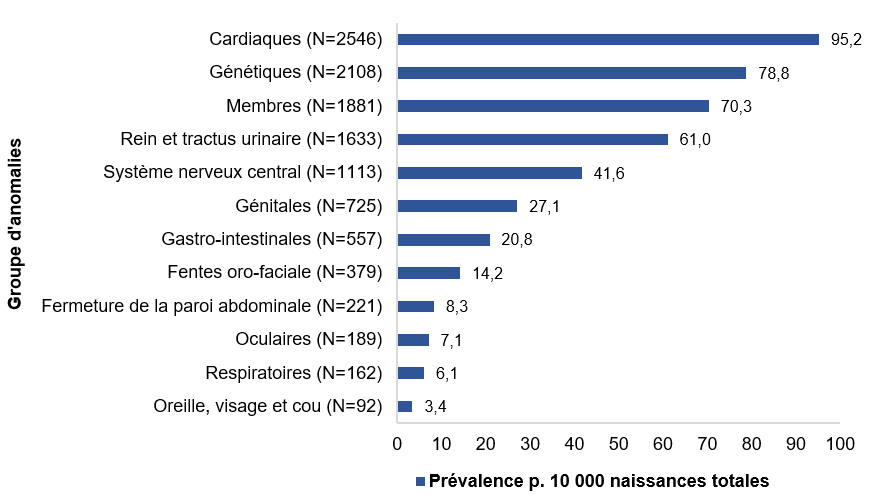
Note: A single fetus, newborn, or child with multiple categories of anomalies may be counted in several of the corresponding bars in the graph. For example, a fetus with a congenital heart defect, a limb anomaly, and a genetic abnormality would be represented in all three respective bars.
Genetic abnormalities are the most common congenital anomalies in cases of medically indicated terminations of pregnancy
The most common groups of congenital anomalies among live births were:
heart defects (78.5 cases per 10,000 live births),
limb anomalies (58.6 cases per 10,000 live births),
kidney and urinary tract anomalies (51.5 cases per 10,000 live births).
The groups of congenital anomalies that most frequently led to medical termination of pregnancy were:
genetic anomalies (54.5 cases per 10,000 total births),
central nervous system anomalies (23.8 cases per 10,000 total births),
cardiac anomalies (15.7 cases per 10,000 total births).
Prevalence of cases with congenital anomalies by pregnancy outcome (live births and medically indicated abortions), by group of congenital anomalies
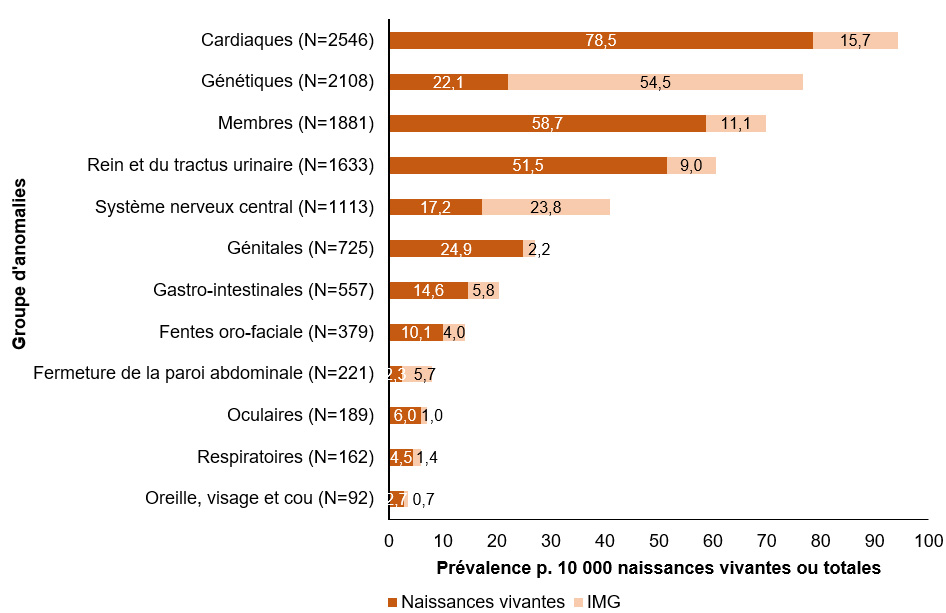
IMG = medical termination of pregnancy
Note (1) A single fetus, newborn, or child with multiple categories of anomalies may be counted in several of the corresponding bars in the graph.
Note (2) Fetal deaths were excluded from this analysis due to their low prevalence.
Many Congenital Anomalies Diagnosed Before Birth
Between 2019 and 2021, nearly 60% of congenital anomalies were diagnosed prenatally. Certain groups of anomalies had particularly high rates (over 75%), notably abdominal wall, renal and urinary, genetic (chromosomal and other), and central nervous system anomalies.
Conversely, the groups of anomalies predominantly diagnosed postnatally include those detected through clinical examination rather than prenatal ultrasound. These include anomalies of the genitalia, eyes, ears, face, and neck.
Distribution of cases with congenital anomalies among all births, by type of anomaly and time of diagnosis (prenatal or postnatal)
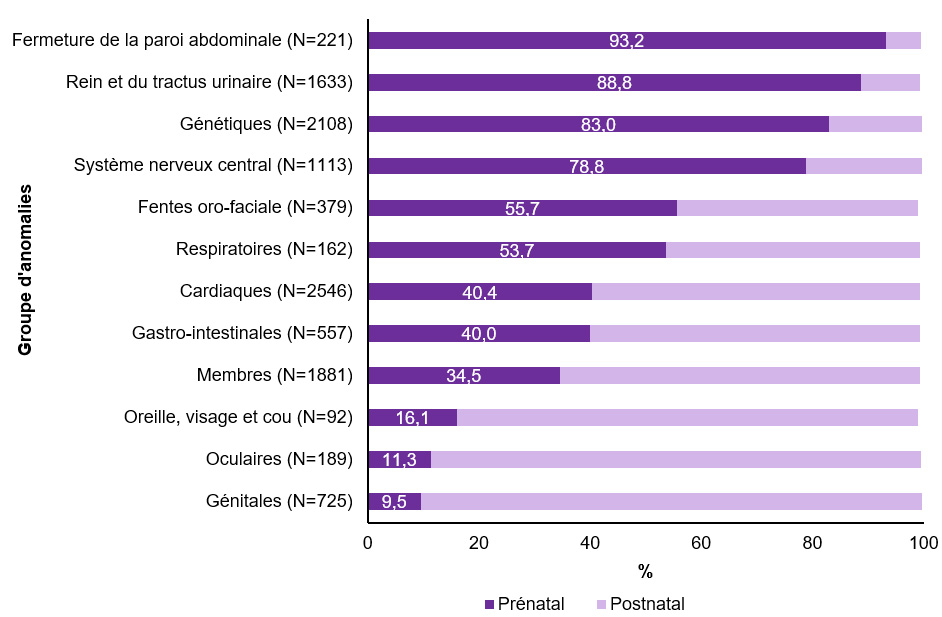
Note: A single fetus, newborn, or child with multiple groups of anomalies may be counted in several of the corresponding bars in the graph.
Advanced maternal age: a major risk factor for aneuploidies
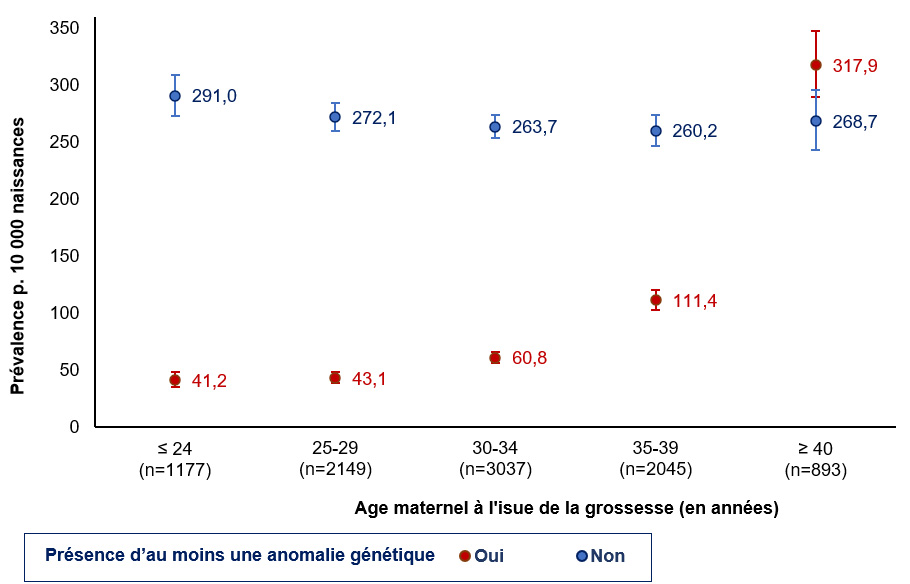
The prevalence of anomalies associated with a genetic abnormality (including chromosomal abnormalities) was 8 times higher among mothers aged 40 or older (317.9 per 10,000 births) than among those under 25 (41.2 per 10,000 births), primarily due to aneuploidies.
Prevalence of congenital anomalies—whether or not associated with a genetic abnormality—among all births, by maternal age
Learn more

enquêtes/études
8 July 2026
Epidemiological Surveillance of Congenital Anomalies in France in Areas Covered by a Registry: 2019–2021
Learn more

bulletin national
8 July 2026
Perinatal and Early Childhood Health in France, 2012–2024.
In relation to

Tobacco
thematic dossier
Despite a slight decrease compared to 2015, tobacco remains responsible for more than 68,000 premature deaths in 2023—accounting for 11% of total mortality—making it still the leading cause of...

Alcohol
thematic dossier
Alcohol is deeply rooted in French culture. Its consumption remains a major cause of death and illness in France.

Pesticides
thematic dossier
Pesticides are widely used in France, primarily in agriculture, and the population is heavily exposed to them. Their effects on the health of the general population are still poorly understood.