
What We Do
Specific surveillance
Santé publique France coordinates the National Program for the Surveillance of Pleural Mesothelioma (PNSM)
Following the total ban on all uses of asbestos adopted in France in 1997, France established a national program to monitor the health effects of asbestos.
In 1998, the General Directorate of Labor (DGT) and the General Directorate of Health (DGS) of the respective ministries tasked Santé publique France (the Institute for Public Health Surveillance in 1998) with establishing the National Program for the Surveillance of Pleural Mesothelioma, a specific marker of asbestos exposure.
The initial objectives of this epidemiological surveillance program were to track the incidence of this cancer in France and the occupational characteristics of cases (occupations, sectors of activity, exposures); however, in 1999, the objectives were expanded to include the medical and social recognition of patients with mesothelioma. From the outset, this program has brought together several teams of experts with complementary skills and is closely linked to research efforts.
Objectives
The PNSM is an epidemiological surveillance system for the effects of asbestos on the health of the French population, enabling:
to estimate and monitor the national incidence of pleural mesothelioma and its trends, as well as regional and departmental incidences;
to monitor the survival of patients with pleural mesothelioma;
to monitor asbestos exposure and the proportion of mesotheliomas attributable to asbestos exposure, particularly occupational exposure;
to identify the occupations and sectors of activity at highest risk and monitor trends;
to contribute to the understanding of other potential etiological factors (refractory ceramic fibers, mineral wool, ionizing radiation, etc.);
to evaluate compensation processes for pleural mesothelioma: recognition as an occupational disease and claims filed with the Asbestos Victims Compensation Fund (FIVA);
furthermore, to contribute to improving the histopathological diagnosis of pleural mesothelioma in France.
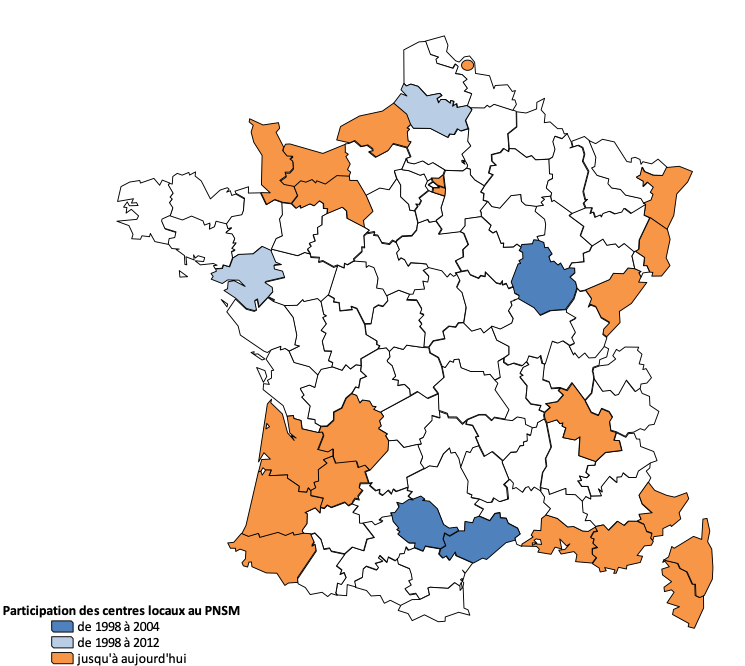
Population: PNSM coverage
Currently, the PNSM covers 20 metropolitan departments and the area surrounding Lille, representing approximately 18 million inhabitants (28% of the French metropolitan population). New
cases recorded and validated involve individuals:
with a diagnosis of pleural mesothelioma,
whose diagnosis date is after January 1, 1998,
residing, at the time of diagnosis, in one of the departments participating in the PNSM.
PNSM coverage, mainland France
General description of the treatment:
1. Case identification: The PNSM relies on the work of 10 local collection centers, which are primarily responsible for identifying new cases.
|
Local Centers |
Coverage Areas |
Collection of data collection |
Accommodation |
Coordinators |
|---|---|---|---|---|
|
Aquitaine |
Dordogne, Gironde, Landes, Lot-et-Garonne, Pyrénées-Atlantiques |
Since 1998 |
University of Bordeaux ISPED |
Prof. S. Mathoulin-Pélissier |
|
Lower Normandy |
Calvados, Manche, Orne |
Since 1998 |
Caen University Hospital |
Prof. B. Clin-Godard |
|
Ile-de-France |
Seine-Saint-Denis, Val-de-Marne |
Since 1999 Since 2001 |
CHIC Créteil IIMTPIF |
Prof. JC Pairon |
|
PACA-Corsica |
Alpes-Maritimes Bouches-du-Rhône*, Southern Corsica, Haute-Corse, Var* |
Since 2006 Since 1999 Since 2006 Since 2006 Since 1999 |
Hôpital Nord, Marseille Public Health France Cire Sud – Marseille |
Prof. Ph. Astoul Dr. Malfait |
|
Doubs |
Doubs |
Since 1998 |
Cancer Registry Besançon University Hospital |
Dr. AS Woronoff |
|
Bas-Rhin |
Bas-Rhin |
Since 1998 |
Cancer Registry University of Strasbourg |
Prof. Velten |
|
Haut-Rhin |
Haut-Rhin |
Since 1998 |
Cancer Registry Mulhouse Hospital |
Dr. E. Marrer |
|
Isère |
Isère |
Since 1998 |
Cancer Registry Grenoble University Hospital |
Mr. Colonna |
|
Lille and its region |
Lille and its region |
Since 2011 |
General Cancer Registry Lille University Hospital |
Dr. S. Plouvier |
|
Upper Normandy |
Seine-Maritime |
Since 2018 |
Rouen University Hospital |
Prof. V. Merle |
|
Côte-d’Or |
Côte-d’Or |
1998–2003 |
Burgundy Gastrointestinal Registry |
|
|
Hérault |
Hérault |
1998–2003 |
Cancer Registry |
|
|
Tarn |
Tarn |
1998–2003 |
Cancer Registry |
|
|
Loire-Atlantique |
Loire-Atlantique |
1998–2012 |
Cancer Registry |
|
|
Somme |
Somme |
1998–2012 |
Cancer Registry |
Local centers collect data on diagnosed cases of pleural mesothelioma occurring among individuals residing within their coverage area. The goal is to achieve comprehensive case collection. To this end, they conduct active case-finding among all relevant medical sources within their coverage area and at treatment facilities outside that area (particularly in neighboring areas).
The main sources consulted by local centers to identify new cases are:
Anatomic and cytopathology laboratories and regional experts from the MESOPATH group: collection of anatomic and cytopathology reports (CRACP)
Medical Information Departments (DIM) of public and private healthcare facilities: extraction of data from the PMSI database based on specific criteria
Health insurance schemes: MSA, SSM, Social Security for the Self-Employed, National Military Social Security Fund, the General Health Insurance Scheme…
Multidisciplinary team meetings (RCP) related to mesotheliomas
Physicians, particularly specialists (oncologists, pulmonologists, surgeons, etc.) and occupational disease clinics
The Asbestos Victims Compensation Fund
Radiotherapy centers
Death certificates
2. Exposure investigations
At the same time, as soon as they are included in the PNSM, and without waiting for confirmation of the diagnosis (see below), cases are investigated by local centers—subject to their doctor’s approval—through face-to-face interviews using standardized questionnaires.
These questionnaires allow for the reconstruction of the patient’s professional career and all the residences and schools they attended. They also enable the collection of information on situations involving exposure to asbestos and other factors (mineral wool, ionizing radiation, and refractory ceramic fibers).
An assessment of occupational and non-occupational exposures to asbestos, artificial mineral fibers, and ionizing radiation is conducted by occupational hygienists through analysis of the questionnaires.
A report on the results of the occupational asbestos exposure assessment is then prepared for the attending physician, who is encouraged to advise the patient to file a claim for occupational disease if applicable, and in all cases, to submit a claim for compensation to the Asbestos Victims Compensation Fund.
3. Diagnostic Review
For each newly identified case, a standardized procedure for confirming the diagnosis is systematically implemented:
Pathological
Confirmation Any specimen (histological slides or embedded blocks) processed by a pathology laboratory responsible for the initial diagnosis of mesothelioma is reviewed by the national group of pathologists specializing in mesothelioma, the MESOPATH national panel, which performs a standardized pathological certification of the diagnosis. Three experts, unaware of the patient’s asbestos exposure status, classify each case as definite mesothelioma, excluded, or uncertain. When the three experts agree on the diagnosis, the lesion is either definitively confirmed or definitively excluded. In case of disagreement, the case is collectively reviewed during monthly consensus meetings attended by at least 10 experts. The case is then either certified, excluded, or placed under discussion (clinical review). Clinical
Confirmation When cases cannot be confirmed pathologically (due to diagnostic difficulties, insufficient material, or lack of a biopsy), a clinical review is initiated. This requires consulting the treating physician and reviewing the patient’s medical records. When the medical record is deemed sufficient, the review is conducted independently by three specialist physicians (radiologist, thoracic oncologist, thoracic surgeon). Cases are classified into four categories: “strongly supportive of a mesothelioma diagnosis,” “weakly supportive,” “impossible to conclude based on the provided evidence,” and “review impossible to perform.”
4. Evaluation of Medical-Social Recognition Processes
Finally, medical-social data is collected during the interview with the patient, and additional information is gathered from the Primary Health Insurance Funds (CPAM) and the Asbestos Victims Compensation Fund (FIVA). These data enable the evaluation of compensation processes for patients with mesothelioma by, on the one hand, studying the recognition of mesothelioma cases registered in the PNSM under the General Social Security Scheme (RGSS) as occupational diseases and, on the other hand, monitoring the number of individuals compensated by FIVA for cases registered since 2005, regardless of their social security scheme. Furthermore, these data enable the study of factors associated with the medical and social care of pleural mesotheliomas included in the PNSM.
Public Health France Partnerships:
Pathological Confirmation: MESOPATH (National Reference Network for the Pathology of Mesotheliomas).
Clinical Confirmation: AP-HM, Hôpital Nord Marseille.
Exposure and Etiology: Epidemiology, Cancer, and Environment Team, Inserm U1219 – Associated Team: Environment, Health, and Work – EpiCEnE-ESSAT, Bordeaux.
Assessment of occupational disease management: Interuniversity Institute of Occupational Medicine of Paris Ile-de-France (IIMTPIF) and Paris-East Institute of Occupational Health (IST-PE), Créteil.
Case reporting and surveys of included subjects: see Table
At the request of the Ministry of Health, Santé publique France has implemented mandatory reporting of mesothelioma
The reporting of mesotheliomas has been mandatory in metropolitan France and overseas territories since January 16, 2012 (Decree No. 2012-47). This applies to all pathologists and clinicians (pulmonologists, surgeons, oncologists, general practitioners, etc.) who diagnose mesothelioma, regardless of the anatomical location (pleura, peritoneum, pericardium, testicular vagina, etc.).
This mandatory reporting (MR) has two objectives:
To strengthen the epidemiological surveillance of mesotheliomas at all anatomical sites throughout the entire national territory (metropolitan and overseas territories);
To improve understanding of occupational and environmental exposure factors in three populations deemed by experts to be insufficiently understood: individuals with non-pleural mesothelioma, men under 50 years of age, and women with pleural mesothelioma.
Case definition: Any new case of malignant mesothelioma of the pleura, peritoneum, pericardium, testicular sheath, or other or unspecified site, diagnosed on or after January 1, 2012, must be reported:
based on a pathological examination (approximately 94% of cases). This examination must specify the histological type of the tumor. This will be coded according to the ICDO-3 classification (International Classification of Diseases in Oncology – 3rd Revision by the WHO). The date of diagnosis and the examination number must be specified by the reporting pathologist;
based on a “clinical” assessment, in the absence of a histopathological examination or histological confirmation, relying on clinical findings, radiology, and ultrasound. The method and date of diagnosis must be specified by the reporting clinician.
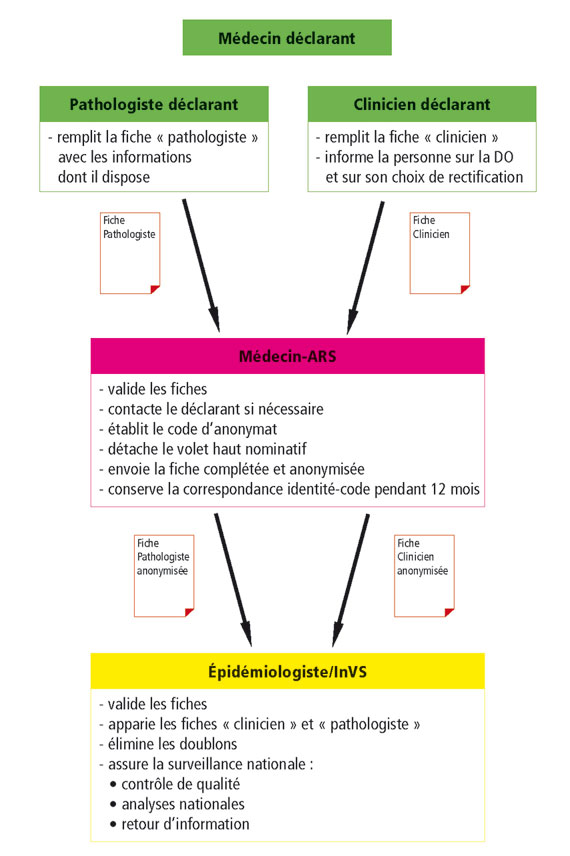
Procedure: Are you a physician who has diagnosed a case of mesothelioma? The reporting procedure consists of two steps:
Fill out the “pathologist” or “clinician” section of the form according to your specialty;
Promptly fax the completed, dated, and signed form to the physician in charge of reportable diseases at the Regional Health Agency (ARS) in your region of practice.
If faxing is not possible, you may scan the form and email it to the physician in charge of notifiable diseases at the ARS. It can also be sent by mail in a confidential envelope marked “medical confidentiality.”
The ARS physician will then process your form and forward it in anonymized form to Santé publique France, which is responsible for the national surveillance of mesotheliomas.
Notification Flowchart
Documents required for the mandatory reporting of mesothelioma:
Individual patient information sheet
In accordance with the 1978 French Data Protection Act, the patient must be individually informed of their rights by their physician (reporting clinician), who will provide them with the downloadable information sheet.
Information for the public on the reporting of notifiable diseases
|
Region |
Submission by fax (preferred method) |
Scanned copy via email (alternative method) |
Phone number |
|---|---|---|---|
|
Auvergne-Rhône-Alpes |
04 72 34 41 27 |
08 10 22 42 62 |
|
|
Burgundy-Franche-Comté |
03 81 65 58 65 |
03 81 65 58 18 |
|
|
Brittany |
02 90 01 25 25 |
09 74 50 00 09 |
|
|
Centre-Val de Loire |
02 34 00 02 58 |
02 38 77 32 10 |
|
|
Corsica |
04 95 51 99 12 |
04 95 51 99 88 |
|
|
Grand Est |
03 10 01 01 61 |
09 69 39 89 89 |
|
|
Guadeloupe |
05 90 99 49 24 |
05 90 41 02 00 |
|
|
French Guiana |
05 94 25 72 95 |
05 94 25 72 37 |
|
|
Hauts-de-France |
03 62 72 88 75 |
03 62 72 77 77 |
|
|
Ile-de-France |
01 44 02 06 76 |
08 25 81 14 11 |
|
|
Martinique |
05 96 39 44 26 |
08 20 20 27 52 |
|
|
Mayotte |
02 69 61 83 21 |
02 69 61 83 20 |
|
|
Normandy |
02 34 00 02 83 |
08 09 40 06 60 |
|
|
Nouvelle-Aquitaine |
05 67 76 70 12 |
08 09 40 00 04 |
|
|
Occitanie |
05 34 30 25 86 |
08 00 30 13 01 |
|
|
Pays-de-la-Loire |
02 34 00 02 89 |
08 00 27 73 03 |
|
|
Provence-Alpes-Côte d’Azur |
04 13 55 83 44 |
04 13 55 80 00 |
|
|
Réunion |
02 62 93 94 56 |
02 62 93 94 15 |
Exposure surveys are the second component of the Mesothelioma Data Collection. A pilot study was conducted to test the feasibility and relevance of conducting exposure surveys among mesothelioma patients in nine participating regions: Alsace, Aquitaine, Lower Normandy, Franche-Comté (regions covered by the PNSM, surveys conducted by local PNSM centers) and Brittany, Picardy, Limousin, Poitou-Charentes, and Réunion (regions not covered by the PNSM, surveys conducted by the regional intervention units of Santé publique France).
SEE ALSO

rapport/synthèse
22 January 2020
Mandatory Reporting of Mesothelioma: Feasibility of Surveys and Exposure Assessment Based on a Pilot Study in 9 French Regions
The Mesothelioma Diagnostic Guidelines receive institutional support (Directorate General for Health, Directorate General for Labor, National Cancer Institute) as well as support from professional bodies and groups (French Society of Pathology, French-Speaking Society of Pulmonology, National Cancer Council, National Professional Council of Pathologists, and national reference networks such as MESOPATH, RENAPE, and MESOCLIN).
Santé publique France is developing the National Mesothelioma Surveillance System (DNSM)
Starting in 2015, Santé publique France led a working group to optimize, modernize, and adapt the national surveillance system for mesotheliomas, exposure to mesothelioma-causing agents, and their medical and social recognition to current challenges. The expert group recommended the establishment of the “National Mesothelioma Surveillance System” (DNSM). In
late 2018, CEREES issued a favorable opinion regarding the establishment of the DNSM, and the application is currently being processed by the CNIL. During this period, surveillance activities are continuing under the current procedures (PNSM, DO).
In accordance with the expert group’s recommendations, the DNSM will consist of three entities:
The DNSM registry, which, like all registries in the Francim network, will have the following main missions:
Surveillance: incidence-survival, exposures, and medical-social assessment;
Research: notably by maintaining links with partner teams at Santé publique France (MESOPATH, U 1219 Epicene, IIMTPIF).
The new specialized mesothelioma registry will be established:
Building on existing systems;
By expanding the scope to include all mesothelioma sites (no longer limited to the pleura);
By maintaining limited geographic coverage, similar to that of the PNSM;
By maintaining the specificity of diagnostic expertise (MESOPATH certification and clinical certification);
By adhering to the criteria of the Registry Evaluation Committee and international case registration standards;
By developing coordination with the cancer surveillance system for the general population and interactions with the Francim network.
Structure of the DNSM and its relationship with Mesopath and other national networks
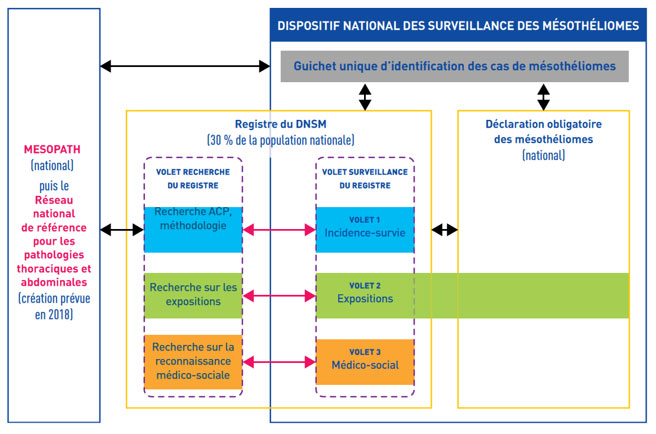
The single-point system for identifying mesothelioma cases will be established at the national level, initially through the integration of MESOPATH and the DO. Its purpose will be to ensure a unified data collection system and to improve the comprehensiveness and rapid identification of cases requiring investigation.
Proposal for the development of the first phase of the single-window case identification system
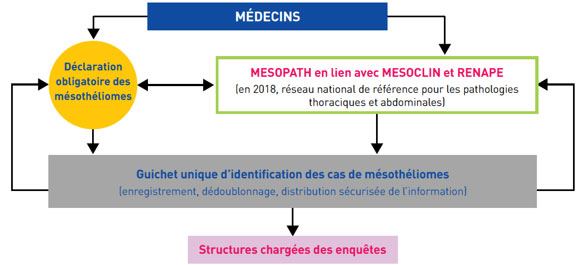
Mandatory reporting of mesothelioma
The mandatory reporting system will be maintained, and the exposure investigation system will be gradually expanded nationwide to improve understanding, particularly regarding environmental exposures.
SEE ALSO
rapport/synthèse
6 September 2019
A National Mesothelioma Surveillance System That Includes Exposure Monitoring: An Overview of Existing Systems, Surveillance Challenges, and Recommendations
Santé publique France has developed epidemiological surveillance and monitoring systems specifically focused on occupational risks associated with asbestos
The ESPrI Program
Monitoring of asbestos victims known to Fiva
The Evalutil program
For more information, see the Santé publique France asbestos dossier
Santé publique France conducts ad hoc studies on:
Occupational exposures, the results of which will be available in the PNSM’s 20-year activity report
In the construction sector
In the national education sector
Environmental exposures:
Pilot study based on surveys conducted as part of the Mesothelioma Surveillance Program (PNSM’s 20-Year Activity Report and Mesothelioma Surveillance Bulletin).
Risk assessment studies focusing on specific situations of non-occupational asbestos exposure. These studies examine the environmental exposure of communities living near either natural outcrops or former industrial sites where asbestos was mined or processed.
Summary of studies on the health consequences of environmental exposure to asbestos
Prevention of asbestos exposure
Santé publique France issues recommendations for strengthening prevention:
Santé publique France advocates for the necessary strengthening of prevention regarding asbestos-related risks and for providing information on the options for utilizing existing medical and social recognition systems.
Regarding current asbestos exposure
It is essential to implement targeted information and prevention initiatives regarding current asbestos exposure, reaching workers, young people in training, healthcare professionals, and the general public:
Among professionals in sectors identified as the most exposed (such as the construction industry) and among young people in these sectors who are in training: inform them and ensure existing prevention measures are enforced.
Do not overlook exposure through buildings (construction materials containing asbestos): for example, workers in the education sector.
Better inform healthcare professionals about the risks of asbestos.
Inform the general public about asbestos risks and protective measures, particularly risks associated with DIY projects and exposure near dilapidated or deteriorating buildings, without neglecting the deterioration of agricultural buildings…
Santé publique France emphasizes the importance of implementing asbestos removal plans to eliminate exposure in public facilities and of establishing a national database of these plans, as provided for in Axis 5 of the Interministerial Asbestos Action Plan and the recommendation of Monitoring Group No. 3 of the 2015–2019 National Health and Environment Plan (PNSE 3) “Pathologies,” in which Santé Publique France participates.
Furthermore, to better understand potential passive indoor exposures, a national centralization of technical asbestos assessments (DTA) is also recommended.
These data are essential for advancing national knowledge on environmental exposures among people with mesothelioma.
Regarding the use of medical-social recognition mechanisms
It is essential to implement information campaigns on medical-social recognition mechanisms and appeal procedures, targeting both healthcare professionals and patients:
Better inform healthcare professionals (medical and paramedical) about the occupational disease recognition criteria and the compensation claim processes
Better inform patients about their rights to compensation:
recognition as an occupational disease
Asbestos Victims Compensation Fund.
In relation to
thematic dossier
Reportable diseases
The surveillance system for reportable diseases relies on the transmission of data by physicians and laboratory professionals (both in private practice and in hospitals) to the relevant staff at...
Asbestos
thematic dossier
Asbestos can cause various diseases, including cancers (bronchopulmonary cancer, mesothelioma). Widely used until it was banned in France in 1997, it is still very common in buildings.