



The Disease
An arbovirus with an evolving and unpredictable epidemiology
West Nile Virus (WNV) is an arbovirus. Arboviruses—short for “arthropod-borne viruses”—are viruses transmitted by blood-feeding arthropods (notably mosquitoes, sandflies, and ticks). They belong to three main families: the Flaviviridae, the Togaviridae, and the Bunyaviridae." data-tooltip-title="Arboviruses, or 'arthropod-borne viruses,' are viruses transmitted by blood-feeding arthropods (notably mosquitoes, sandflies, and ticks). They belong to three main families: the Flaviviridae, the Togaviridae, and the Bunyaviridae." data-tooltip-content="" data-tooltip-placeholder-is-selection="true" data-tooltip-placeholder-is-selection-text="arbovirus" data-tooltip-data="[{"tooltipTitle":"Arboviruses « arthropod-borne viruses » are viruses transmitted by blood-feeding arthropods (mosquitoes, sandflies, and ticks, among others). They belong to 3 main families, the Flaviviridae, the Togaviridae, and the Bunyaviridae.","tooltipContent":"","placeholderIsSelection":"true","placeholderIsSelectionText":"arbovirus"}]">arbovirus of the genus Orthoflavivirus (family Flaviviridae). It was first isolated in 1937 in the West Nile District of Uganda, hence its name. Historically, it has been responsible for epidemics in Africa, the Middle East, Western Asia, and Europe. It first appeared in North America in 1999 and spread throughout the entire continent within a few years. There are several lineages of this virus, meaning genetic variants of the same virus.
The epidemiology of the West Nile virus, influenced by numerous factors—particularly environmental ones—is dynamic and difficult to predict. In mainland France, the virus was first detected in the early 1960s, with numerous human and equine cases already observed in the Camargue in 1962. It has been circulating regularly ever since, particularly around the Mediterranean basin.
In recent years, the epidemiology of West Nile virus in mainland France has undergone a notable change, as has been the case more broadly across Europe. In mainland France, this trend has been particularly evident since the 2020s. Starting in 2023, an increase in human cases was observed, with the virus spreading geographically to departments previously unaffected, outside the Mediterranean region.
In Europe, the virus was initially introduced by migratory birds from Africa. It is now established in several regions of Europe. Monitoring of the disease highlights two main findings:
- Geographic expansion: the introduction of the virus by migratory birds compounds the fact that it is already well established locally. As a result, it is steadily gaining ground toward the west and north of the European continent. In France, regions where the virus had never been documented prior to 2022 are now affected, such as the Atlantic coast (2023), Île-de-France (2025), and the Pays de la Loire region (2026); the virus is also taking hold in countries that were previously spared, such as Germany, the Netherlands, and Belgium.
- This trend is linked to a combination of various factors with complex interactions: scientists strongly suspect that climate change and the increase in extreme weather events are driving this spread, although this remains a working hypothesis. The reality almost certainly lies in a complex combination of factors, including changes in local ecosystems, urbanization, and the coexistence of birds, mosquitoes, and humans. Beyond these environmental causes, the virus itself has evolved: while Europe historically faced “lineage 1” of the virus, the introduction and spread of a new strain, known as lineage 2, have profoundly altered the epidemiological situation. This version of the virus has proven particularly effective at establishing a long-term presence and spreading across the European continent, thus becoming the primary cause of the seasonal outbreaks observed in recent years.
"A Disease Transmissible from Animals to Humans and Vice Versa" data-tooltip-title="A Disease Transmissible from Animals to Humans and Vice Versa" data-tooltip-content="" data-tooltip-placeholder-is-selection="true" data-tooltip-placeholder-is-selection-text="zoonosis" data-tooltip-data="[{"tooltipTitle":"Diseases transmissible from a’animal to human and vice versa","tooltipContent":"","placeholderIsSelection":"true","placeholderIsSelectionText":"zoonosis"}]">zoonosis transmitted by mosquitoes
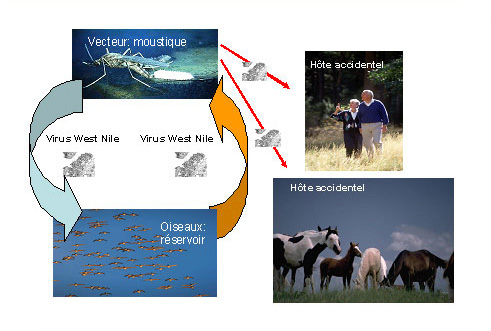
Birds are the primary reservoir of the West Nile virus.
The West Nile virus is transmitted to humans through the bite of a mosquito that has become infected by feeding on an infected bird. These are primarily mosquitoes of the genus Culex, a common mosquito found throughout the country. A mosquito infected in this way can, through another bite, transmit the virus to another bird or to an accidental host, such as a human or a horse.
Humans and horses represent “epidemiological dead ends” for the West Nile virus; that is, the amount of virus in the blood (Amount of virus in the blood." data-tooltip-title="Amount of virus in the blood." data-tooltip-content="" data-tooltip-placeholder-is-selection="true" data-tooltip-placeholder-is-selection-text="viremia" data-tooltip-data="[{"tooltipTitle":"Amount of virus in the blood.","tooltipContent":"","placeholderIsSelection":"true","placeholderIsSelectionText":"viremia"}]">viremia) is insufficient to infect a mosquito.
There is no human-to-human transmission of the infection (except for possible transmission through blood transfusion or transplantation of solid organs, tissues, or cells). Cases of mother-to-child transmission during pregnancy, childbirth, and breastfeeding have also been reported.
In temperate regions, West Nile virus transmission is seasonal, occurring during the mosquito activity period (from May to late November in mainland France).
Transmission of the West Nile virus
A disease that is most often asymptomatic but potentially serious
Although 80% of infected individuals remain asymptomatic or have only mild symptoms, the West Nile virus can cause neurological complications (meningitis, encephalitis, and meningoencephalitis), which account for its severity. These neuroinvasive forms are more common in older adults and can lead to long-term complications and even be fatal in humans.
- In 20% of infected individuals, a flu-like syndrome develops (sudden onset of fever, headache, joint and muscle pain), which may be accompanied by a rash.
- Severe forms of the disease occur in fewer than 1 in 100 infected individuals, predominantly adults and particularly the elderly. These are neuroinvasive forms that manifest as meningitis, meningoencephalitis, flaccid paralysis, or Guillain-Barré syndrome.
- The incubation period typically lasts 2 to 6 days but can range from 2 to 14 days.
The diagnosis can be confirmed by laboratory tests performed on blood, urine, and cerebrospinal fluid (CSF) obtained via lumbar puncture:
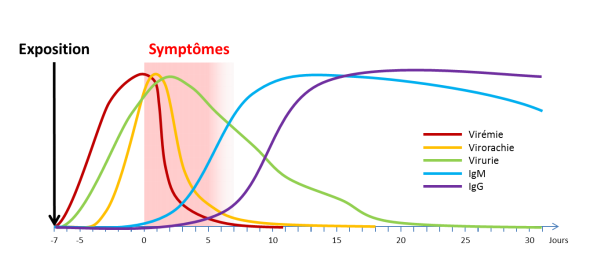
- A blood test used to detect antibodies, which are indirect indicators of recent or past exposure to the virus, bacterium, or parasite under investigation (or of a previous vaccination)." data-tooltip-title="A blood test used to detect antibodies, which are indirect indicators of recent or past exposure to the virus, bacterium, or parasite being studied (or of a previous vaccination)." data-tooltip-content="" data-tooltip-placeholder-is-selection="true" data-tooltip-placeholder-is-selection-text="Serology" data-tooltip-data="[{"tooltipTitle":"A blood test used to detect antibodies, which serve as at least indirect evidence of’a recent or past exposure to the virus, bacteria, or the parasite under study (or from a previous vaccination).","tooltipContent":"","placeholderIsSelection":"true","placeholderIsSelectionText":"Serology"}]">Serology (detection of antibodies against West Nile virus). IgM antibodies are typically detected 3 to 8 days after the onset of clinical signs and generally persist for 1 to 3 months. IgG antibodies appear 2 to 3 weeks after the onset of infection and persist for years. Two samples taken 2 to 3 weeks apart are required; a significant increase in antibody titer between these samples will confirm that the infection is recent.
- Serological cross-reactions are observed with other flaviviruses (e.g., dengue or Zika viruses). These cross-reactions require that any positive result be confirmed by a neutralization test.
- Gene amplification by RT-PCR. The viral genome is detectable in serum 2 to 18 days after infection—that is, up to 5 days after the onset of symptoms—and sometimes for longer in urine and whole blood. The viral genome can also be detected in cerebrospinal fluid (CSF) in cases of neurological manifestations.
- Viral isolation by viral culture. This technique is labor-intensive and requires a biosafety level 3 laboratory. It is not a routine test.
Schematic overview of the kinetics of viral RNA (blood, CSF, urine) and antibodies (IgM, IgG) following exposure, according to Barzon et al. 2013 (27) and Lustig et al., 2018 (28)
Symptomatic treatment
There is no specific antiviral treatment for West Nile virus. Management therefore focuses on treating symptoms as they arise.
Severe cases are treated in a hospital setting, in the intensive care unit if necessary.
When human cases are detected, it is important to remind people living near the transmission site(s) of the measures to protect against mosquitoes.
Mosquito Prevention Measures
There is currently no commercially available vaccine for humans, nor is there a preventive treatment against West Nile virus infection. For horses, an equine vaccine is commercially available.
Prevention of West Nile virus infection relies on measures to protect against mosquito bites, particularly from common mosquitoes of the genus Culex, which are primarily active at night:
- Wear loose-fitting, light-colored clothing that covers the skin;
- Use only skin repellents that have been approved for use (DEET, IR3535, or icaridin), following the recommended usage instructions (taking into account age and specific circumstances such as pregnancy or allergies);
- Install mosquito nets (on doors, windows, beds, and cribs);
- Create drafts (using fans, air circulators, or, if possible, air conditioning).
Note that electric insecticide diffusers are only a supplementary measure; pregnant women, young children (under 3 years of age), and people with asthma should not be exposed to them. It is recommended not to use smoke coils.
These personal protective measures are supplemented by community-wide prevention measures, which involve regularly removing standing water that promotes mosquito breeding.
More information on personal protection measures:
- Recommendations for Personal Vector Protection from the High Council for Public Health
Specific measures are in place to ensure the safety of blood transfusions and organ and tissue donations. These measures are based on screening donors or excluding high-risk donors. These measures are implemented in accordance with the recommendations issued by the High Council for Public Health (HCSP) and its permanent working group on the Safety of Human Body Components and Products (SECPROH).
Learn more:
Download

Health Recommendations for Travelers
In relation to

Chikungunya
thematic dossier
Chikungunya is a viral disease transmitted by mosquitoes of the genus Aedes. The most common symptoms are fever and joint pain.

Dengue
thematic dossier
Dengue fever is a viral disease transmitted by mosquitoes of the genus Aedes. The most common symptoms are fever and joint pain. Its complications can be severe.

Zika
thematic dossier
Zika is a viral disease transmitted primarily by mosquitoes but also through sexual contact. Symptoms are usually mild, but the virus can cause birth defects if a woman becomes infected during...