Childhood Vaccination: What Role Does Santé publique France Play?
Starting December 22, 2021, parents who wish to do so can have their children aged 5–11 vaccinated. Learn all about the logistics of pediatric vaccinations and the role of Santé publique France in the vaccination strategy.
Stay informed about the COVID-19 pandemic in France and around the world
Updates, Q&As, expert interviews... everything you need to know about the novel coronavirus (SARS-CoV-2) and COVID-19 in France and around the world
Child Vaccination: Launch of the Campaign for 5- to 11-Year-Olds
In recent weeks, the SARS-CoV-2 outbreak has seen a very rapid resurgence, with incidence rates rising sharply across all age groups, including among children. Due to the vaccination of children aged 12 to 17, the 6-to-10-year-old age group now has the highest incidence rate among school-aged children.
To address the spread of the coronavirus in France, the vaccination campaign for children aged 5 to 11 who are at risk of developing severe COVID-19 and for children living in the household of an immunocompromised person or someone with a serious medical condition began on December 15, 2021. The vaccination campaign is expanding and has been open since December 22, 2021, to the 5-11 age group following an opinion from the High Authority for Health (HAS)¹—to which Santé publique France contributed—and the opinions of the National Consultative Ethics Committee and the Vaccination Strategy Steering Committee. These opinions follow the extension of the indication for the conditional marketing authorization of the Comirnaty vaccine to children aged 5 to 11, issued by the EMA on November 25, 2021.
Vaccinating Children: What Are the Logistical Considerations?
The pediatric vaccine is a new vaccine developed by Pfizer specifically for children. While it is the same product used for those aged 12 and older, the dose administered is one-third that of the adult dose. As has been the case so far, it will be administered in two injections into the upper arm muscles, 21 days apart. Finally, as with older individuals, the vaccine is limited to a single dose for those with a history of COVID-19.
Santé publique France, and more specifically its pharmaceutical division, is responsible for:
procuring, receiving, and storing the vaccines,
distributing them to community pharmacies that have placed orders for authorized distributors,
where applicable and as needed, for their distribution to vaccination centers.
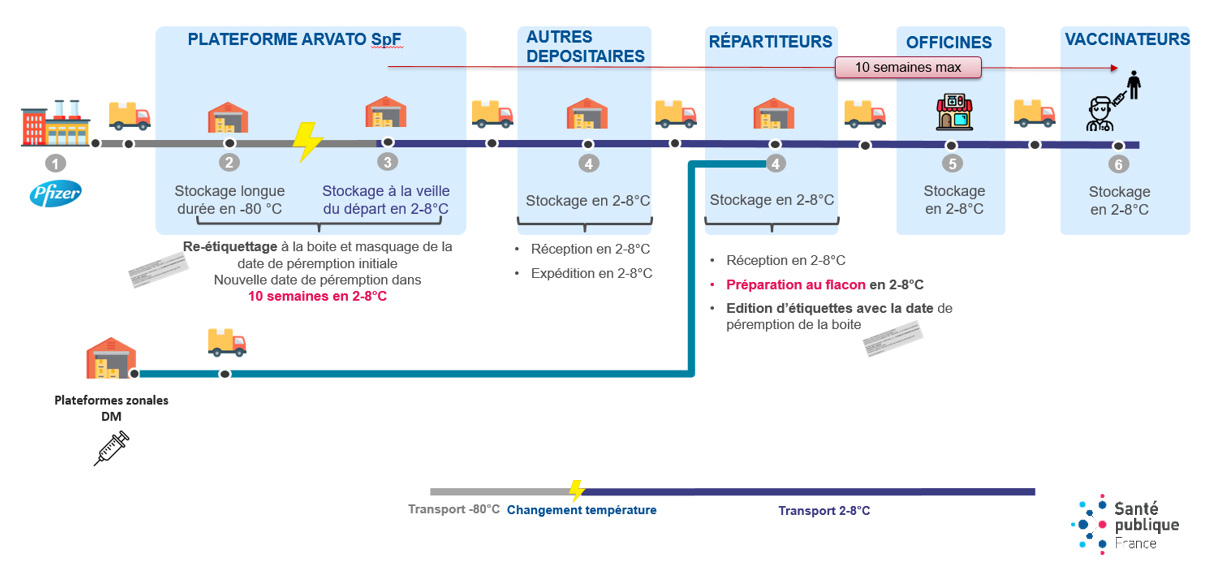
From a logistical standpoint, this vaccine has essentially the same characteristics as the Pfizer vaccine for those aged 12 and older: long-term storage at -80°C followed by transport and short-term storage between +2 and +8°C.
Santé publique France also purchases, receives, stores, and distributes medical devices such as injection supplies (needles, syringes) and the necessary diluent.
The agency has also purchased the rapid antigen tests (TROD) used as part of this vaccination campaign at vaccination centers.
More information on vaccine logistics and the role of Santé publique France
Logistics diagram for the distribution of pediatric vaccines within the urban supply chain
COVID-19 Vaccination: Monitoring and Evaluation of the Vaccination Strategy
To monitor the progress of the vaccination campaign, Santé publique France is responsible for producing vaccination coverage monitoring indicators to identify the percentage of people who have been vaccinated, including children. Using the “Vaccin Covid” database—administered by the French Health Insurance system and updated by healthcare professionals administering the vaccines—Santé publique France analyzes this information and makes it available to the public. These data allow for the calculation, as of the previous day, of the number of people who have received a dose of the COVID-19 vaccine.
The availability of these new, reliable, and expert-reviewed indicators helps ensure the public is well-informed and supports the management of the COVID-19 vaccination campaign.
In line with its mandate, Santé publique France contributes to the COVID-19 vaccination strategy in several ways:
Contributing to the development and adaptation of vaccination strategies
Assessment of vaccination coverage, efficacy, and impact
Vaccine supply, from procurement to distribution of vaccine doses, within the framework of a logistics plan established with the Ministry of Health and in support of the overall vaccination strategy established by the Government
Monitoring vaccination uptake and providing information on vaccination
Where can I find vaccination coverage indicators?
Santé publique France makes vaccination coverage monitoring indicators available to everyone on its new COVID-19 epidemic monitoring dashboard, as well as on Géodes, its mapping platform, for detailed, region-specific monitoring.
Vaccination coverage among children - Cumulative number of people vaccinated against COVID-19 with at least one dose, by age group
Spotlight on open-data indicators for tracking vaccination coverage on Géodes
The indicators available for free on our Géodes platform cover both the number of people vaccinated based on vaccination progress (number of people who have received at least one dose, who have completed their primary vaccination series, and who have received a booster dose) and the corresponding vaccination coverage rates. These indicators are broken down by date of vaccination, age group, and gender, as well as by the number of doses per vaccine type, distinguishing between first, second, third, and fourth doses, supplemented by analyses of specific populations (residents of long-term care facilities, healthcare professionals, etc.). Most of these indicators are broken down at the national, regional, and departmental levels.
See all vaccination coverage monitoring indicators (vaccination dossier)
In Géodes: select “by condition,” letter “C,” “COVID-19: vaccination”
These indicators are updated daily on Géodes and will soon be available on InfoCovidFrance, Santé publique France’s epidemic monitoring dashboard. Key highlights of COVID-19 vaccination coverage data are also presented weekly in the COVID-19 weekly epidemiological update published on Thursday evenings.
Vaccination Information Service
What are vaccines for? How do they work? At what age should children be vaccinated? Vaccination-info-service.fr answers the most frequently asked questions about vaccination. A separate...