


Data
Incidence varies by gender, while mortality is declining
In France, with 47,582 new cases in 2023 and 17,117 deaths in 2018, colorectal cancer is among the most common cancers (third most common in men and second most common in women) and is the second leading cause of cancer death (second leading cause in men and third leading cause in women):
Colorectal cancer is rare before the age of 50.
The incidence (standardized rate) is decreasing among men (by an average of 0.5% per year between 2010 and 2023), while it is increasing slightly among women (by an average of 0.4% per year between 2010 and 2023).
Incidence and mortality rates for colorectal cancer in mainland France by year (World-Standardized Rates) – Logarithmic scale

Download

article
30 June 2023
Incidence of the most common cancers in mainland France in 2023 and trends since 1990
This study examines the incidence of the 19 most common cancers, including cervical cancer, as well as the incidence of all cancers.
For information on the incidence of other types of cancer and cancer mortality, please refer to the report on National Estimates of Cancer Incidence and Mortality in Metropolitan France between 1990 and 2018.
Eight out of ten deaths occur among people aged 65 and older.
Mortality (standardized rate) is declining among both men and women.
For the first time in 2019, incidence estimates were published distinguishing between colon cancer and rectal cancer.
|
|
2018 |
Average annual change (%) [95% CI] |
||||
|---|---|---|---|---|---|---|
|
|
Number of new cases |
TSM |
1990–2018 |
95% CI |
2010–2018 |
95% CI |
|
Men |
||||||
|
Colon |
14,597 |
20.7 |
-0.3 |
[-0.4; -0.2] |
-1.1 |
[-1.5; -0.8] |
|
Rectum |
8,249 |
12.7 |
-1.0 |
[-1.2; -0.9] |
-1.9 |
[-2.3; -1.5] |
|
Women |
||||||
|
Colon |
13,217 |
14.8 |
-0.1 |
[-0.2; 0.1] |
-0.1 |
[-0.5; 0.2] |
|
Rectum |
5,495 |
6.9 |
-0.5 |
[-0.7; -0.3] |
-0.9 |
[-1.4; -0.4] |
Within the European Union, France has the 16th highest incidence rate (age-standardized) among men and the 15th highest among women. In terms of mortality, France has the 9th lowest mortality rate (age-standardized) among men and the 7th lowest among women.
1
million new cases are estimated for 2018
Globally, 1 million new cases are estimated for 2018. The highest incidence rates (standardized rates) are observed in Australia/New Zealand, Europe, and North America, and the lowest in Central America, South Asia, and Africa. In terms of mortality, 881,000 deaths from colorectal cancer are estimated for 2018. Mortality rates (standardized rates) are highest in Melanesia, East Asia, and Central and Eastern Europe, and lowest in South Central Asia, Central Africa, and West Africa.
LEARN MORE

13 March 2019
National estimates of cancer incidence and mortality in mainland France between 1990 and 2018: a study based on cancer registries from the Francim network. Preliminary results. Summary.
Regional and Departmental Incidence and Mortality
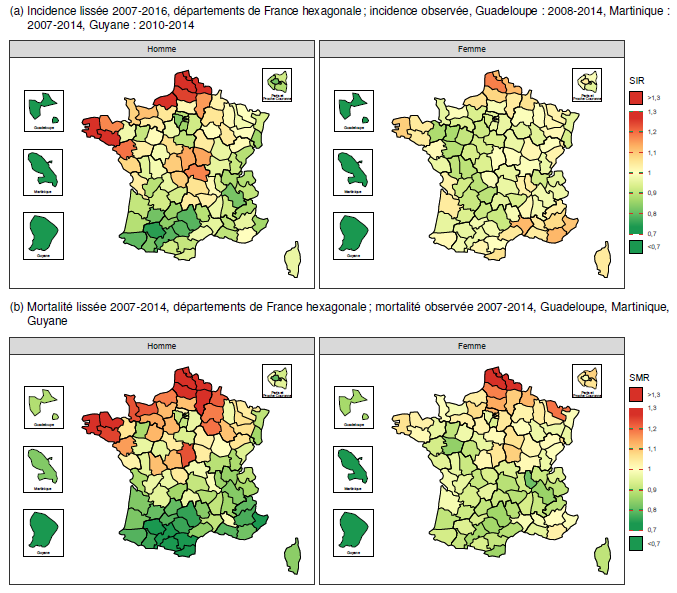
Few regional and departmental disparities in colorectal cancer incidence are observed, particularly among women. Among men, 8 departments show an over-incidence exceeding 10% compared to the national average, and 5 departments show an under-incidence exceeding 10%.
Regarding mortality, the contrasts are more pronounced: among men, “the departments of Pas-de-Calais and Nord (Hauts-de-France region) and, to a lesser extent, those in the Grand Est region (especially in the Ardennes) as well as those along the Vienne-Nièvre corridor (central France) have a mortality rate higher than the national average. In total, 21 departments have excess mortality exceeding 10% compared to the national average, and 12 have under-mortality4 exceeding 10%. Among women, excess mortality exceeding 10% is observed in 3 departments of Hauts-de-France (Aisne, Pas-de-Calais, and Nord), while a mortality rate below the national average by more than 10% is observed in two departments in southern France (Alpes-de-Haute-Provence, Alpes-Maritimes) and in the Hauts-de-Seine department.”
SEE ALSO

Regional and departmental estimates of cancer incidence and mortality in France, 2007–2016
Regional and departmental estimates of cancer incidence and mortality can be viewed here.
Standardized incidence ratios (SIR) and mortality ratios (SMR) for colorectal cancer
LEARN MORE
Regional and Departmental Estimates of Cancer Incidence and Mortality in France, 2007–2016 - Martinique
Improved 5-year survival
Survival (standardized net survival) among people with colorectal cancer stands at 63% five years after diagnosis for those diagnosed between 2010 and 2015, slightly higher among women (65%) than among men (62%).
Five-year survival decreases with age: from 72% among those diagnosed at age 50 to 57% among those diagnosed at age 80 (2010–2015).
Five-year survival has improved over time, rising from 53% for those diagnosed in 1990 to 65% for those diagnosed in 2015.
Updated survival estimates were produced separately for colon cancer, rectal cancer, and, for the first time, anal cancer. The 5-year net survival rate for people diagnosed in 2010–2015 for these three sites was 64%, 62%, and 66%, respectively.
Survival Rates in the Overseas Departments and Regions
Survival rates for people with colorectal cancer were estimated using data from the general cancer registries of Guadeloupe, Martinique, and Réunion.
The 5-year net survival rate is estimated at 53% for Martinique and 57% for Guadeloupe and Réunion among people diagnosed between 2008 and 2015 (63% in mainland France).
Prevalence of colorectal cancer
The 5-year partial prevalence of colorectal cancer in 2017 is estimated at nearly 83,000 men (53%) and 69,000 women. This figure represents individuals diagnosed within the past five years, whether they are in complete remission, cured, or under ongoing surveillance.
LEARN MORE

Colorectal cancer: a similar distribution of stages at diagnosis across genders
Data from registries show that:
For colon cancer:
44% of cancers are diagnosed at an early stage
One-third are diagnosed at an advanced stage
This distribution varies with age: cancers diagnosed at an early stage are more common among those aged 40–74 (48%), while those at an advanced stage are more common among those under 40 (38%) and those over 74 (37%).
All these results are similar for both genders.
For rectal cancer:
47% of cancers are diagnosed at an early stage
One-third are diagnosed at an advanced stage.
This distribution varies with age: more than one in two cancers is diagnosed at an early stage among those aged 15–39 (57%) and those aged 50–74 (51%). Cancers diagnosed at an advanced stage are more common among those over 74 (42%).
All these results are similar for both genders
Organized Colorectal Cancer Screening Program
Find national, regional, and county-level indicators for the organized colorectal cancer screening program.

GEODES
Track trends in colorectal cancer in France and in your region
In relation to

Alcohol
thematic dossier
Alcohol is deeply rooted in French culture. Its consumption remains a major cause of death and illness in France.

Tobacco
thematic dossier
Despite a slight decrease compared to 2015, tobacco remains responsible for more than 68,000 premature deaths in 2023—accounting for 11% of total mortality—making it still the leading cause of...

Nutrition and Physical Activity
thematic dossier
Nutrition and physical activity are two major determinants of health that contribute to improving the health of the population and are key priorities in public health policy.