

How can you reduce the risks associated with alcohol consumption?
Alcohol consumption poses health risks. To minimize these risks, guidelines for lower-risk drinking are available. Self-assessment tools are available, as is support from healthcare professionals. The Alcool Info Service website lists all the available resources and support options.
Guidelines for Alcohol Consumption
There is no such thing as risk-free alcohol consumption. The health risks associated with alcohol consumption increase over the course of a person’s life as the amount consumed rises.
However, a 2017 report by a group of experts commissioned by Santé publique France and INCa defined what are considered acceptable risks and proposed a single guideline for both genders, expressed as the number of standard drinks: no more than 10 standard drinks per week and no more than 2 standard drinks per day. These same experts recommend having days during the week when no alcohol is consumed and, on each occasion when alcohol is consumed, to:
- reduce the total amount of alcohol consumed on each occasion
- drink slowly, while eating and alternating with water
- avoid risky places and activities
- make sure you are surrounded by people you trust and that you can get home safely
These guidelines can be summarized as follows:
“FOR YOUR HEALTH, LIMIT ALCOHOL TO A MAXIMUM OF 2 DRINKS PER DAY—AND NOT EVERY DAY”
Generally speaking, the safest option is to avoid drinking alcohol in the following situations:
- throughout pregnancy and while breastfeeding
- during childhood, adolescence, and throughout the growth period
- when driving
- when participating in high-risk sports
- when taking certain medications
- if you have certain medical conditions
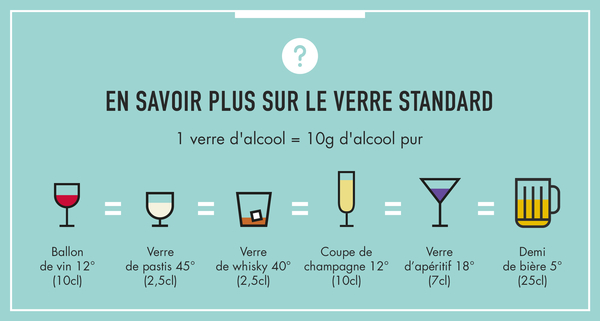
For reference, a “standard drink” as served in a bar or restaurant contains 10 grams of pure alcohol, regardless of the type of alcoholic beverage (wine, beer, or spirits).
Alcohol Content of a Standard Drink
Risk Prevention
The long-term risks associated with alcohol consumption are still poorly understood and are often downplayed or put into perspective, and consumers tend to dismiss them. It is therefore important to be able to identify, inform, and assist individuals with risky drinking patterns—that is, those who exceed recommended consumption limits. The proactive role of healthcare professionals is essential.
The alcohol meter tool allows individuals to assess their consumption and understand the risks involved. It can be used independently or recommended by healthcare professionals to their patients.
General practitioners or primary care providers (midwives, obstetrician-gynecologists, pharmacists, etc.) are the key actors in identifying risky alcohol consumption. By identifying these patients and, if necessary, conducting a “brief” intervention, they have the opportunity to inform them of the risks associated with their alcohol consumption, encourage them, and support them in reducing their intake. This screening stage is crucial because non-dependent drinkers find it easier to reduce or stop their alcohol consumption—with appropriate support and effort—than those who are already dependent. It is recommended to do this at least once a year, and at any time deemed appropriate (life events, health issues, prescription of a medication that interacts with alcohol, etc.). Certain high-risk situations also provide an opportunity to discuss the issue: pregnancy, driving, and psychosocial stressors (academic failure, exams, job changes, etc.).
Healthcare professionals can take action on several levels:
- For patients with low-risk drinking, the goal will be to reinforce health-promoting behaviors (primary prevention).
- For patients in whom the physician has identified risky drinking (exceeding recommended limits) or even harmful drinking, “brief” intervention can prevent the progression to complications, reduce the harm resulting from this behavior, and improve patients’ quality of life.
- For patients with a severe alcohol-use disorder or who are dependent, a referral to a specialized treatment facility may be made.
Early Detection and Brief Intervention (EDBI)
EIDBI is a preventive procedure aimed at identifying the use of psychoactive substances—in this case, alcohol—and reducing that use.
It primarily targets individuals who are not alcohol-dependent. Those who are dependent may, following the screening phase, be referred to specialized addiction treatment facilities.
EIT consists of two stages:
- Screening: This involves collecting self-reported consumption data and assessing risks using a questionnaire
- Brief intervention: This takes the form of a motivational interview.
Numerous studies show that RPIB is an effective strategy for reducing alcohol consumption. Longer interventions are not necessarily associated with a significantly greater reduction in consumption.
In practice: early screening
The goal of early identification is to determine risky drinking patterns To do this, the patient should be asked about their level of drinking, particularly in terms of quantity and frequency. It is better to ask specific questions (e.g., “How many drinks do you have per week?”) rather than vague questions (e.g., “Do you drink alcohol?”), which can sometimes be difficult to answer.
To facilitate data collection, there are a wide variety of questionnaires available, depending on the types of substances they assess. Regarding alcohol, two of the most commonly used questionnaires are:
- AUDIT (Alcohol Use Disorders Identification Test)
- and FACE (Fast Alcohol Consumption Evaluation)
AUDIT, developed by the World Health Organization (WHO), consists of 10 questions that assess reported alcohol consumption over the past 12 months. The questions measure the frequency of alcohol consumption, dependence, and problems caused by alcohol use.
Alcohol misuse [dependence] is suspected:
- in men with a score of 7 or higher [>12]
- in women with a score of 6 or higher [>12].
| Score | |||||
|---|---|---|---|---|---|
| Questions | 0 | 1 | 2 | 3 | 4 |
| 1. How often do you drink alcoholic beverages? | Never | Once a month or less | 2 to 4 times a month | 2 to 3 times a week | At least 4 times a week |
| 2. How many standard drinks do you have on a typical day when you drink alcohol? | 1 or 2 | 3 or 4 | 5 or 6 | 7 to 9 | 10 or more |
| 3. On a single occasion, how often do you drink six standard drinks or more? | Never
| Less than once a month | Once a month | Once a week | Every day or almost every day |
| 4. Over the past year, how often have you found that you were unable to stop drinking once you had started? | Never
| Less than once a month | Once a month | Once a week | Every day or almost every day |
| 5. Over the past year, how often has drinking alcohol prevented you from doing what was normally expected of you? | Never
| Less than once a month | Once a month | Once a week | Every day or almost every day |
| 6. Over the past year, how often, after a period of heavy drinking, have you had to drink alcohol first thing in the morning to feel well? | Never
| Less than once a month | Once a month | Once a week | Every day or almost every day |
| 7. Over the past year, how often have you felt guilty or regretful after drinking? | Never
| Less than once a month | Once a month | Once a week | Every day or almost every day |
| 8. Over the past year, how often have you been unable to remember what happened the night before because you had been drinking? | Never
| Less than once a month | Once a month | Once a week | Every day or almost every day |
9. Have you ever injured yourself or someone else because you were drinking?
| No
| / | Yes, but not in the past year | / | Yes, within the past year |
| 10. Has a friend, doctor, or other healthcare professional ever expressed concern about your alcohol use and advised you to cut back? | No
| / | Yes, but not in the past year | / | Yes, in the past year |
The FACE questionnaire is based on a simplified version of AUDIT. It consists of 5 questions scored on a scale of 0 to 4. Questions 1 through 2 assess self-reported alcohol consumption over the past 12 months, while questions 3 through 5 assess lifetime risky drinking and dependence. One advantage of this questionnaire is that it is extremely quick to administer and can therefore be easily completed during a consultation.
Alcohol misuse is suspected:
- in men with a score of ≥ 5,
- in women with a score of ≥ 4.
| Score | |||||
|---|---|---|---|---|---|
| Questions | 0 | 1 | 2 | 3 | 4 |
| 1. How often do you drink alcoholic beverages? | Never | Once a month or less | 2 to 4 times a month | 2 to 3 times a week | At least 4 times a week |
| 2. How many standard drinks do you have on a typical day when you drink alcohol? | 1 or 2 | 3 or 4 | 5 or 6 | 7 to 9 | 10 or more |
| 3. Have people around you ever commented on your alcohol consumption? | No | / | / | / | Yes |
| 4. Have you ever needed alcohol in the morning to feel well? | No | / | / | / | Yes |
| 5. Do you ever drink and then not remember what you might have said or done? | No | / | / | / | Yes |
Brief Intervention
Support for healthy behaviors should be offered to any consumer who exceeds the guidelines for lower-risk consumption. A brief intervention can be conducted: it aims to motivate a change in behavior among drinkers. It takes the form of a motivational interview. It should be offered, in particular, to individuals with the following misuse scores:
- Men with a score of 7 to 12 on the AUDIT questionnaire or 5 to 9 on the FACE questionnaire.
- Women with a score of 6 to 12 on the AUDIT questionnaire or 4 to 9 on the FACE questionnaire.
Lasting anywhere from 5 to 20 minutes, the brief intervention can be a one-time session or repeated.
The recommended steps are:
| Inform | Report the results of the alcohol use questionnaires. Provide information on the risks associated with alcohol consumption. |
| Discuss | Assess personal and situational risks. Identify the patient’s perceptions and expectations. Discuss the personal benefits of quitting or reducing alcohol consumption. |
| Set goals | Suggest goals and let the person choose. The most effective approach appears to be encouraging self-assessment of alcohol consumption—that is, asking the person to record the number of drinks consumed each day Assess the patient’s motivation, whether the timing is right, and their confidence in successfully reducing or stopping their consumption. Offer the opportunity to reassess during a follow-up visit. A second effective approach is to regularly reinforce the person’s commitment to reducing their alcohol consumption |
| Refer | Provide a brochure or refer the individual to a website, app, forum, organization, or remote support service… |
The intervention is based on empathy-driven motivational interviewing to strengthen the individual’s motivation and provide them with information while respecting their choices and ambivalence. Success depends largely on the quality of the relationship—particularly the trust between the patient and the professional. Do not hesitate to refer individuals to specialized services.
Preventing Alcohol Use During Pregnancy
Alcohol is toxic throughout pregnancy, particularly to the brain. Any amount of alcohol consumption is considered risky because no safe dose for the fetus has been established. As a precautionary measure, it is therefore recommended to avoid alcohol during pregnancy—and even when planning to conceive. If alcohol is consumed, it is beneficial to stop drinking at any stage of pregnancy. It is also recommended to avoid drinking alcohol while breastfeeding.
Without making the pregnant woman feel guilty, those around her can provide support (for example, by not drinking alcohol in her presence, suggesting other activities, etc.).
As a healthcare professional, the issue of alcohol consumption during pregnancy should be discussed with every patient as a matter of routine. There are several appropriate times to bring this up, but the sooner, the better.
- Preconception
- Upon confirmation of pregnancy
- During the early prenatal visit
- During a follow-up visit
- During childbirth preparation classes
Many questionnaires are available, but they cannot replace dialogue. They can, however, facilitate dialogue by encouraging and informing the conversation. The T-ACE is the test that is generally used.
In addition to pregnancy, for women of childbearing age, gynecological and medical visits provide an opportunity—just as smoking is discussed—to screen for alcohol use and provide information on the associated health and obstetric risks.
Screening for alcohol use during pregnancy addresses three key health concerns:
- fetal development, to limit exposure and/or reduce its effects;
- the course of the pregnancy;
- the consequences of alcohol on the woman’s health.
Fetal Alcohol Spectrum Disorders (FASD) encompass a wide range of conditions; while treatment can only mitigate their impacts, they are preventable through effective prevention measures.
The risk exists from conception and continues through the end of pregnancy (and even after childbirth in the case of breastfeeding). Prevention is beneficial at any stage of pregnancy; it is never too late to address the issue.
Bringing up the issue of alcohol consumption can be difficult, as it requires overcoming the social and cultural stigma surrounding alcohol that affects both the patient and the healthcare professional; but the more we talk about it, the more comfortable we become!
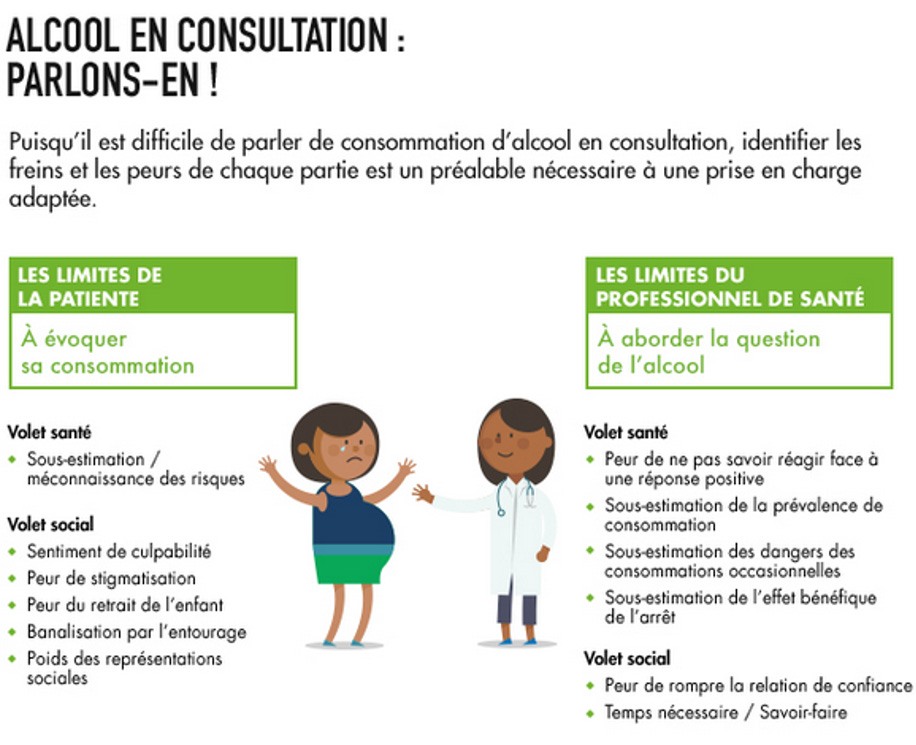
All healthcare professionals can help spread the message about avoiding alcohol during pregnancy—for example, when ordering blood HCG tests, when selling pregnancy or ovulation tests, or when handling administrative procedures (such as registering a pregnancy). It’s important to keep in mind that pregnant women rarely bring up the topic of alcohol on their own.
To identify alcohol use, it is therefore up to the healthcare professional to be proactive. The professional should be aware that:
- Alcohol use occurs across all socioeconomic groups (and is slightly more common among higher socioeconomic groups) and in all regions.
- Some pregnant women may be struggling with their alcohol use, whether they are already aware of it or not. They may be offered follow-up care by specialized professionals (addiction specialists). For those already receiving care, the issues of motherhood and parenting must be addressed early on to provide proactive support for pregnancy plans and, if necessary, to connect them with a team capable of providing support during the perinatal period. Women with substance use disorders are at the highest risk of their babies developing fetal alcohol syndrome. We must be vigilant with these women, who may have multiple risk factors (precarious living conditions, domestic violence, etc.). During follow-up, it is important to inquire about the health of any children she may already have in order to provide her with the information needed to screen for possible FAS.
- Discussing alcohol consumption during pregnancy is a good way to address the toxic effects of alcohol. It serves as a starting point for explaining the benefits of reducing alcohol consumption in general.
Any healthcare professional is likely to identify alcohol use during pregnancy.
Many questionnaires are available, but they cannot replace a conversation. They can, however, facilitate the discussion with the patient. They can be offered as self-administered questionnaires in the waiting room, for example. The first questions of the AUDIT test and the FACE questionnaire can be used for this purpose. The T-ACE can also be used as a self-administered questionnaire to identify heavy drinkers.
- T = TOLERANCE: How many drinks do you have before you feel the effects of alcohol? 0 drinks = 0 points, 1 or 2 drinks = 1 point; > 2 drinks = 2 points
- A = ANNOYANCE: Have you ever been annoyed when someone told you that you should cut down on your alcohol consumption? No (0 points) / Yes (1 point)
- C = CUTBACK: Have you ever thought you should cut back on your drinking? No (0 points) / Yes (1 point)
- E: WAKING UP: Do you ever drink when you wake up to help you get going or to recover from the effects of a night of heavy drinking? No (0 points) / Yes (1 point)
Result: A score of ≥ 2 likely indicates an alcohol problem; a more thorough evaluation is necessary.
There is also a self-assessment questionnaire developed by the Pregnancy & Addiction Study Group (GEGA) designed to facilitate communication between pregnant women and the professionals involved in their prenatal care.
In addition, training programs for professionals are available to raise awareness or deepen their practice and knowledge.
For more information
- Guillemont J, Cogordan C, Nalpas B, et al. Effectiveness of a web-based intervention to reduce alcohol consumption among French hazardous drinkers: a randomized controlled trial. Health Educ Res. August 1, 2017;32(4):332-342.
- Alcohol Misuse: Screening, Diagnosis, and Treatment. SFA Recommendations 2023.
- Tool to Aid in Early Detection and Brief Intervention—Alcohol, Cannabis, and Tobacco in Adults | Haute Autorité de santé
- Alcohol and Pregnancy: Disorders Caused by Fetal Alcohol Exposure | French National Authority for Health
- Alcohol and Pregnancy: Let’s Talk About It. A Guide for Professionals | Ministry of Health
- First Steps in Alcoholism Treatment, 2023 | Respadd
- www.alcool-info-service.fr
- https://www.1000-premiers-jours.fr
In relation to

thematic dossier
The First 1,000 Days
The period from conception through the first two years of life is critical for a child’s development and the health of the adult they will become. That is why it is essential to prioritize the...

thematic dossier
Cancers
Les cancers représentent en France la première cause de décès chez l’homme et la deuxième chez la femme. Santé Publique France copilote la surveillance épidémiologique et participe à leur prévention.