
The Disease
A Viral Hepatitis Transmitted Through Fecal-Oral Contact
Acute hepatitis A is caused by a virus that affects the liver. It is common in developing countries, where it most often affects children. In countries with good hygiene conditions, however, the incidence of hepatitis A is lower, and it more often affects adults. In adults, it is also more likely to be symptomatic than in children and can be severe.
Santé publique France monitors trends in the epidemiology of acute hepatitis A in France through the mandatory reporting system. This surveillance system enables the early detection of clusters of cases or outbreaks, allowing for the implementation of measures to prevent new cases from occurring.
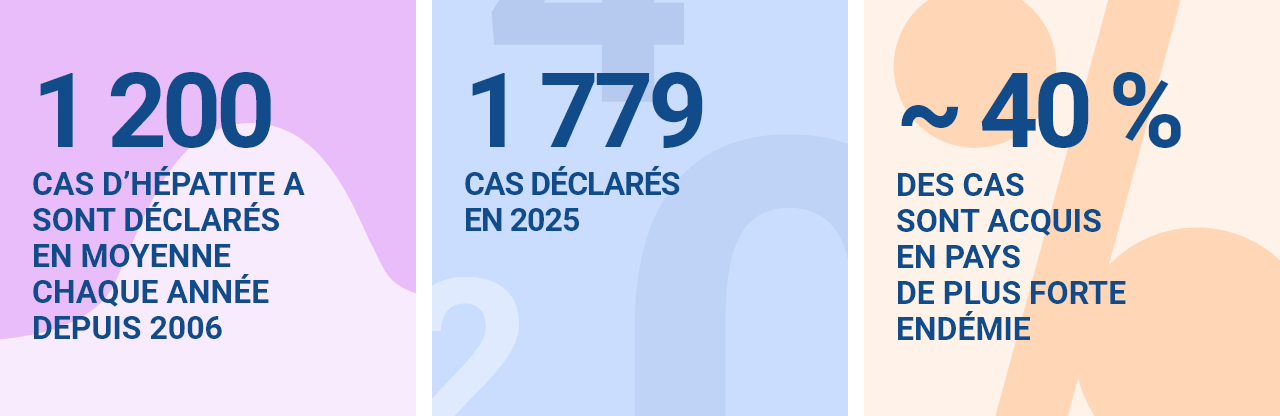
Key Statistics on Hepatitis A
A mode of transmission primarily via the fecal-oral route
Hepatitis A is transmitted primarily from person to person (human-to-human transmission) via the fecal-oral route. Although less common, foodborne transmission can also cause major outbreaks. Food can be contaminated directly by human feces (water, shellfish, vegetables) or indirectly by a food handler infected with the virus.
The hepatitis A virus is responsible for sporadic cases and outbreaks that are most often limited to specific communities (daycare centers, preschools, facilities for people with disabilities). In some cases, these outbreaks can be more widespread and affect a larger population at the local, regional, national, or even international level.
Preventive Measures
These measures are based on personal and community hygiene, particularly simple handwashing with soap and water. This includes washing hands after using the restroom, after changing a baby’s diaper, before preparing meals, and before eating or feeding children.
Vaccination: Effective Protection
An effective vaccine against hepatitis A has been available since 1992. Protection against hepatitis A begins about two weeks after vaccination and is likely to last a lifetime if the vaccination series is completed (2 doses).
Vaccination is recommended for:
- people at risk of developing severe illness
- people who are particularly exposed to the virus, especially those living in communities where basic hygiene measures are difficult to implement, people over 1 year of age traveling to countries with moderate or high endemicity, people exposed to the virus or at risk of transmitting the virus due to their occupation, men who have sex with men
Specific recommendations also exist in the event of contact with a person infected with hepatitis A, particularly for people living in the same household.
Learn more
In the event of a cluster of cases in a community, simple hygiene measures are generally sufficient to contain an outbreak. However, vaccination should be considered, particularly in situations where hygiene measures cannot be followed. All of these context-specific measures are available here.
Clinical Presentation and Diagnosis of Hepatitis A
The hepatitis A virus can cause acute hepatitis. Most often, hepatitis A is asymptomatic or causes only mild symptoms. When symptoms do appear after an incubation period of 15 to 50 days (30 days on average), they most commonly include fever and severe fatigue (asthenia), which may be accompanied by nausea, abdominal pain, and a yellowing of the skin (jaundice).
Severe or fulminant forms that can progress to end-stage liver failure are also possible, but deaths are rare. The hepatitis A virus does not cause chronic hepatitis.
The diagnosis of acute hepatitis A is based on a blood test that detects antibodies, which are indirect indicators of recent or past exposure to the virus, bacterium, or parasite in question (or of a previous vaccination)." data-tooltip-title="A blood test that detects antibodies, which are indirect indicators of recent or past exposure to the virus, bacterium, or parasite under investigation (or of a previous vaccination)." data-tooltip-content="" data-tooltip-placeholder-is-selection="true" data-tooltip-placeholder-is-selection-text="serology" data-tooltip-data="%5B%7B%22tooltipTitle%22%3A%22A%20blood%20test%20used%20to%20detect%20antibodies%2C%20which%20serve%20as%20at%20least%20indirect%20evidence%20of%E2%80%99a%20recent%20or%20past%20exposure%20to%20the%20virus%2C%20bacteria%2C%20or%20the%20parasite%20under%20study%20(or%20from%20a%20previous%20vaccination).%22%2C%22tooltipContent%22%3A%22%22%2C%22placeholderIsSelection%22%3A%22true%22%2C%22placeholderIsSelectionText%22%3A%22serology%22%7D%5D">serology (detection of anti-HAV IgM antibodies).
Treatment and Management
There is no curative treatment for hepatitis A. In most cases, the disease resolves spontaneously with a favorable outcome. Hospitalization may be necessary in some cases to monitor the patient and provide symptomatic care. Finally, the rare severe or fulminant forms of hepatitis A may require a liver transplant.
Download

Health Recommendations for Travelers
In relation to

Vaccination
thematic dossier
Contagious diseases most often affect children at a very young age. Because children are particularly vulnerable, they are a priority target for vaccination programs.

Outbreaks of foodborne illness
thematic dossier
A foodborne illness outbreak is defined as the occurrence of at least two cases with similar symptoms—typically gastrointestinal—that can be traced to a single food source. In France, such...