

Data
The surveillance system for typhoid and paratyphoid fever established by Santé publique France makes it possible to study the epidemiological trends of these diseases through mandatory reporting.
A stable incidence of typhoid and paratyphoid fever; a significant impact of the global COVID-19 pandemic on the number of reported cases in 2020–2021
The number of typhoid and paratyphoid fever cases reported through mandatory reporting has varied between 100 and approximately 230 each year since 1999 (Figure 1).
In 2019, 207 cases of typhoid and paratyphoid fever were reported
. In 2020 and 2021, the reduction in travel due to the global COVID-19 pandemic had a significant impact on the number of typhoid and paratyphoid fever cases, with 73 and 63 cases reported, respectively, in those years.
Since 2022, the annual number of reported cases has been close to the number of cases observed before the COVID-19 pandemic, with an incidence of around 3 cases per million people (Figure 2).
In 2025, 227 cases of typhoid and paratyphoid fever were reported, including 185 (81%) cases of typhoid fever, 16 (7%) cases of paratyphoid fever A, 23 (10%) cases of paratyphoid fever B, and 3 (1%) cases of paratyphoid fever C. Of these 227 cases reported in France in 2025, 138 (61%) occurred among people residing in Metropolitan France and 77 (34%) among people residing in Mayotte (Table 1).
The median age of the cases was 23 years (min: 1 year, max: 92 years), and 47% were women.
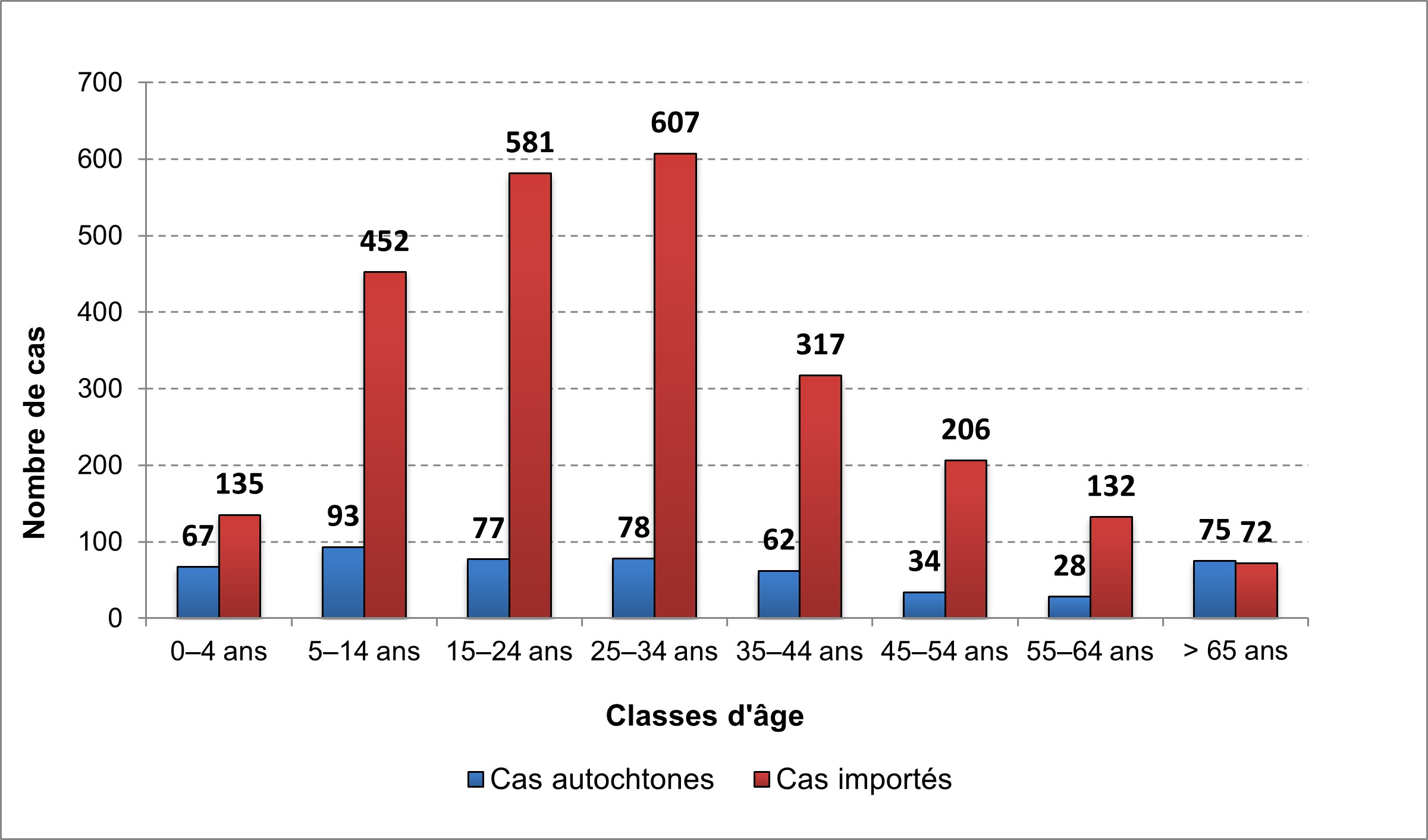
People of all ages can be affected by typhoid and paratyphoid fever. Between 1999 and 2025, the 5–34 age group was the most common, accounting for 75% of reported cases in metropolitan France (Figure 3).
Figure 1: Number of reported cases of typhoid fever and paratyphoid fever in France from 1999 to 2020
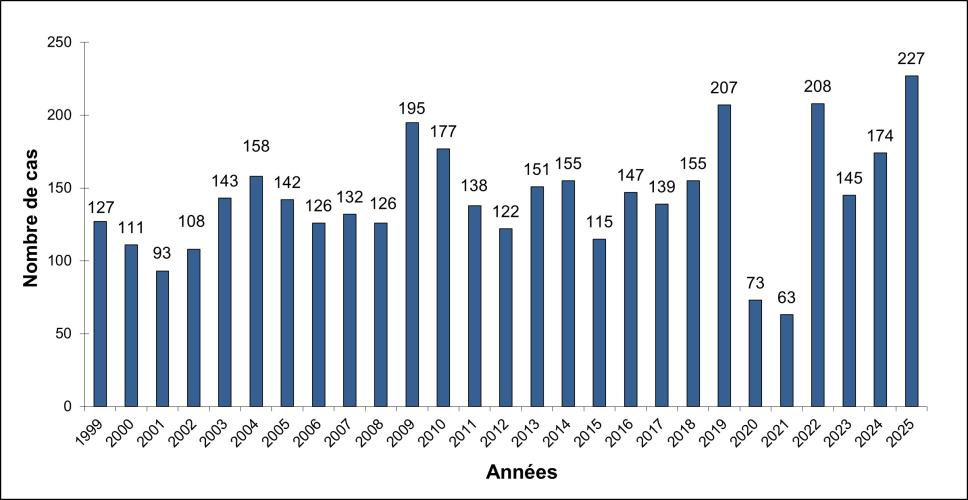
Figure 2: Incidence of typhoid and paratyphoid fever, per million people in France, 1999–2020
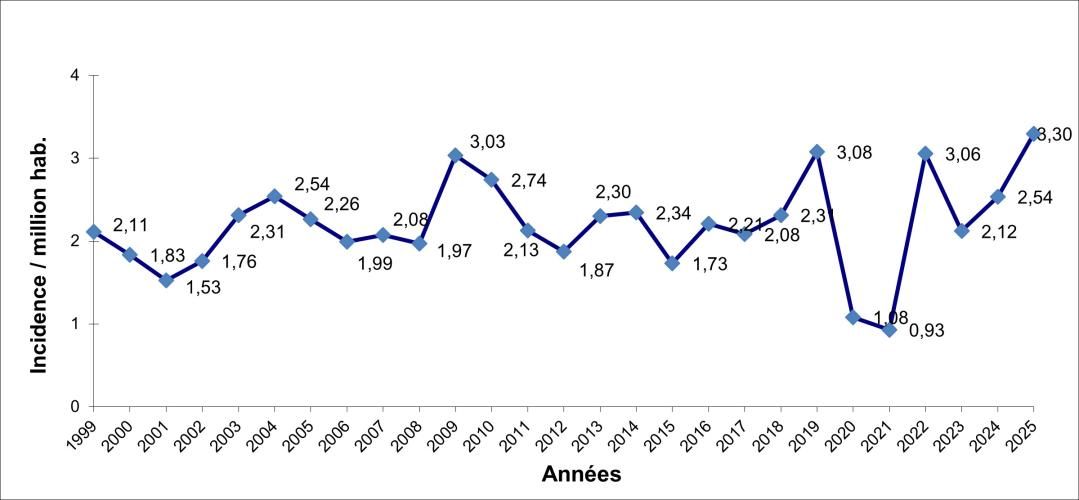
Table 1: Number of cases and deaths from typhoid fever and paratyphoid fevers reported in France from 1999 to 2025, by region of residence.
| 1999 | 2000 | 2001 | 2002 | 2003 | 2004 | 2005 | 2006 | 2007 | 2008 | 2009 | 2010 | 2011 | 2012 | 2013 | 2014 | 2015 | 2016 | 2017 | 2018 | 2019 | 2020 | 2021 | 2022 | 2023 | 2024 | 2025 | |
|---|---|---|---|---|---|---|---|---|---|---|---|---|---|---|---|---|---|---|---|---|---|---|---|---|---|---|---|
| Salmonella Typhi | |||||||||||||||||||||||||||
| All of France | 112 | 92 | 84 | 96 | 113 | 112 | 107 | 88 | 84 | 88 | 133 | 135 | 103 | 86 | 108 | 117 | 100 | 117 | 111 | 119 | 171 | 63 | 50 | 182 | 103 | 133 | 185 |
| Mainland France | 89 | 82 | 74 | 80 | 101 | 87 | 91 | 79 | 76 | 78 | 104 | 114 | 72 | 53 | 66 | 90 | 50 | 71 | 82 | 64 | 96 | 24 | 34 | 78 | 84 | 66 | 98 |
| Guadeloupe | 3 | 0 | 0 | 1 | 1 | 2 | 0 | 0 | 1 | 4 | 7 | 1 | 2 | 0 | 0 | 1 | 0 | 0 | 0 | 0 | 0 | 0 | 0 | 0 | 0 | 1 | 0 |
| French Guiana | 10 | 7 | 2 | 0 | 0 | 11 | 7 | 2 | 3 | 5 | 8 | 8 | 3 | 5 | 5 | 5 | 3 | 5 | 6 | 5 | 19 | 2 | 1 | 3 | 4 | 10 | 5 |
| Martinique | 0 | 0 | 4 | 2 | 1 | 1 | 1 | 1 | 0 | 0 | 0 | 0 | 0 | 1 | 1 | 0 | 1 | 0 | 0 | 1 | 0 | 0 | 0 | 0 | 0 | 0 | 0 |
| Mayotte | 5 | 6 | 20 | 21 | 31 | 19 | 44 | 39 | 21 | 45 | 53 | 37 | 15 | 100 | 12 | 53 | 77 | ||||||||||
| Reunion | 3 | 1 | 0 | 6 | 2 | 1 | 1 | 0 | 4 | 0 | 4 | 2 | 5 | 5 | 3 | 0 | 2 | 1 | 2 | 3 | 1 | 0 | 0 | 0 | 2 | 1 | 0 |
| Foreign* | 7 | 2 | 4 | 7 | 8 | 10 | 7 | 6 | 0 | 1 | 5 | 4 | 1 | 1 | 2 | 2 | 0 | 2 | 0 | 1 | 2 | 0 | 0 | 1 | 1 | 2 | 5 |
| Salmonella Paratyphi A | |||||||||||||||||||||||||||
| All of France | 10 | 11 | 7 | 7 | 19 | 37 | 19 | 32 | 35 | 21 | 34 | 30 | 27 | 27 | 34 | 30 | 12 | 23 | 14 | 28 | 23 | 7 | 8 | 15 | 23 | 20 | 16 |
| Mainland France | 10 | 11 | 7 | 7 | 19 | 37 | 17 | 31 | 33 | 21 | 33 | 30 | 27 | 27 | 34 | 29 | 12 | 23 | 13 | 28 | 23 | 6 | 8 | 15 | 23 | 19 | 16 |
| Salmonella Paratyphi B | |||||||||||||||||||||||||||
| All of France | 5 | 8 | 2 | 5 | 10 | 9 | 15 | 5 | 13 | 15 | 26 | 11 | 9 | 7 | 6 | 7 | 3 | 6 | 13 | 8 | 9 | 3 | 3 | 8 | 14 | 19 | 23 |
| Mainland France | 5 | 7 | 2 | 5 | 10 | 9 | 15 | 3 | 12 | 14 | 26 | 11 | 8 | 6 | 5 | 7 | 3 | 6 | 13 | 8 | 8 | 3 | 3 | 7 | 14 | 19 | 21 |
| Salmonella Paratyphi C | |||||||||||||||||||||||||||
| All of France | 0 | 0 | 0 | 0 | 1 | 0 | 1 | 1 | 0 | 2 | 2 | 1 | 0 | 2 | 1 | 1 | 0 | 0 | 1 | 0 | 4 | 0 | 2 | 3 | 5 | 2 | 3 |
| Mainland France | 0 | 0 | 0 | 0 | 1 | 0 | 0 | 0 | 0 | 1 | 2 | 1 | 0 | 2 | 1 | 1 | 0 | 0 | 1 | 0 | 4 | 0 | 2 | 1 | 3 | 2 | 3 |
| TOTAL (typhoid + paratyphoid) | |||||||||||||||||||||||||||
| All of France | 127 | 111 | 93 | 108 | 143 | 158 | 142 | 126 | 132 | 126 | 195 | 177 | 139 | 122 | 149 | 155 | 115 | 147 | 139 | 155 | 208 | 73 | 63 | 208 | 145 | 174 | 227 |
| Mainland France | 104 | 100 | 83 | 92 | 131 | 133 | 123 | 113 | 121 | 114 | 165 | 156 | 107 | 88 | 106 | 127 | 65 | 100 | 109 | 100 | 131 | 33 | 47 | 101 | 124 | 106 | 138 |
| Number of deaths | 1 | 0 | 2 | 0 | 1 | 0 | 0 | 0 | 0 | 0 | 0 | 0 | 0 | 0 | 0 | 0 | 0 | 0 | 0 | 0 | 0 | 0 | 1 | 0 | 1 | 0 | 1 |
* Confirmed cases of residents abroad who were diagnosed in France
Figure 3: Distribution by age group of reported cases of typhoid and paratyphoid fever in metropolitan France from 1999 to 2025, by imported or locally acquired status
Mostly Imported Cases
Of the 2,868 cases of typhoid and paratyphoid fever reported in metropolitan France between 1999 and 2025 for which information is available, 2,372 (83%) occurred within one month of a trip to an endemic area, particularly a country on the Indian subcontinent, in Southeast Asia, in sub-Saharan Africa, or in the Maghreb.
Nearly 90% of typhoid fever cases occurred in people who had not previously been vaccinated against the disease.
Between 1999 and 2020, the proportion of typhoid and paratyphoid fever cases imported from Africa steadily decreased, falling from 73% of imported cases in 1999 to 26% in 2020, while the proportion of cases imported from Asia had steadily increased, rising from 23% in 1999 to 63% in 2020 (Table 2). Since 2020, this trend has reversed, primarily due to an increase in typhoid fever cases observed since 2022 among travelers returning from Senegal, linked to the emergence of a new clone 1. Cases imported from Senegal thus accounted for 36% of all imported cases in 2025 and nearly 60% in the first nine months of 2026.
In 2013, the National Reference Center for Escherichia coli, Salmonella, and Shigella, along with Santé publique France, detected that an outbreak of paratyphoid fever A was underway in Cambodia based on diagnoses made among travelers returning from that country 2. This outbreak has since been reported in other countries as well 3,4.
In 2017, an outbreak of typhoid fever among participants at a “Rainbow” gathering held in Italy in July–August 2017 was also detected based on surveillance data. The identification of this outbreak subsequently led to the identification of 16 cases linked to this event in six European countries and New Zealand 4.
- Njamkepo E, de la Gandara MP, Nodari CS, Moura A, Weill F-X. Emergence of a genotype 2.3.1 multidrug-resistant Salmonella enterica serovar Typhi strain in West Africa, 2021–2025. Emerg Infect Dis. Oct. 2026. https://doi.org/10.3201/eid3210.260813
- Tourdjman M, Le Hello S, Gossner C, et al. Unusual increase in reported cases of paratyphoid A fever among travelers returning from Cambodia, January through September 2013. Euro Surveill 2013; 18(39).
- Judd MC, Grass JE, Mintz ED, Bicknese A, Mahon BE. Salmonella enterica Paratyphi A Infections in Travelers Returning from Cambodia, United States. Emerg Infect Dis. June 2015; 21(6):1089-91.
- Saitoh T, Morita M, et al. Increase in paratyphoid fever cases among Japanese travelers returning from Cambodia in 2013. Epidemiol Infect. July 14, 2015:1-5.
Download

Table 2: Proportion of imported cases of typhoid fever and paratyphoid fevers among reported cases among residents of metropolitan France from 1999 to 2025, and probable regions of acquisition (according to the United Nations classification)
A distribution that occurs primarily in the summer
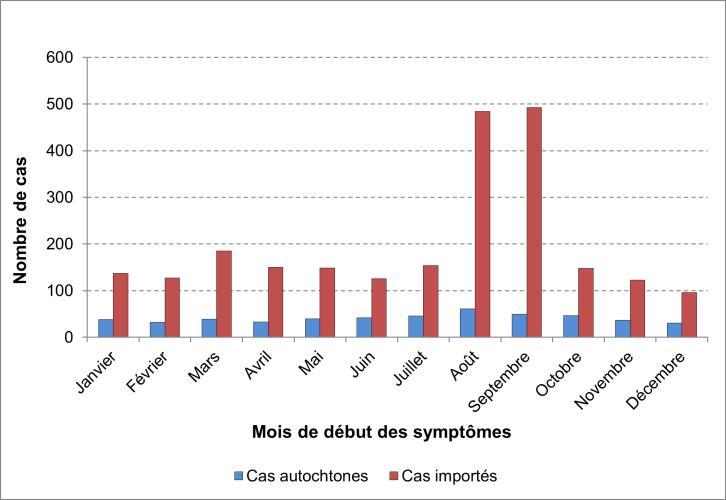
There is a peak in imported cases of typhoid and paratyphoid fever during August and September, coinciding with periods of population movement, particularly tourism, whereas the distribution of locally acquired cases remains stable throughout the year (Figure 4).
The predominantly imported nature of typhoid fever, which occurs in more than 90% of cases among unvaccinated individuals, underscores the importance of recommendations for travelers planning to stay in endemic areas, particularly regarding vaccination against typhoid fever and the practice of personal and food hygiene measures.
Figure 4: Distribution of reported cases of typhoid and paratyphoid fever among residents of metropolitan France, by month of symptom onset and by whether the cases were locally acquired or imported — 1999–2025
The Unique Situation in Mayotte
Given the lack of adequate access to drinking water and sanitation, typhoid fever remains an endemic disease in Mayotte. Since the 2020s, the number of reported typhoid fever cases in Mayotte has accounted for nearly 40 to 50 percent of all reported cases in France.
Clusters of cases are regularly identified, most often linked to inadequate sanitation and access to safe drinking water.
Learn more

bulletin régional
11 April 2025
Epidemiological Update, April 16, 2018
In relation to

Vaccination
thematic dossier
Contagious diseases most often affect children at a very young age. Because children are particularly vulnerable, they are a priority target for vaccination programs.