

What Is the Relationship Between Nutri-Score and Price? A Descriptive Analysis by Product Category
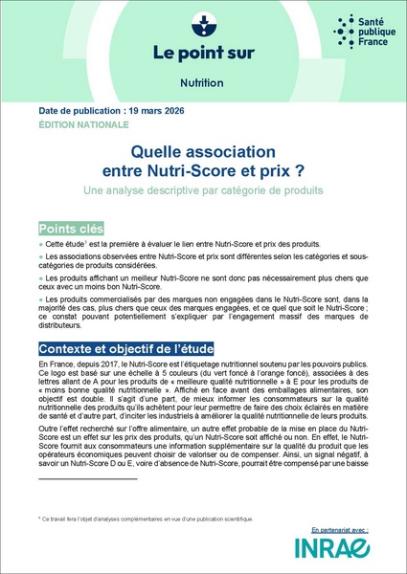
In France, since 2017, Nutri-Score has been the nutrition labeling system endorsed by the government. This logo is based on a 5-color scale (from dark green to dark orange), combined with letters ranging from A for products of “the highest nutritional quality” to E for products of “the lowest nutritional quality.” Displayed on the front of food packaging, it serves a dual purpose. On the one hand, it aims to better inform consumers about the nutritional quality of the products they buy, enabling them to make informed health choices; on the other hand, it aims to encourage manufacturers to improve the nutritional quality of their products. In addition to the intended effect on the food supply, another likely effect of implementing the Nutri-Score is an impact on product prices, regardless of whether a Nutri-Score is displayed. Indeed, the Nutri-Score provides consumers with additional information about a product’s quality, which food businesses may choose to highlight or offset. Thus, a negative signal—namely, a Nutri-Score of D or E, or even the absence of a Nutri-Score—could be offset by a price reduction, whereas a positive signal, such as a Nutri-Score of A or B, could result in a price increase. Furthermore, potential reformulation efforts encouraged by the widespread use of Nutri-Score could lead to an increase in the product’s manufacturing costs (for example, through higher costs associated with changing production processes and raw materials) and thus affect prices. Thus, it is possible that products with a higher Nutri-Score could be, on average, more expensive, while those with a lower Nutri-Score could be cheaper, compared to products of equivalent quality without a Nutri-Score. This perception was also reported by consumers in a previous qualitative study conducted by Santé publique France (Ducrot, 2024). However, to the best of our knowledge, no study to date has assessed the link between Nutri-Score and product price. The objective of this study is to examine whether there is a relationship between Nutri-Score and product price within the French market. Our hypothesis, based on both consumer perceptions and the market operators’ strategies described above, is that operators reflect a signal of higher nutritional quality through a higher price, or conversely, compensate for a signal of lower nutritional quality with a lower price. Thus, on average, products rated A or B would be sold at a higher price than those rated D or E, or than those without a Nutri-Score. Given the potential impact of these price differences on social inequalities in health, this study aims to provide insights into the validity of this hypothesis and to determine whether or not it holds true for certain product categories.
Author(s): Ducrot Pauline, Serry Anne-Juliette, Allais Olivier
Publishing year: 2026
Pages: 33 p.
Collection: An Update on
In relation to
Our latest news

news
Winter Illnesses: A Dynamic and Accessible Way to Track the Spread of...

news
SIBCA 2026: The UrBaCS network presents its solutions for cities and...

news