


Zika in the Caribbean and French Guiana: Santé publique France provides an update on the emergence of the virus
Santé publique France has published a health surveillance bulletin on the emergence of the Zika virus in the French West Indies and French Guiana, drawing on numerous epidemiological, clinical, entomological, and sociological studies conducted on the subject, as well as on the surveillance and management measures that have been implemented.
Access the health watch bulletin
Since late 2015, the Zika virus has been responsible for an outbreak that has spread across the Americas and the Caribbean. The French territories in the Americas (Martinique, Guadeloupe, Saint Martin, Saint Barthélemy, and French Guiana) have also been affected. The World Health Organization declared Zika a public health emergency of international concern on February 1, 2016, a status that remained in effect until November 18, 2016.
In response to the emergence of this virus, Santé publique France established a dedicated surveillance system in May 2015 in the French departments of the Americas, the Indian Ocean, and mainland France.
In the French West Indies and French Guiana
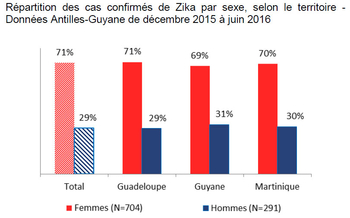
From late December 2015 to late September 2016, more than 76,000 clinical consultations suggestive of Zika were estimated (36,600 in Guadeloupe, Saint Martin, and Saint Barthélemy; 30,500 in Martinique; 9,700 in French Guiana). To date, surveillance continues in collaboration with healthcare professionals to identify Zika-related complications.
In mainland France
In mainland France, 30 departments are infested with the Aedes albopictus mosquito. Enhanced surveillance during the active season is implemented annually from May 1 to November 30.
Between January 1 and December 22, 2016, Zika virus infection was biologically confirmed in 1,117 people, including 58 pregnant women and 5 cases of neurological complications. More than 84% of imported cases originated from a French territory in the Americas. No cases of local vector-borne transmission were identified. Twelve cases of sexual transmission of the virus have been confirmed.
Zika is a disease caused by a virus (arbovirus) that is transmitted primarily by mosquitoes (of the genus Aedes, including Aedes aegypti and Aedes albopictus) and through sexual contact. Symptoms include a rash with or without fever, as well as conjunctivitis, headaches, fatigue, muscle and joint pain, and retro-orbital pain.