

World Diabetes Day, November 14, 2020
Santé publique France has released new regional and departmental indicators on diabetes in France for 2019 and trends since 2010 through its Géodes mapping observatory.

Diabetes
thematic dossier
Diabetes mellitus is a metabolic disorder characterized by chronic hyperglycemia resulting from a deficiency in either insulin secretion, insulin action, or both.
New diabetes monitoring indicators tailored to local communities
To mark World Diabetes Day, Santé publique France is making available on Géodes the prevalence rates of pharmacologically treated diabetes from 2010 to 2019, at the departmental level. New indicators regarding the occurrence of diabetes-related complications and the frequency of recommended screening tests are also available for the years 2010, 2013, 2016, and 2019, at the regional level.
The set of indicators available on Géodes provides an overview of the diabetes situation in France in 2019, its evolution since 2010, and the regional disparities that remain significant.
Key Statistics and Findings on Diabetes in France
Diabetes: A Disease on the Rise
Approximately 3.5 million people were receiving medication for diabetes in France in 2019, representing 5.2% of the population
Diabetes is more common among men than women, with the exception of overseas territories, where women are the most affected
There are significant regional disparities, with a very high prevalence of diabetes:
very high in the overseas departments and in Seine-Saint-Denis
high in the Val d’Oise and northeastern departments of mainland France
low in the western departments, particularly in Brittany
Crude prevalence rate of pharmacologically treated diabetes (all types) – men and women
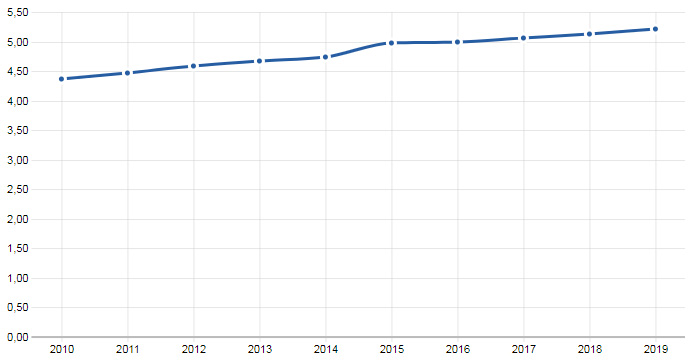
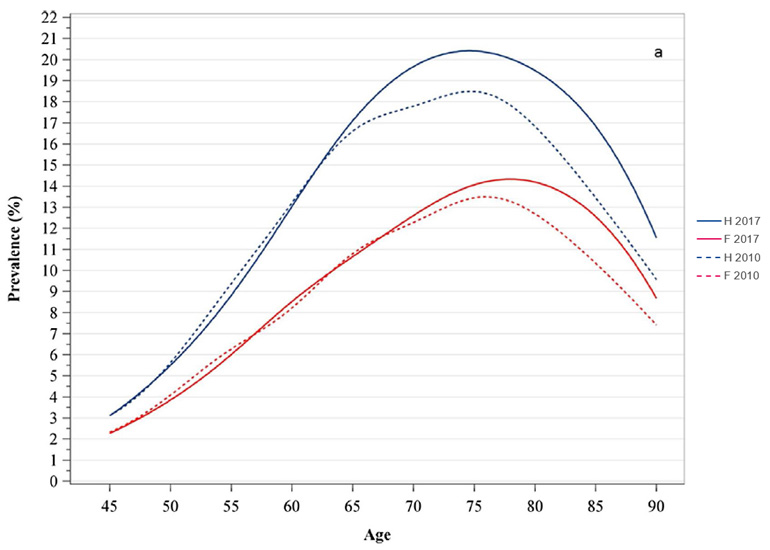
A recent study¹ published in 2019 reports a 0.9% annual increase in the prevalence of medication-treated diabetes among men and a 0.4% annual increase among women over the 2010–2017 period. Furthermore, our indicators, available on Géodes, show that this moderate increase continued between 2017 and 2019. The study also shows a decrease in incidence (number of new cases per year): -2.6% among men and -3.9% among women from 2012 to 2017. This trend was observed across all age groups among those over 45.
Trends in the prevalence of medication-treated diabetes between 2012 and 2017 in France among adults aged 45 and older, by sex
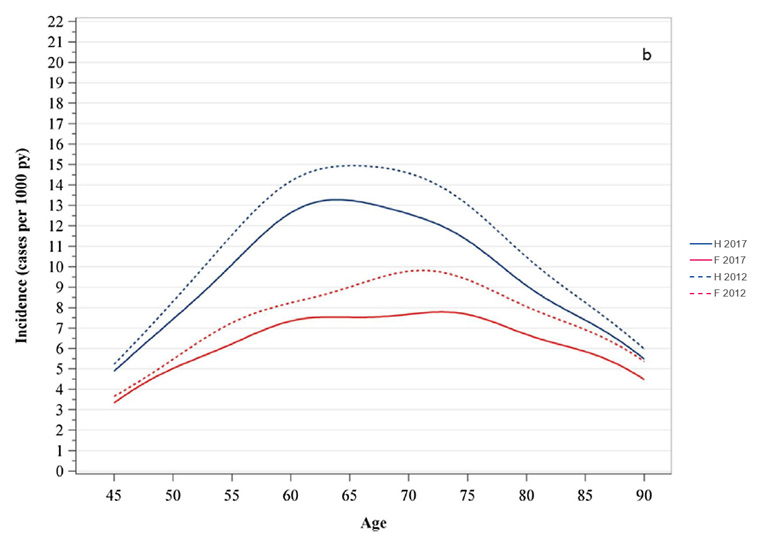
Changes in the prevalence of medication-treated diabetes between 2010 and 2017 in France among adults aged 45 and older, by sex
In addition to diabetes treated with medication, it is important to note that a significant proportion of people with diabetes are also managed through lifestyle changes (adopting a more balanced diet and increasing physical activity)—a necessary prerequisite for medication—and that some people with diabetes remain undiagnosed. In 2014–2016, the Esteban2 survey found a prevalence of non-medicated diabetes of 1.2% among adults aged 18 to 74 living in mainland France and 1.7% who were unaware of their diabetes. Among all individuals identified as having diabetes in this survey, 23% were unaware of their condition.
Diabetes-related complications remain common but are stabilizing
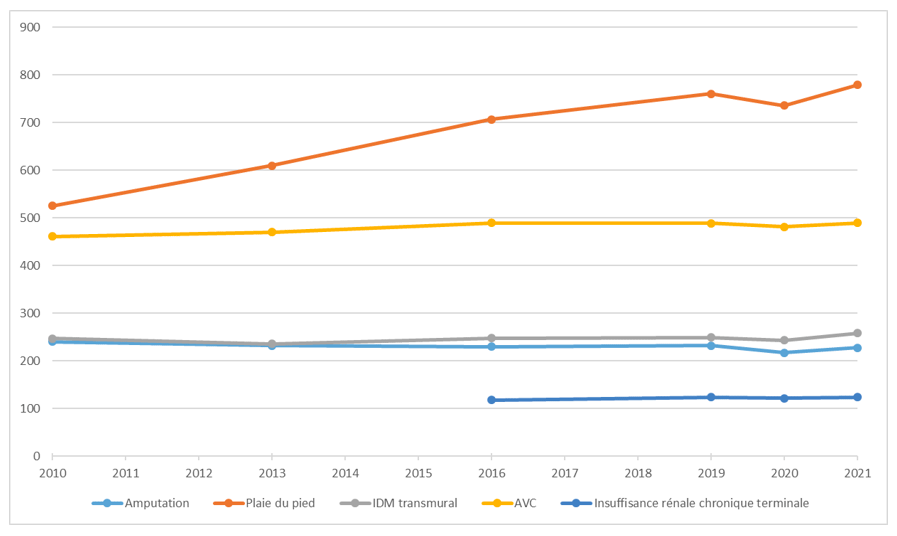
In 2019, chronic complications related to diabetes remained very common, with marked regional disparities. The incidence of lower limb amputations and transmural myocardial infarctions has remained relatively stable since 2010. The incidence of strokes, which increased during the 2010–2016 period, has stabilized since 2016. Hospitalizations for foot ulcers continue to rise. It is important to note, however, that while foot ulcers are a serious complication of diabetes, early treatment—potentially during hospitalization—can prevent the condition from worsening, which could lead to amputation.
Trends in the incidence of hospitalizations for diabetes-related complications in France between 2010 and 2021
The rate at which recommended screenings are performed has been rising slightly since 2016
The 2004 Public Health Act recommended that by 2008, 80% of people with diabetes receive all the recommended tests for diabetes management. This management is guided by the care pathway recommendations established by the French National Authority for Health.
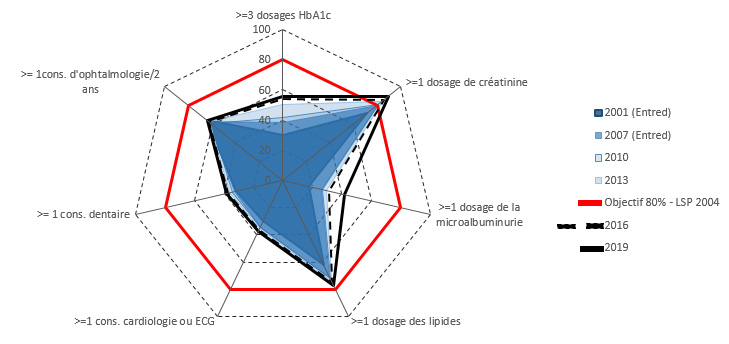
While the frequency of annual creatinine testing exceeded this 80% threshold, other tests still did not reach it in 2019.
Frequency of lipid testing is on the rise (+2 percentage points since 2016) and approaching the threshold (77% in 2019)
The frequency of the three annual HbA1c tests stood at 56% in 2019 (+2 percentage points since 2016)
Significant increase in microalbuminuria (more than 10 percentage points between 2016 and 2019, reaching nearly 42%) with regional variability in testing rates, particularly in Réunion, where the testing rate reached 59%.
The indicators for the performance of recommended tests available on Géodes reflect the efforts made over the past several years, but also highlight the work that remains to be done to ensure that as many people with diabetes as possible receive follow-up care in accordance with recommendations.
Proportion of people with diabetes receiving pharmacological treatment who underwent the recommended follow-up tests in private practice, France as a whole, 2001–2019
Diabetes and Continuity of Care: A Health Challenge in the Face of COVID-19
Santé publique France emphasizes the importance for people with diabetes to protect themselves against COVID-19 by adhering to physical distancing measures and practicing preventive hygiene. Indeed, people with uncontrolled diabetes or diabetes-related complications are at higher risk of developing severe COVID-19. In this context, clinical and laboratory monitoring of diabetes is essential.
It helps maintain better blood sugar control, which can otherwise be compromised during periods of lockdown. Indeed, reduced physical activity, poor dietary habits, and anxiety caused by lockdown can affect blood sugar control. Clinical and laboratory monitoring also enables early diagnosis and management of complications. It is therefore essential during this pandemic not to delay this care and not to hesitate to contact your doctor.
See also:
COVID-19 and Continuity of Care - Continuing Treatment: A Public Health Imperative (press release dated May 7, 2020)
COVID-19: Health Challenges
1 Is the type 2 diabetes epidemic plateauing in France? A nationwide population-based study. Fuentes S, Mandereau-Bruno L, Regnault N, Bernillon P, Bonaldi C, Cosson E, Fosse-Edorh S. Diabetes Metab. 2020 Jan 7:S1262-3636(20)30001-X. doi: 10.1016/j.diabet.2019.12.006.
2 Prevalence of prediabetes and undiagnosed type 2 diabetes in France: Results from the national ESTEBAN survey, 2014–2016, Grégory Lailler, Clara Piffaretti, Sonsoles Fuentes, Hadja Djessira Nabe, Amivi Oleko, Emmanuel Cosson, Sandrine Fosse-Edorh, Diabetes Research and Clinical Practice, Volume 165, 2020, 108252, ISSN 0168-8227, https://doi.org/10.1016/j.diabres.2020.108252.
Eat and Move
Visit mangerbouger.fr for comprehensive information on nutrition, tools and tips to help you eat better and be more active, as well as a wide variety of recipes.