
thematic dossier
Vector-borne diseases
Les maladies à transmission vectorielle sont des maladies infectieuses transmises par des vecteurs, essentiellement insectes et acariens hématophages. Santé publique France participe à leur...




Tick season in France runs from spring to fall, during which time ticks are active and therefore pose a potential risk of transmitting diseases to humans and animals. Among these diseases, Lyme disease is the most common. However, cases of tick-borne encephalitis are also diagnosed in mainland France, and the emerging threat of Crimean-Congo hemorrhagic fever also requires increased vigilance.
thematic dossier
Les maladies à transmission vectorielle sont des maladies infectieuses transmises par des vecteurs, essentiellement insectes et acariens hématophages. Santé publique France participe à leur...
The tick season in France runs from March to November. Found primarily in relatively humid areas such as forests, but also in fields, meadows, and gardens, these ticks are major vectors of pathogens (bacteria, viruses, parasites) that cause infectious diseases in humans and animals.
Diseases transmitted by ticks can be bacterial, viral, or parasitic in origin. They are transmitted when ticks feed on the blood of the animals or humans to which they attach themselves. Ticks can become infected by absorbing pathogens present in infected hosts. When they feed on blood again, they transmit these pathogens. Acting as "vectors," ticks primarily transmit these pathogens through their saliva during the bite, making them major vectors for the spread of animal and human diseases.
In France, the most common human disease transmitted by Ixodes ricinus ticks is Lyme borreliosis (or Lyme disease). It is caused by a bacterium of the genus Borrelia burgdorferi sensu lato, which is present throughout France.
In 2023, nearly 39,000 cases were diagnosed in primary care, representing an incidence of 59 cases per 100,000 inhabitants. There is significant regional variation, with cases being more frequent in the East and Center (Alsace, Lorraine, Limousin, among others) compared to the West and the Mediterranean South.
Tick-borne encephalitis is an infection that affects the central nervous system and can lead to neurological sequelae lasting several years in 40% of cases. The virus is transmitted to humans through the bite of Ixodes ricinus ticks in wooded and humid areas. More rarely, infection can occur through the consumption of raw milk or raw milk cheese from infected animals, primarily goats or sheep.
The Eastern regions and Auvergne-Rhône-Alpes are particularly affected. Haute-Savoie has reported the highest number of cases over the past two years, although recognition of the virus’s circulation there is more recent than in Alsace. The Auvergne-Rhône-Alpes region is also a major area of virus circulation, and the departments bordering it to the south and west require increased vigilance due to the risk of the virus’s circulation area expanding.
In 2023, 39 cases of tick-borne encephalitis virus infection were reported through mandatory reporting to Santé publique France.
Crimean-Congo hemorrhagic fever (CCHF) is an infection caused by a virus (Crimean-Congo hemorrhagic fever virus) transmitted by a tick of the genus Hyalomma or through the fresh blood of an infected and viremic animal or the bodily fluids of an infected and viremic human. The disease is characterized by fever, chills, digestive problems, and, in rare cases, a hemorrhagic illness with uncontrolled bleeding that can lead to death. CCHF is endemic in certain countries in Africa, Asia, and the Middle East, and, over the past decade, a few indigenous cases have been diagnosed in Spain.
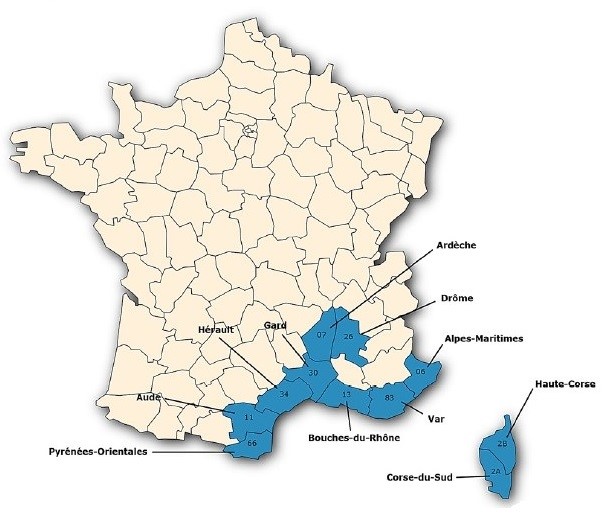
No human cases have been diagnosed in France to date. However, the risk of infection within the country is possible because Hyalomma ticks found to be infected with the Crimean-Congo hemorrhagic fever virus are present in several departments in southern France.
Learn more

article
21 February 2022
Although small in size, ticks are hard to spot. When walking in the woods, in meadows, or while gardening, here are a few tips to help protect yourself from bites:
Cover up by wearing long sleeves and pants, a hat, and tucking your pant legs into your socks;
stay on the trails and avoid brush, ferns, and tall grass;
use skin repellents.
When returning home after a walk in the woods or meadows, or after gardening, it is advisable to:
examine yourself and carefully check your entire body;
if bitten, remove the tick(s) as quickly as possible using a tick remover or, if unavailable, fine-tipped tweezers.
Brochures and prevention materials are available to healthcare professionals and the general public to improve awareness of tick-borne diseases. Materials have also been created for children to teach them preventive measures against tick bites from a young age.
Download:
Information and prevention resources on Crimean-Congo hemorrhagic fever
Advice from ‘Prudence’: the anti-tick strategy (information leaflet for children)
Prudence’s advice: tick prevention tactics (poster for children)
In France, surveillance of Crimean-Congo hemorrhagic fever and tick-borne encephalitis relies on clinical, virological, and epidemiological data collected through mandatory reporting. Mandatory reporting involves gathering, for certain diseases known as “notifiable diseases,” as comprehensive information as possible regarding cases from laboratory technicians and physicians.
Lyme disease is not a notifiable disease. However, Santé publique France coordinates surveillance of the disease nationwide and relies on several partners for this purpose, notably the Sentinelles network and the National Reference Center for Borrelia. Annual surveillance data are based on cases diagnosed in primary care and in hospitals; these data make it possible to describe the different forms of the disease and track trends.
Learn more:
With the free smartphone app “Tick Report,” available at https://www.citique.fr/signalement-tique/, you can report tick bites, whether they are found on a person or an animal.

thematic dossier
Lyme borreliosis, or Lyme disease, is an infectious disease caused by bacteria of the Borrelia burgdorferi sensu lato complex, which is transmitted to humans through the bites of infected ticks.

thematic dossier
Tick-borne encephalitis is transmitted to humans through the bite of a tick carrying the virus. The primary preventive measure involves protecting oneself against tick bites. In addition, vaccines...