



Tetanus in France: 2020 Epidemiological Data
Santé publique France has released an update on tetanus surveillance data in France through 2020.

Tetanus
thematic dossier
Tetanus is a serious, acute, noncontagious infection that is often fatal and usually requires hospitalization in an intensive care unit. Vaccination, along with the administration of...
Tetanus is a serious, acute, non-contagious infection that is often fatal and usually requires hospitalization in an intensive care unit. It is caused by exotoxins produced by a Gram-positive anaerobic bacillus, a bacterium called Clostridium tetani, which is naturally present in soil. Infection can occur through any minor injury, cut, or wound. Generalized tetanus is a notifiable disease in France. Vaccination, along with the administration of immunoglobulins in the event of an injury, is the only possible prevention.
Due to the widespread use of tetanus vaccination, tetanus infections have become very rare in France and throughout industrialized countries, but have not completely disappeared. Thus, the disease primarily affects elderly people who are unvaccinated or have incomplete vaccination.
However, it can affect anyone whose vaccinations are not up to date; thus, over the past 10 years, three cases have been reported in children aged 3 to 8 at the time of illness who had not been vaccinated, despite being born in France—a country where primary vaccination has been mandatory since 1940.
Key Points
In France, between 2011 and 2020, there were between 1 and 10 reported cases of tetanus per year. This represents an average annual incidence of between 0.01 and 0.15 cases per million inhabitants over this period.
The disease primarily affects the oldest age groups in the population: between 2011 and 2020, 70% of the 52 reported cases were 70 years of age or older. The average annual incidence rate (per million inhabitants) of tetanus infection thus increases with age. It is 0.76 for those aged 80 and older and 0.20 for those aged 70 to 79.
Furthermore, this incidence rate is higher among women (0.33) than among men (0.06).
Finally, it is also observed that between 2011 and 2020, the overall case-fatality rate was 27% over the period, and that it was higher among those aged 70 and older (33%) compared to those under 70 (8%).
Figure - Tetanus in France from 1960 to 2021: Annual reported cases and deaths
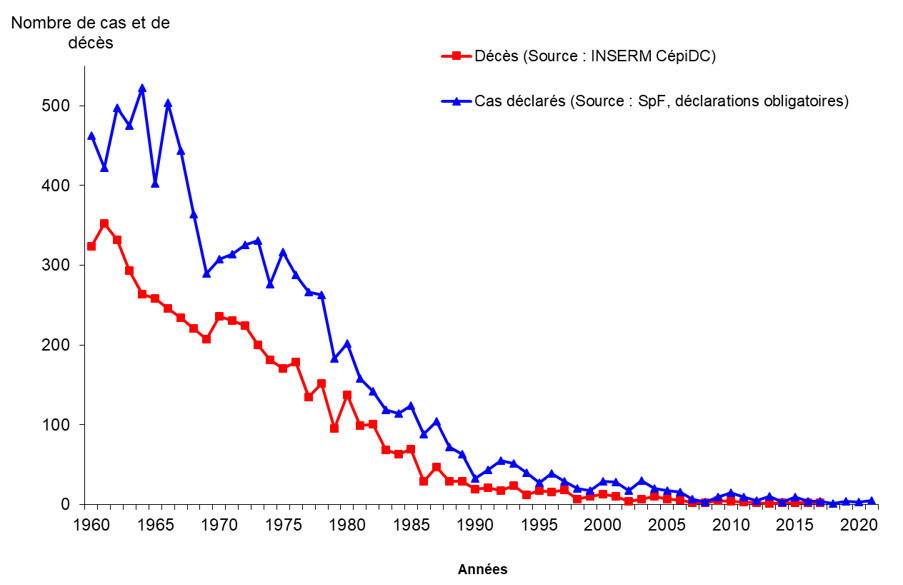
Table - Number of reported tetanus cases* and incidence rate, France as a whole, 2012–2021
| Women | Men | Total | ||||
|---|---|---|---|---|---|---|
| Age groups | Number of cases | Average annual incidence rate (per million) | Number of cases | Average annual incidence rate (per million) | Number of cases | Average annual incidence rate (per million) |
| 0–49 years | 0 | 0 | 3 | 0.01 | 3 | 0.01 |
| 50–59 years | 3 | 0.07 | 3 | 0.07 | 6 | 0.07 |
| 60–69 years | 1 | 0.03 | 3 | 0.09 | 3 | 0.06 |
| 70–79 years | 4 | 0.14 | 3 | 0.13 | 10 | 0.14 |
| 80 years or older | 24 | 0.99 | 4 | 0.31 | 30 | 0.75 |
| TOTAL | 32 | 0.09 | 16 | 0.05 | 52 | 0.07 |
Source: DO, Santé publique France. * Five additional cases (not included in the table) were reported in Mayotte among Comorian nationals. These cases involved four children aged 3 to 8 and a 20-year-old man, all unvaccinated, who had recently arrived in Mayotte or were transferred to the Mamoudzou Hospital after symptoms appeared. All recovered without complications.
Reminder - Tetanus Vaccination
Santé publique France reminds the public that tetanus infection is prevented through vaccination, which has been mandatory in France for all infants since 1940. The vaccine has been in use for over 70 years and has demonstrated near-perfect efficacy and safety.
Thus, for infants and children, the vaccination schedule calls for an initial series consisting of two doses of the combined vaccine administered two months apart, at 2 and 4 months of age, followed by a booster dose at 11 months of age. This initial series is mandatory for children.
Subsequent boosters should be given at age 6 and then between ages 11 and 13. In adulthood, boosters are administered at ages 25, 45, and 65, and then every 10 years (at ages 75, 85, 95, etc.) to account for immunosenescence.
For unvaccinated adults, the primary vaccination series consists of 2 doses 2 months apart, with a booster 8 to 12 months later, followed by resumption of the vaccination schedule according to age, maintaining a minimum interval of 5 years from the last dose administered.
Since tetanus is not a disease transmitted from person to person, high vaccination coverage in the population does not protect those who are unvaccinated or inadequately vaccinated. Only a complete individual vaccination series (including boosters) protects against infection.
Vaccination Information Service
What are vaccines for? How do they work? At what age should children be vaccinated? Vaccination-info-service.fr answers the most frequently asked questions about vaccination. A separate...

Vaccination
thematic dossier
Contagious diseases most often affect children at a very young age. Because children are particularly vulnerable, they are a priority target for vaccination programs.