Social Marketing: From Understanding Audiences to Changing Behavior
To mark the publication of the book *Social Marketing: From Understanding Audiences to Changing Behavior* in November 2019, read this joint interview with the authors, Karine Gallopel-Morvan and Viêt Nguyen Thanh.
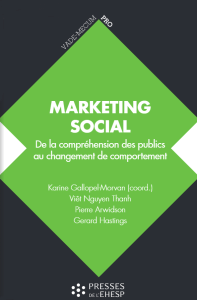
What is social marketing? What are its principles and tools? What do the 5 Cs mean? How can a social marketing campaign effectively change behaviors that promote individuals’ well-being and/or health?...
To answer these questions, the book *Social Marketing: From Understanding Audiences to Behavior Change*, co-authored by numerous professionals from Santé publique France, is illustrated with practical advice and examples of social marketing initiatives led by Santé publique France on topics such as diet and physical activity, sexual health, vaccination, and addictive behaviors...
Who initiated this project for a practical and educational handbook on social marketing?
VNT - The co-authors of this book have known each other for a long time (more than 10 years for most of them). We have discussed on numerous occasions the value of writing a book on social marketing in France. It is a project we have been considering for several years, and we began writing it in 2019.
This is the first book in French on this topic. How was this need identified?
KGM - Our desire to write this book stemmed from three observations: 1/ social marketing is little known in France; 2/ there was no book on this subject in French; 3/ we are very regularly asked to speak at conferences and/or teach courses on social marketing. These various reasons prompted us to write a joint EHESP–Santé publique France book.
How would you define social marketing, and more importantly, what do you consider its primary purpose to be?
VNT - As the subtitle of our book indicates, social marketing begins with an understanding of target audiences and employs various tools and techniques to bring about behavioral change. The combination of the terms “marketing” and “social” (which may seem like an oxymoron) originated in the 1970s in the United States.
This book illustrates three priorities of Santé publique France: acting at the forefront of science for prevention, promoting methods and success stories for public health, and collaborating with leading public health schools.
Social marketing essentially involves using commercial marketing techniques to encourage behaviors that promote individuals’ well-being and/or health. To achieve this, social marketing relies on segmentation, branding, and the “5Cs”: proposing a Behavior (and tools to facilitate its adoption) that promotes health and/or well-being; minimizing the Costs of adopting this behavior; fostering the Capacity to access this behavior; promoting this behavior through appropriate Communication; working with Collaborators or partners to disseminate the behavior in the living environments of the target audiences.
What are the major successes of social marketing in public health?
KGM - Abroad, numerous campaigns have relied on social marketing: Truth, developed by the American Legacy Foundation, whose goal was to encourage adolescents (ages 12–17) not to start smoking or to quit; Verb, designed in the United States by the Centers for Disease Control (CDC) to promote daily physical activity among adolescents aged 9 to 13.
In France, we can of course cite the “Mois sans tabac” initiative, launched in 2016 by Santé publique France, which has proven effective in encouraging people to quit smoking. To stick with “home-grown” examples, we can also mention initiatives such as Chlamyweb, designed to encourage young people to get tested for chlamydia, which will soon be rolled out nationwide. Or the Nutri-Score support program, which enjoys over 80% brand awareness two years after its launch.
Which professionals are already using social marketing, and in your opinion, who would benefit from using it?
VNT - Internationally, health organizations have been using social marketing for several years: the Institut national de santé publique du Québec, the CDC in the United States, etc. Similarly, the WHO is rolling out COMBI (Communication for Behavioral Impact) programs directly inspired by social marketing. The National Social Marketing Centre, established in 2006 in the United Kingdom, relies on this approach to develop its prevention programs. In France, social marketing is gaining recognition, which is reflected in the rollout of prevention programs based on this approach and/or the development of dedicated training programs.
On what other projects are Santé publique France and EHESP collaborating?
KGM - Research and training are the two main areas of collaboration between our organizations. We collaborate on specific research projects (particularly on tobacco and alcohol) and, for example, we co-organize the International Course in Applied Epidemiology (IDEA) with the support of the Pasteur School CNAM, CESPA, and the EPITER association.
Karine Gallopel-Morvan is a professor of social marketing at the School of Advanced Studies in Public Health. Viêt Nguyen Thanh is head of the Addictions Unit within the Directorate of Prevention and Health Promotion at Santé publique France. They are both authors of the book “Social Marketing: From Understanding Audiences to Behavior Change,” published in November 2019 and co-authored with Pierre Arwidson (Santé publique France) and Gerard Hastings (University of Stirling, Scotland).