


Outbreak of pediatric HUS caused by E. coli O26 in mainland France linked to the consumption of Saint Marcellin and Saint Félicien cheeses: update as of May 28, 2019
Santé publique France is currently investigating an increase in the number of children diagnosed with hemolytic uremic syndrome (HUS).
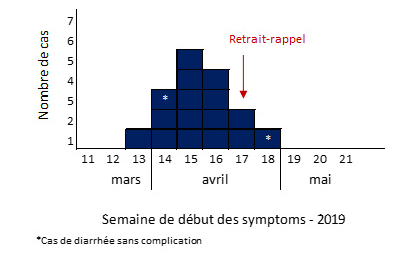
Between March 31 and April 29, 15 children and one adult infected with Escherichia coli serogroup O26, which shared the same characteristics in genomic analysis, were identified by the National Reference Center (CNR) for E. coli and its associated laboratories (Institut Pasteur, Paris, and the Microbiology Laboratory at Robert Debré Hospital, Paris). Fourteen children had HUS, and one child and one adult presented with uncomplicated diarrhea.
The 15 children infected with the epidemic strain of E. coli O26 are aged 6 months to 4 years and reside in 6 regions of metropolitan France. Investigations into food consumption, conducted by Santé publique France and the Directorate General for Food (DGAl), identified a possible link between the consumption of raw-milk Saint Marcellin and Saint Félicien cheeses and the onset of the illness.
In fact, the families of 15 out of 16 cases reported consuming these cheeses. For 13 families, a link to the same producer, the Alpine cheese dairy (Drôme), was identified. A recall of these Saint Marcellin and Saint Félicien cheeses was initiated on April 27, 2019 (DGAl).
DISTRIBUTION OF E. COLI O26 INFECTION CASES (EPIDEMIC STRAIN), BY WEEK OF SYMPTOM ONSET. FRANCE, MARCH–APRIL 2019 (N=16).
Week when symptoms began
The investigation is ongoing and consists of two parts:
an epidemiological component, which involves interviewing parents about their children’s dietary habits—specifically regarding the consumption of Saint Marcellin and/or Saint Félicien cheeses—and, if necessary, tracing the origin of these cheeses;
a microbiological component, which aims, through analyses at the CNR and its associated laboratory, to identify the strain that infected the child and to determine whether this strain shares characteristics with those identified among the 14 epidemic cases. These investigations are a long and complex process, and for some children, the strain responsible for the infection cannot be identified.
Surveillance of pediatric hemolytic uremic syndrome in France
HUS is a rare disease in France: between 100 and 160 cases are reported annually through the surveillance system. It is a serious disease, as it is the leading cause of acute kidney failure in children aged 1 month to 3 years. In the international literature, the mortality rate ranges from 3% to 5% (1% according to French surveillance data). This disease is most often caused by a bacterium belonging to the Escherichia coli family, some strains of which are more virulent and produce toxins called “shigatoxins.”
Contamination occurs:
by ingesting contaminated food consumed raw or undercooked: unpasteurized milk or dairy products, undercooked beef (especially ground beef), contaminated raw vegetables, contaminated drinking water;
by touching the mouth with soiled hands after handling animals carrying the bacteria or their contaminated environment;
through contact with an infected person who excretes the bacteria in their stool.
In France, surveillance of hemolytic uremic syndrome and infections caused by Shiga toxin-producing Escherichia coli relies on several surveillance systems that identify the vast majority of cases:
HUS surveillance in children under 15 years of age: since 1996, a network of volunteer pediatric nephrology departments has been reporting cases to Santé publique France;
the National Reference Center for E. coli;
mandatory reporting of foodborne outbreaks.
Each year, Santé publique France produces a report on HUS surveillance in children under 15 years of age. In 2017, 164 cases of pediatric HUS were reported to Santé publique France, and no outbreaks were identified.
Recommendations for preventing hemolytic uremic syndrome in children
Transmission of the disease can be prevented by taking the following precautions:
meat, especially ground beef, must be cooked thoroughly;
raw milk and cheeses made from raw milk should not be consumed by young children; choose hard, cooked cheeses (such as Emmental, Comté, etc.), processed cheese spreads, and cheeses made from pasteurized milk;
Vegetables, fruits, and herbs, particularly those to be eaten raw, must be thoroughly washed;
Raw foods must be stored separately from cooked or ready-to-eat foods;
Leftovers and prepared meals should be thoroughly reheated and consumed promptly;
Kitchen utensils (especially if they have previously come into contact with raw meat), as well as the countertop, must be thoroughly washed;
Hands must be washed systematically before preparing food and after using the restroom;
In the event of gastroenteritis, avoid swimming in public swimming areas and preparing meals;
Children should not drink untreated water (well water, streams, etc.) and should avoid swallowing it while swimming (lakes, ponds, etc.);
Finally, very young children (under 5 years old) should avoid contact with cows, calves, sheep, goats, deer, etc., and their environments
More information:
Summary of surveillance data by year