


Musculoskeletal Disorders in the Human Health and Social Work Sector: Understanding Risk Factors to Better Prevent Them
Santé publique France has published the results of a study on the exposure of workers in the human health and social services sector to certain risk factors for musculoskeletal disorders, and encourages occupational health and safety professionals to tailor prevention efforts to these populations, who are particularly affected by this issue.

Musculoskeletal disorders
thematic dossier
Musculoskeletal disorders primarily manifest as pain and functional impairment of varying severity, often occurring on a daily basis and caused or exacerbated by work
The human health and social services sector (SHAS), which encompasses all activities related to human health, social and medical-social housing, and non-residential social services, is particularly affected by musculoskeletal disorders (MSDs). MSDs account for more than 90% of occupational diseases reported in this sector, and up to 96% in the sub-sector of social services without accommodation1.
In this context, Santé publique France studied the exposure of SHAS employees to certain MSD risk factors, in collaboration with the Ester team (University of Angers – INSERM-LRSET). The prevalence of occupational exposure to biomechanical, psychosocial, and organizational stressors, as well as the prevalence of co-exposure to different types of stressors, were described for the various SHAS sub-sectors, based on data from the Sumer survey (2016–2017 edition).
Musculoskeletal Disorders in France
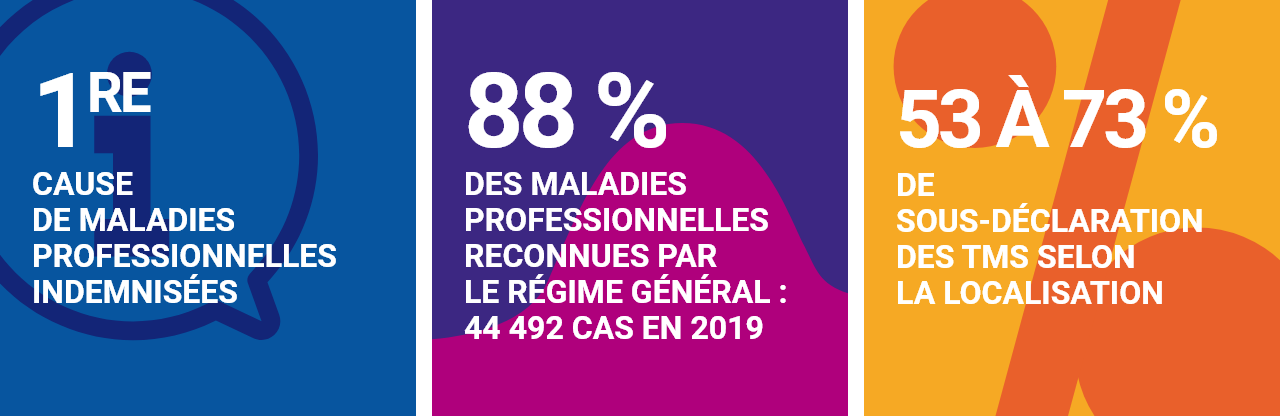
Musculoskeletal disorders are the leading cause of compensated occupational diseases, accounting for 88% of occupational diseases recognized by the general social security system: 44,492 cases in 2019.
Key statistics on musculoskeletal disorders
What are the key findings of the study, and what do they reveal?
Employees across the entire SHAS sector (2,927 employees surveyed) were more exposed to biomechanical and psychosocial stressors than employees in other sectors, but less exposed to work pace stressors. Nevertheless, there were significant disparities in exposure to these stressors depending on the subsector of activity.
SHAS employees were significantly more frequently exposed to two biomechanical risk factors for low back pain than employees in other sectors. Conversely, they were less frequently exposed to three risk factors for upper limb MSDs and to forced joint positions or kneeling.
Employees in the subsectors of social housing for the elderly or physically disabled and medical care facilities were most exposed to biomechanical stressors. They were particularly exposed to standing or repetitive walking, as well as walking while working, and to a lesser extent to twisting or squatting positions.
“Job strain” (corresponding to high psychological demands combined with low decision-making autonomy) primarily affected employees in the medical care facilities subsector, those in other social care activities, as well as activities involving medical specialists or hospital-based activities.
Employees at small facilities were less exposed to biomechanical, work pace, and psychosocial constraints than those at facilities with 500 or more employees (primarily hospitals and clinics).
Individuals on precarious contracts (fixed-term/temporary) were less exposed to work pace and psychosocial stressors than those on permanent contracts.
What lessons can be drawn from this study?
This research, which complements the description of MSDs identified as occupational diseases in this sector of activity³, encourages occupational health and safety professionals to focus prevention efforts particularly on employees in the subsectors of medical care facilities, other human health activities (primarily comprising human health activities not performed in hospitals or by physicians or dentists), social services for the elderly or people with disabilities (with or without residential care), the practice of medical specialists, and hospital activities.
Building on this work, Santé publique France is already continuing these studies on exposure to MSD risk factors in the construction sector, another sector particularly affected by MSDs.
Download

enquêtes/études
7 February 2022
Gaining a better understanding of the risk factors for musculoskeletal disorders among employees in the human health and social services sectors, in order to better address them. Sumer Study 2016–2017.
Santé publique France’s Role in the Surveillance and Prevention of Musculoskeletal Disorders
Monitoring musculoskeletal disorders and their trends
Monitoring occupational exposure to MSD risk factors and their trends to enable the adaptation of preventive measures
Monitoring the impact of MSDs on career trajectories and quality of life and its trends
Translating epidemiological knowledge into preventive actions
1 CNAM - Occupational Risk Division. 2018 Statistical Report on Work-Related Accidents and Occupational Diseases (CTN I) - Service Activities II [Internet]. Paris: CNAM - Occupational Risks Division; 2019 [cited 2021 Feb 10] p. 73. Report No.: 2019-206.
2 CNAM. 2019 Annual Report [Internet]. Paris: Health Insurance - Occupational Risks; 2020, p. 168.
3 Robert M, Delézire P, Homère J, Garras L, Fernet F, Boulanger G. Surveillance of Occupational Diseases. The Human Health and Social Services Sector in France. 2021. 18 p. Saint-Maurice: Santé publique France.