
thematic dossier
Vector-borne diseases
Les maladies à transmission vectorielle sont des maladies infectieuses transmises par des vecteurs, essentiellement insectes et acariens hématophages. Santé publique France participe à leur...




Santé publique France has released its annual surveillance data on Lyme disease. Although the incidence of this disease, which is transmitted to humans through bites from infected ticks, remains high in France, the estimated number of cases did not increase in 2019.

thematic dossier
Lyme borreliosis, or Lyme disease, is an infectious disease caused by bacteria of the Borrelia burgdorferi sensu lato complex, which is transmitted to humans through the bites of infected ticks.
An estimated 25,000 to 68,530 cases of Lyme disease diagnosed annually between 2009 and 2019.
Incidence decreased to 76 cases per 100,000 inhabitants (50,133 estimated cases) in 2019, despite a significant increase in mainland France observed between 2015 and 2016 (84 per 100,000 inhabitants) and then between 2017 and 2018 (104 cases per 100,000 inhabitants).
In 2019, 893 cases of Lyme disease were hospitalized in France. Between 2005 and 2019, the annual number of hospitalized cases diagnosed with Lyme disease ranged from 649 in 2005 to 945 in 2017, with an average of 850 hospitalized cases per year. The incidence rate of these hospitalizations fluctuated between 1.1 per 100,000 inhabitants in 2005 and 1.5 per 100,000 inhabitants in 2011 and 2017; it was 1.4 per 100,000 in 2019. During this period, a statistically significant upward trend was observed.
Hospitalizations for Lyme disease are more common between June and October.
The age groups most affected are children aged 5 to 9 and adults aged 70 to 79.
About half of hospitalized cases are associated with neurological symptoms (neuroborreliosis).
The annual incidence of hospitalizations for neuroborreliosis has remained stable since 2005 (between 0.5 and 0.8 per 100,000 inhabitants). In 2019, it was 0.7 per 100,000 inhabitants.
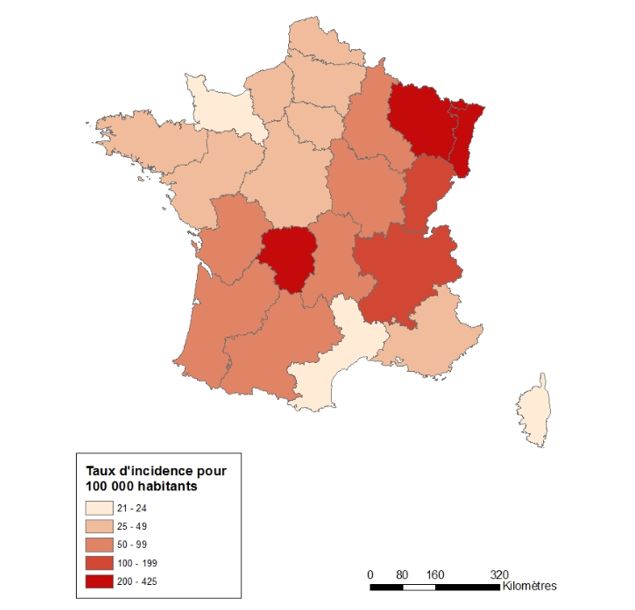
The data show significant regional variation in incidence rates for cases diagnosed in private practice:
The eastern and central regions of mainland France (notably Alsace, Lorraine, and Limousin) have high incidence rates (over 100 cases per 100,000 inhabitants)
The western regions and the southeastern Mediterranean region have low incidence rates (less than 50 per 100,000 inhabitants).
The same pattern is observed for hospitalizations, with higher annual incidence rates of hospitalized cases for Lyme borreliosis (more than 2 cases per 100,000 inhabitants) in eastern and central France.
Estimated average annual incidence rate of Lyme borreliosis by region, mainland France, 2015–2019, Sentinelles Network)
thematic dossier
Les maladies à transmission vectorielle sont des maladies infectieuses transmises par des vecteurs, essentiellement insectes et acariens hématophages. Santé publique France participe à leur...