


Heat Waves and Climate Change: A Review of the 2017 Heat Waves and Their Health Impacts
To mark the launch of the heat wave and health alert system on June 1 and in observance of World Environment Day, Santé publique France is releasing a national assessment of the health impacts of the 2017 heat waves, as well as a special issue of the Weekly Epidemiological Bulletin on the health impacts of heat in the context of climate change.

Heat waves are a directly measurable example of the health risks posed by climate change. Despite significant preventive measures under the national heat wave plan, health impacts are observed every year. Reducing these impacts while coping with more frequent heat waves is a challenge for public health, as it requires combining rapid preventive action during alerts with long-term interventions to make cities more resilient to heat.
"Recent heatwaves are more frequent, more intense, and occur at times or in regions that have never been affected before"
France experienced six heat episodes in 2017, including two notable heat waves, from June 17 to 24 and from July 31 to August 7: the first was notable for its early onset and widespread reach, the second for its intensity in the south. For the first time since the heat wave plan was implemented in 2004, all metropolitan departments were placed under a yellow or orange heat wave alert at least once during the summer.
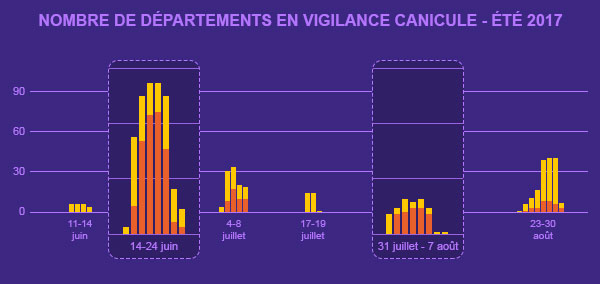
Key Figures for 2017 – Key Takeaways
Two peaks and four heat waves marked the summer of 2017
9 departments placed under an orange heat wave alert for the first time since the national heat wave plan was implemented
8,000 emergency room visits for heat-related causes, including 1,187 for children under 15 (during heat wave alerts)
2,760 SOS Médecins consultations for heat-related causes, including 921 involving children under 15 and 1,115 involving adults under 75 (during heatwave alerts)
474 excess deaths across all periods when alert thresholds were exceeded, representing a 5% increase in mortality compared to the same periods in previous years
10 workplace deaths potentially heat-related, including 7 during the June heatwave
500,000 prevention materials distributed across the country before summer, with communication efforts reinforced by radio and TV spots and poster campaigns during heat waves
DOWNLOAD THE 2017 HEAT WAVE REPORT
"In the coming years, the number and intensity of heat waves will continue to increase"
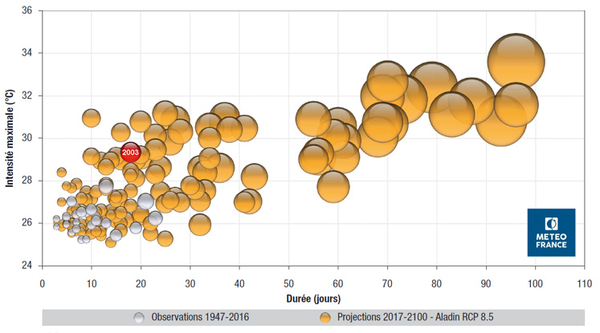
In the context of climate change, events as severe as the 2003 heatwave will occur with increasing frequency. If greenhouse gas emissions—which are responsible for rising temperatures—are not reduced, heatwaves that are more intense and last five times longer than the 2003 event could occur in France.
Heat waves observed in mainland France from 1947 to 2017 and projections for 2017–2100
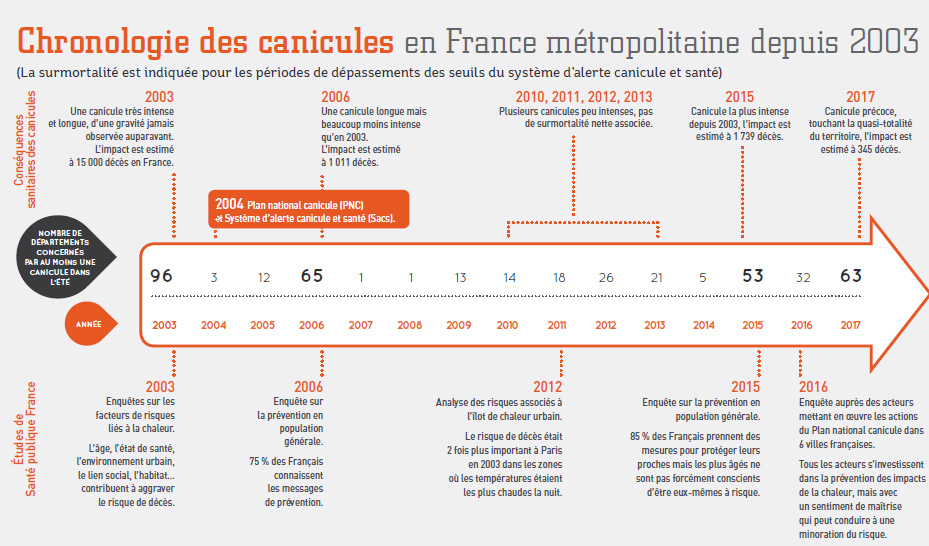
Nearly 200 heat waves identified over 10 years
Between 2004 and 2014, 196 heat waves were identified in the departments of mainland France. Several heat waves are observed each year, but 2006 stands out with 76 heat waves spread across 65 departments. That year, the Alpes-Maritimes and Rhône departments were the most affected, with 8 heat waves over a total of 42 days and 10 heat waves over 58 days, respectively. The longest heat waves lasted 12 days and were recorded in the departments of Landes, Rhône, Paris, Hauts-de-Seine, Seine-Saint-Denis, and Val-de-Marne. An excess mortality of 1,562 deaths was observed during periods when alert thresholds were strictly exceeded, with the majority occurring in 2006.
"Over the past three years, summers have exhibited new characteristics, particularly in terms of timing, geographic extent, and local heat records."
Between 2015 and 2017, heat waves occurred particularly early or late (June and September). Temperatures broke records locally, particularly in Corsica in 2017 and in the Grand-Est region in 2015. The number of excess deaths observed in 2015 was higher than in 2006 and was the highest since 2004. The heat waves of the summers from 2015 to 2017 are notable for their occurrence periods spanning June through September, their significant geographic extent, and their locally very high intensities. These changing patterns call for the development of prevention measures that better target exposure in school and workplace settings, and for strengthening these measures as soon as a yellow alert is issued.
LEARN MORE: ADAPTING TO HEAT IN THE CONTEXT OF CLIMATE CHANGE
How is health monitoring of heat wave impacts organized?
Since 2004, France has implemented a national heatwave plan designed to reduce the health impacts of heatwaves. This plan relies on the heatwave and health alert system managed by Santé publique France in collaboration with Météo-France, whose objective is to identify periods when heat poses a risk to a large portion of the population. These periods are then classified into different alert levels: yellow, orange, or red. Each day, the risk level is assessed by comparing meteorological forecasts with departmental alert thresholds, and an analysis of the situation is conducted by Météo-France, Santé publique France, and the prefects to best protect the population.
In the event of a yellow, orange, or red alert, Santé publique France implements health monitoring to quickly identify any unusual impacts in order to adapt the management measures to be implemented and describe the observed impacts. During alert periods, reports on the evolution of national and regional indicators are sent to health authorities, and a comprehensive report is produced at the end of the year.
Cities and Heat Waves: Reducing Urban Heat Islands in Urban Development Projects
An urban heat island is a phenomenon characterized by higher temperatures in cities than in rural areas, linked to the presence of buildings and artificial surfaces as well as intra-urban energy consumption.
The need to adapt cities to climate change to protect the health of city dwellers is becoming increasingly evident. Recommendations from the national consultation on the National Climate Change Adaptation Plan emphasize the need to better account for health impacts in the adaptation of cities and the built environment, and to develop tools to predict these impacts. To be effective, this prevention must combine emergency measures during heat waves with long-term interventions aimed at moderating urban temperatures. This is why some cities are incorporating heat island reduction into their urban planning projects by leveraging the thermal moderation provided by irrigated green spaces, which are seen as a promising approach to reducing local exposure to high temperatures.
Sharing experimental findings to identify best practices is a key avenue for progress in mitigating the effects of heat waves.
Learn more:
Understanding and preventing the health impacts of heat in the context of climate change. BEH No. 16-17.
Epidemiological Update - National Heat Wave Report, Summer 2017
Special Report: Health Impacts of Climate Change
Heat and Health Reports: Surveillance - Prevention












