

Heat Wave and Extreme Heat: Launch of the Seasonal Monitoring Initiative and Reminder of Precautions Everyone Should Take

Periods of extreme heat and heat waves can be dangerous to health, especially for those most at risk. Effective June 1, the national heat wave plan is in effect throughout the country. As it does every year, Santé publique France is implementing its seasonal monitoring program and reminding the public of preventive measures and steps to take during periods of extreme heat.

Fortes chaleurs, canicule

Extreme heat, heat wave

thematic dossier

Heat waves can have a significant impact on health. It is therefore essential to take proper precautions. Certain measures must be put in place, especially for those most at risk.

From June 1 to September 15, Santé publique France coordinates the Heat Wave and Health Alert System in close collaboration with Météo France. In this context, and during heat waves, Santé publique France monitors indicators of emergency care use that are likely to increase with rising temperatures and produces national and regional epidemiological summaries, in conjunction with the meteorological and health situation. A prevention initiative has also been launched in partnership with the Ministry of Health and Prevention, reminding the public of simple steps to take to mitigate the health impacts of extreme heat through various tools available to everyone.

Get real-time updates and learn about health recommendations to follow during heat waves via a toll-free number

For real-time information on weather conditions, you can consult the Météo-France alert map, which is updated at least twice a day at 6 a.m. and 4 p.m.: https://vigilance.meteofrance.fr/fr.

A "Heat Wave" information hotline, accessible at 0 800 06 66 66 (toll-free from a landline in France), is activated in the summer starting with the first heatwave by the Directorate General for Health (toll-free from a landline in France, from 9 a.m. to 7 p.m.) to answer questions and provide information on health recommendations to follow during periods of extreme heat.

Weather Watch Levels

Departmental weather forecasts are analyzed daily during the summer by Météo-France. The results of this analysis enable Météo-France to produce the weather watch map, which is released daily at 4 p.m.

  • The yellow alert level corresponds to two situations:

    • a heat wave: short-term exposure (1 or 2 days) to intense heat

    • a prolonged heat episode that remains below alert thresholds

Both of these situations pose a risk to human health, particularly for vulnerable or overexposed populations due to their working conditions or physical activity.

  • The orange alert level corresponds to a heatwave: a period of intense heat during which the 3-day average of night and day temperatures reaches or exceeds departmental thresholds, and which is likely to pose a health risk, particularly for vulnerable or overexposed individuals.

  • The red alert level corresponds to an extreme heat wave: a heat wave that is exceptional in terms of its duration, intensity, and geographic extent, with a significant health impact on all types of populations, and which may lead to secondary effects, particularly regarding business continuity.

A tailored prevention campaign to remind us that heat waves affect us all

Santé publique France is leading the prevention initiative, in collaboration with the Ministry of Health and Prevention, to raise public awareness based on alert levels.

The goal is to empower everyone to protect themselves against the risks associated with extreme heat and to provide information on precautions to take, tailored to individuals’ physiology, age, or specific exposure levels. This year, the initiative is designed to raise awareness that everyone is affected by heat waves and their potential consequences.

Visuel campagne fortes chaleur, canicules
  • A TV spot and a radio spot broadcast via media requisition in the event of a nationwide heat wave alert.

  • A targeted digital campaign: geolocated messages—via social media and text messages—sent to the most vulnerable individuals as soon as a department is placed on yellow alert.

  • Posters and leaflets outlining key preventive measures against the effects of heat, along with an educational description of the symptoms of dehydration and heatstroke to help people recognize them. Several informational posters for the general public in French, English, and Arabic are also available.

  • Two leaflets from the “Guidelines for Your Practice” collection are specifically intended for healthcare professionals to assist them in caring for their patients:

Simple tips and steps everyone can take to protect themselves from extreme heat

  • Drink water regularly without waiting until you’re thirsty

  • Cool off and wet your body (at least your face and forearms) several times a day

  • Avoid going outside during the hottest hours (11 a.m. to 9 p.m. during a heat wave)

  • Opt for low-effort activities during the hottest hours

  • Keep your home cool (close windows and shutters during the day; open them in the evening and at night if it’s cooler)

  • If your home cannot stay cool, spend several hours a day in a cool place (movie theater, public library, supermarket, museum, air-conditioned room, etc.)

  • Do not drink alcohol

  • Eat plenty of light, water-rich foods (fruits and vegetables)

  • Check in regularly with your loved ones, especially those who are most vulnerable

When driving and on long trips

  • Never leave anyone alone in a car, especially a child, even for a very short time, as the temperature inside the vehicle can rise very quickly. Likewise, never leave a pet alone in a car.

  • If possible, plan your trip for cooler times of the day.

  • Remember to bring plenty of water and a spray bottle with you on car trips.

  • Stop regularly to rest and cool off: some highway rest areas have water fountains or misting stations available for your use.

It is important to protect yourself and know what steps to take, even when heat waves are short-lived. These prevention tips apply to anyone exposed to extreme heat (workers in hot environments, athletes, etc.) and to vulnerable individuals (the elderly, people with disabilities, and those with chronic illnesses), who are at greater risk of developing complications.

Infants and children

  • Make sure to protect them from the heat at all times (avoid going out during the hottest hours of the day, and make sure they drink and stay cool regularly)

  • Never leave a child in a poorly ventilated room or a vehicle, even for a very short time

  • Be sure to bring enough water for any car trip

  • During cooler hours, when going out, have children wear a wide-brimmed hat, sunglasses, and light, covering clothing. Cool them down regularly: wet their clothes, and spray water on their face and exposed parts of the body using a spray bottle. Apply sunscreen suitable for children to exposed parts of the body to protect them from UV rays

  • Never expose babies under one year of age to the sun

Elderly

It is very important to protect yourself (or with the help of those around you) as much as possible from extreme heat:

  • Spend several hours a day in a cool or air-conditioned place if your home cannot be kept cool

  • Regularly wet your body to lower your body temperature (for example, by applying damp cloths or a wet washcloth to your face, arms, and neck) and by spraying water on your face...

  • Stay sufficiently hydrated while varying your fluid intake (water-rich fruits and vegetables, yogurt, sorbets, fruit juices…)

  • Eat enough (if necessary, by spreading out meals) to provide the body with the necessary minerals.

Athletes

  • Postpone physical activity until the coolest times of the day, or even until after the heat wave has passed

  • Regularly splash water on your face and neck

  • Stay hydrated very regularly—before you feel thirsty—before, during, and after exercise

  • Stay vigilant regarding your own well-being and that of other athletes

Workers

  • For workers most at risk, refer to the safety guidelines issued by the National Research and Safety Institute for the Prevention of Workplace Accidents and Occupational Diseases (INRS)

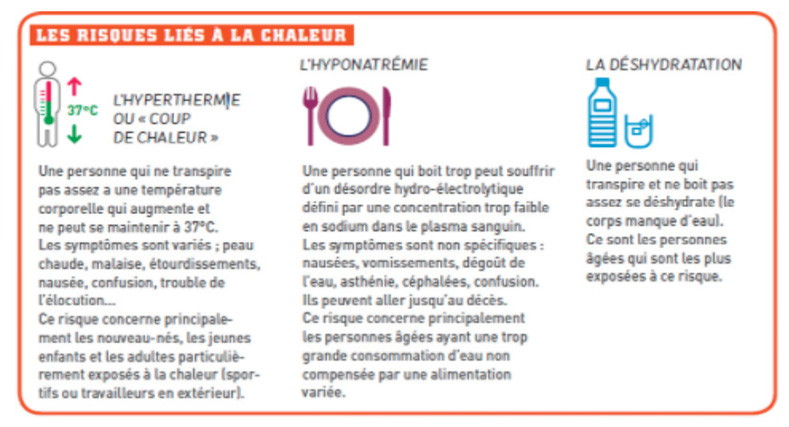
Heat-related risks: recognize the warning signs (cramps, unusual fatigue, nausea, vomiting, headaches, etc.) and take appropriate action

wide

If you experience hot flashes while drinking a glass of water, if you haven’t urinated in over 5 hours, or if your urine is dark: drink immediately, even if you aren’t thirsty.

If you feel relief when running water over your forearms: increase the moisture and ventilation of your skin.
Your body is beginning to suffer if you experience cramps, headaches, nausea, unusual fatigue... Move to a cool place, drink, stop all physical activity, splash yourself with water, and fan yourself if these signs appear after direct sun exposure. In any case, call a doctor if symptoms worsen or persist for more than an hour.

In case of an emergency, call 15 immediately.

Infographic: Heat-Related Risks

Schéma illustrant les risques liés à la chaleur : hyperthermie, hyponatrémie, déshydratation

UV

thematic dossier

Ultraviolet radiation, which is everywhere, is emitted naturally by the sun or by artificial sources. It is responsible for various health conditions, including certain types of skin cancer.