
Exposure to natural and artificial ultraviolet radiation: data from the 2015 Cancer Barometer
Whether natural (sunlight) or artificial (tanning beds and lamps), ultraviolet rays have both health benefits and harmful effects. What do the French know about and do regarding exposure to ultraviolet rays? This chapter of the 2015 Cancer Barometer assesses the French population’s sense of being informed and their perception of potential cancer risks, their protective behaviors regarding sun exposure, and, more generally, their opinions on sun-related risks.
In France, skin melanomas are among the most common cancers in young adults. They are one of the leading causes of death among people under 35. The increase in ultraviolet radiation observed in Europe does not appear to explain the rise in these melanomas. The role of recent behavioral changes linked to seeking earlier and more intense UV exposure could be one explanation for these trends. However, tanning—with or without sunburn—indicates excessive UV exposure and the body’s reaction to protect itself from damage, particularly to DNA. These messages do not yet seem to have been sufficiently internalized by the public.
Ultraviolet radiation is a major cause of skin cancer, sunburn, eye inflammation, and cataracts. The survey examined awareness of dangerous times for sun exposure, the use of tanning beds or lamps, preventive attitudes among adults as well as parents regarding their children’s sun exposure, and those of workers exposed to the sun…
"Skin Cancers: Little-Known Cancers, but a Relatively Vigilant Population"
For the first time, the Cancer Barometer includes questions on skin abnormalities (such as a new or changing mole) and concerns regarding melanoma screening, particularly the so-called “ABCDE” criteria (asymmetry, border, color, diameter, and evolution over time). Other questions (eye, skin, and hair color; photosensitivity during initial sun exposure; tendency to burn, get sunburned, or tan) were designed to determine the respondents’ phototype retrospectively (a skin type characterized by its color and sensitivity to the sun and classified from I to VI).
Key takeaways:
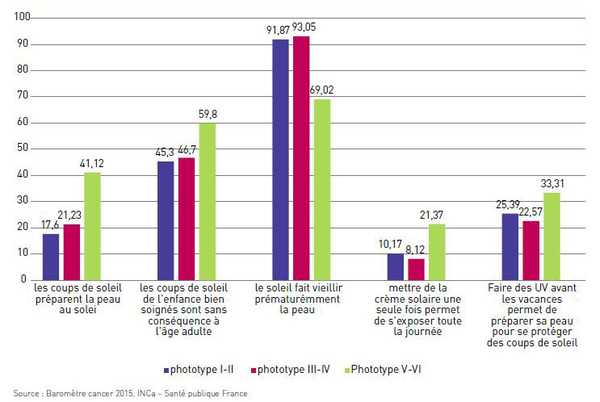
More than 9 out of 10 people are convinced that sun exposure is a likely cause of skin cancer and agree that the sun causes premature skin aging; the perception of being well-informed about the cancer risks associated with sun exposure is higher among executives and residents of coastal regions.
Misconceptions persist, particularly the belief that sunburns during childhood have no consequences in adulthood, or that “getting UV exposure before a vacation prepares the skin to protect against sunburn.” Users of artificial UV light also mistakenly claim that UV exposure in tanning beds is less harmful than the sun and are less likely to follow recommended prevention methods.
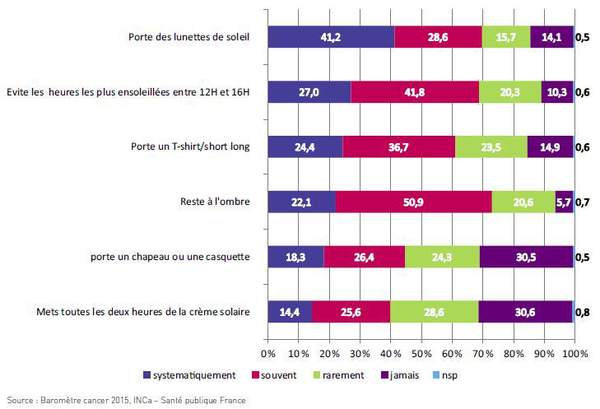
Among young people and adults, protection is not systematic: only 27.0% avoid the sunniest hours, 22.1% stay in the shade, 14.4% apply sunscreen every two hours, 24.4% wear a T-shirt or long shorts, 41.2% wear sunglasses, and 18.3% wear a hat or cap.
In contrast, parents tend to be more attentive to protecting their children: more than half of parents with children under 15 and 70% of parents with children under 4 report avoiding exposing them to the sun or protecting them with sunscreen, a T-shirt, and a hat.
Among the employed, 21.9% report having to work frequently or routinely in the sun (primarily men, individuals with a high school diploma or lower, farmers, or other self-employed professionals) and have greater difficulty using collective or individual protective measures.
The use of artificial ultraviolet light also involves users under 18, despite the ban on this practice for minors.
Opinions on the sun by phototype, among 15-75-year-olds who have never had cancer (in %)
Methods used to protect oneself on a sunny summer day among all 15- to 75-year-olds (N=3,931)
What are the recommendations for prevention?
In the context of global warming, skin cancers and other UV-induced conditions will continue to rise. Their prevention must therefore be comprehensive and designed for the long term. To reduce excessive UV exposure from an early age, prevention messages should be reinforced through national information campaigns, with a focus on expanding these messages (widespread dissemination of the UV index, and information on the lack of health benefits from tanning or using artificial UV light). These messages should be communicated as closely as possible to target populations, taking into account social and individual inequalities. Field initiatives tailored to specific exposure contexts should be promoted, while ensuring the creation of supportive environments (shaded areas in cities, schools, UV-filtered glass, etc.) and involving key stakeholders (healthcare professionals, school and after-school settings, associations, and managers and staff of tanning salons). The issue of preventing exposure in the workplace warrants a comprehensive reassessment tailored to the specific occupational sectors at risk, incorporating not only collective and individual protective measures but also organizational adjustments, alongside awareness-raising and informational campaigns targeting both employers and employees.
For more information
Ménard C, Thuret A. Cancer Barometer 2015. Ultraviolet Radiation, Natural or Artificial. Knowledge, Beliefs, and Practices of the Population in 2015. Saint-Maurice: Santé publique France, 2018. 46 p.