



Diabetes in France: 2020 Statistics
To mark World Diabetes Day on November 14, 2021, Santé publique France is releasing its annual data on diabetes surveillance in France and providing a new indicator on the incidence of type 1 diabetes in children at the regional level.

Diabetes
thematic dossier
Diabetes mellitus is a metabolic disorder characterized by chronic hyperglycemia resulting from a deficiency in either insulin secretion, insulin action, or both.
Every year, diabetes continues to rise, affecting millions of people. The surveillance program developed by Santé publique France aims to provide indicators on the prevalence, severity, and trends of diabetes in France. These data are released annually. To mark World Diabetes Day, Santé publique France is publishing updated diabetes surveillance data for 2020, also available on its Géodes platform (prevalence, complications, frequency of recommended follow-up tests). A new indicator on the incidence of type 1 diabetes in children is available at the regional level through 2017.
Diabetes in France: Key Figures and Findings for 2020
A disease that continues to rise
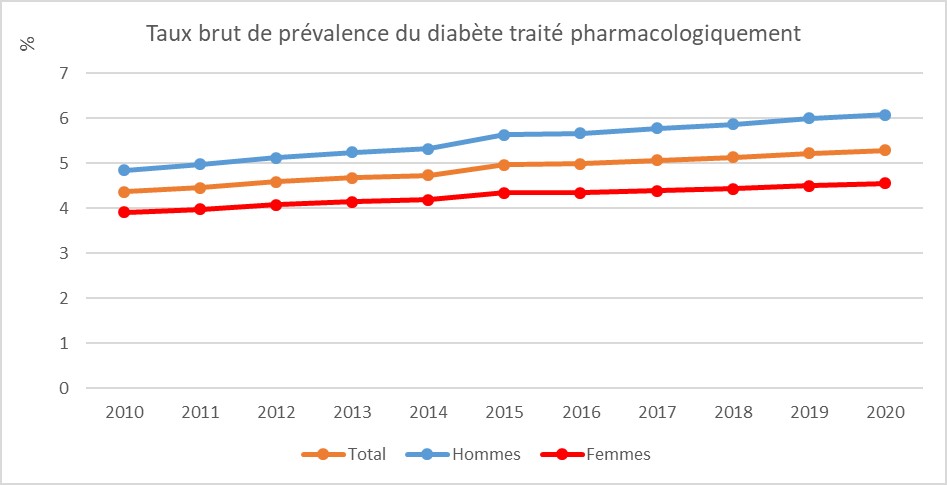
In 2020, diabetes continued to rise at nearly the same rate as in previous years.
Who is most affected by diabetes?
Diabetes is more common among men than women, with the exception of overseas territories, where women are the most affected.
What percentage of people with diabetes are treated with medication in France?
In France in 2020, more than 3.5 million people were receiving medication for diabetes, representing 5.3% of the population.
Regional disparities remain very pronounced, with a much higher prevalence of diabetes in the overseas departments and in Seine-Saint-Denis. High prevalence rates are also observed in the Val-d’Oise department and in the northeastern part of mainland France. In contrast, the departments located in the western part of mainland France, particularly in Brittany, have the lowest prevalence rates.
Diabetes-related complications: decline in hospitalizations for foot ulcers and strokes
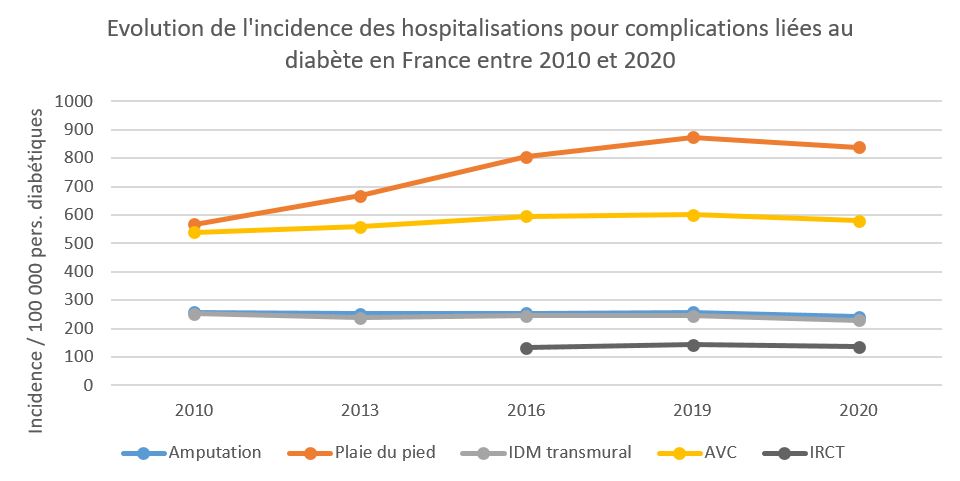
Diabetes-related complications remain common and stable, but a slight decrease is observed for the first time in hospitalizations for foot ulcers and strokes
In 2020, chronic diabetes-related complications remain very common. Nevertheless, for the first time since monitoring began in 2010, hospitalizations for foot ulcers and stroke have decreased, albeit moderately. The incidence of lower limb amputations, transmural myocardial infarctions, and end-stage chronic kidney disease—which had been relatively stable since monitoring began—also decreased, though only modestly.
Learn more about the standardized incidence rates of diabetes-related complications on Géodes
Standardized incidence rate of lower limb amputations in 2020 – ages 45 and older
Standardized incidence rate of hospitalizations for foot ulcers in 2020
Standardized incidence rate of hospitalizations for transmural myocardial infarction in 2020
Standardized incidence rate of hospitalizations for stroke in 2020
Standardized incidence rate of hospitalizations for end-stage chronic kidney disease treated in 2020
Diabetes Monitoring: The Frequency of Recommended Examinations Is Slightly Declining
Clinical monitoring of people with diabetes is guided by the care pathway recommendations established by the French National Authority for Health (HAS). Until 2019, the frequency of recommended follow-up tests increased each year. In 2020, the frequency of all recommended tests declined, albeit modestly. The sharpest decreases were seen in the three HbA1c tests (a marker of glycemic control) and dental visits, which fell by 3.4 and 4.2 percentage points, respectively, between 2019 and 2020.
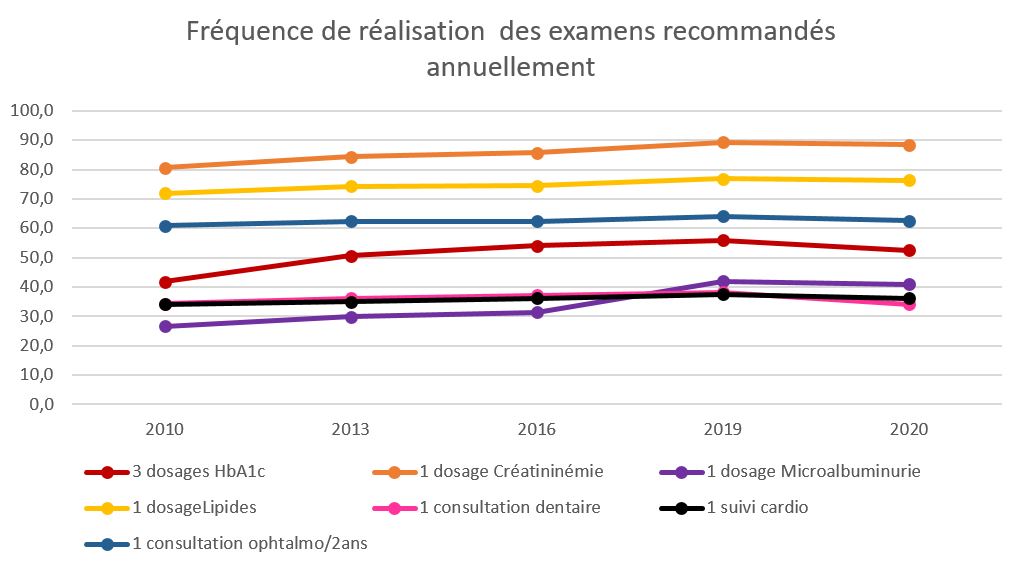
While healthcare utilization has dropped sharply among the general population due to the COVID-19 health crisis, the decline in the use of the three recommended HbA1c tests remains moderate. Nevertheless, it is important to note that only 52% of people with diabetes have undergone these tests, even though they are an essential indicator for monitoring blood glucose control and thus for preventing diabetes complications.
Type 1 diabetes in children: an increase of about 4% per year
The incidence of type 1 diabetes in children is increasing by approximately 4% per year: the national incidence rate was 18.0 per 100,000 in 2013–2015 and 19.5 per 100,000 in 2015–2017.
Regional variations are observed, with the highest incidence rates in Martinique, Occitanie, and Provence-Alpes-Côte d'Azur, and the lowest incidence rates in French Guiana, Guadeloupe, and Réunion—as well as in metropolitan France, in the Pays de la Loire, Normandy, and Nouvelle-Aquitaine.
Diabetes: What You Need to Know
Diabetes mellitus is a metabolic disorder characterized by chronic hyperglycemia (high blood sugar levels) resulting from a deficiency in insulin secretion or insulin action, or both.
There are two main forms of diabetes:
Type 1 diabetes occurs primarily in children or young adults (about 6% of diabetes cases);
Type 2 diabetes, which is the most common form (over 90%), occurs primarily in adults but can also develop as early as adolescence.
There are other forms of diabetes, such as gestational diabetes (which occurs during pregnancy and resolves after childbirth), or cases of diabetes resulting from specific medical conditions or genetic factors.
As the disease progresses, diabetes can lead to serious complications affecting the heart, blood vessels, eyes, kidneys, and nerves. However, good management of the disease can significantly reduce the risk of complications.
Eat and Move
Visit mangerbouger.fr for comprehensive information on nutrition, tools and tips to help you eat better and be more active, as well as a wide variety of recipes.
Odysseus
Santé publique France's open data portal, based on its 70 surveillance systems, surveys, and scientific expertise.