Chickenpox: Santé publique France releases an update as of March 27, 2017
Each year, nearly 700,000 cases of chickenpox are diagnosed, particularly among children under the age of 10. Santé publique France notes that chickenpox is a seasonal illness with two peaks each year: in March–April and June–July. The data presented reflect chickenpox activity throughout the year and the high prevalence of the disease in childhood.
Definition of Chickenpox
Chickenpox is a highly contagious viral disease, usually mild, that most commonly occurs during childhood. It is caused by a herpes virus (Varicella-Zoster Virus or VZV). Chickenpox is the primary infection with VZV. The lifetime risk of contracting chickenpox is very high (about 95%), and the risk of experiencing at least one reactivation of the virus (shingles) is around 15 to 20%. More than 90% of the population is immune by age 10.
For more information on symptoms and clinical presentations: chickenpox fact sheet
Each year, there are approximately 700,000 cases of chickenpox (more than 90% are under 10 years old), about 3,000 hospitalizations (25% are over 10 years old), and 20 deaths (70% are over 10 years old). These data reflect the frequent and exceptionally severe nature of the disease in childhood, as well as the increased risk of complications with age.
Chickenpox has been monitored by the Sentinelles network since 1990, and shingles since 2004 (Sentinelles). This network is coordinated by the "Surveillance and Modeling of Communicable Diseases" team at the Pierre Louis Institute of Epidemiology and Public Health (UMR S 1136, formerly UMR-S 707) of the National Institute of Health and Medical Research (Inserm) and Pierre and Marie Curie University, in collaboration with Santé Publique France. Each week, the network reports in its weekly bulletin an estimate of the number of chickenpox cases that have sought medical care in mainland France, along with maps showing their geographic distribution.
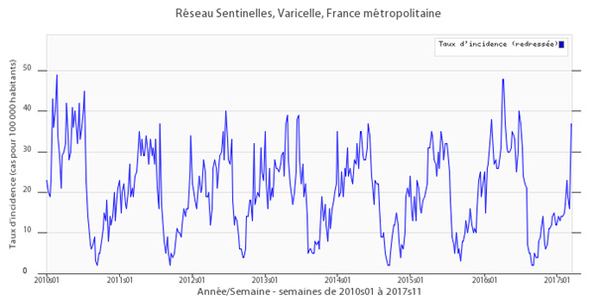
Chickenpox is a "seasonal" disease for which a spring surge in the number of cases is observed every year (weeks 11 to 15); this is an expected increase in the disease. A second peak can also be observed in June/July (weeks 25 to 28). The data produced by the Sentinelles network over the past few years are presented below (Figures 1 and 2: 2016 to S11 2017, and 2010 to 2017) and clearly reflect these periodic increases in the number of cases.
Figure 1 - Chickenpox incidence per 100,000 inhabitants. Sentinelles data from 2016 S1 to 2017 S11 (source: SentiWEB website).
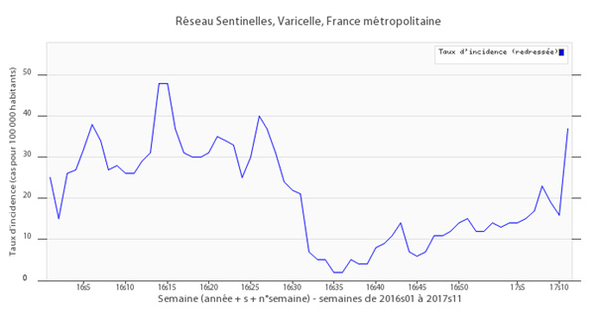
Figure 2 - Incidence per 100,000 inhabitants. Sentinelles data from 2010 S1 to 2017 S11 (Source: SentiWEB website).
The current situation regarding chickenpox, with incidence rates in certain regions well above the national average reported since mid-March by the Sentinelles network, corresponds to the expected resurgence in the number of cases observed each year at this time of year (more details on Sentinelles network data).
Prevention and Vaccination
In France, widespread vaccination against chickenpox for children over 12 months of age is not recommended. Current vaccination recommendations apply to individuals with no history of chickenpox or with an uncertain history, under the following circumstances: adolescents aged 12–18, women of childbearing age, adolescents and adults in contact with a case, healthcare professionals and professionals working with young children, individuals in close contact with immunocompromised persons, and children who are candidates for solid organ transplantation. A serological screening prior to vaccination may (or must, depending on the circumstances) be performed (vaccination schedule).