
thematic dossier
Cancers
Les cancers représentent en France la première cause de décès chez l’homme et la deuxième chez la femme. Santé Publique France copilote la surveillance épidémiologique et participe à leur prévention.




Santé publique France, the Biostatistics and Bioinformatics Department of the Hospices Civils de Lyon, the Francim cancer registry network, and the National Cancer Institute have released new survival data for 14 types of cancer.
These new data update the estimates published in 2016. These are the first survival estimates for adenocarcinomas and squamous cell carcinomas of the esophagus, anal cancers, papillary thyroid cancers, and glioblastomas (a subtype of central nervous system tumor).
Summary documents for each cancer site are being published throughout 2021. A first wave of summaries covering 12 cancer sites was published in November 2020. In total, the series of publications will cover 73 types and subtypes of cancer.
Cancers with a poor prognosis: adenocarcinomas and squamous cell carcinomas of the esophagus and stomach, and glioblastomas.
Cancers with intermediate, good, and very good prognoses: oral cavity, oropharynx, colon, rectum, anus, uterine body, vagina, vulva, thyroid, and papillary thyroid cancers.
For each of these cancers, the results describe:
1-year and 5-year survival rates for individuals diagnosed between 2010 and 2015 and followed through 2018,
trends in 1-, 5-, and 10-year survival rates for individuals diagnosed between 1989 and 2015 and followed through 2018,
20-year survival for individuals under the age of 75 at the time of diagnosis between 1989 and 2000, and followed through 2018.
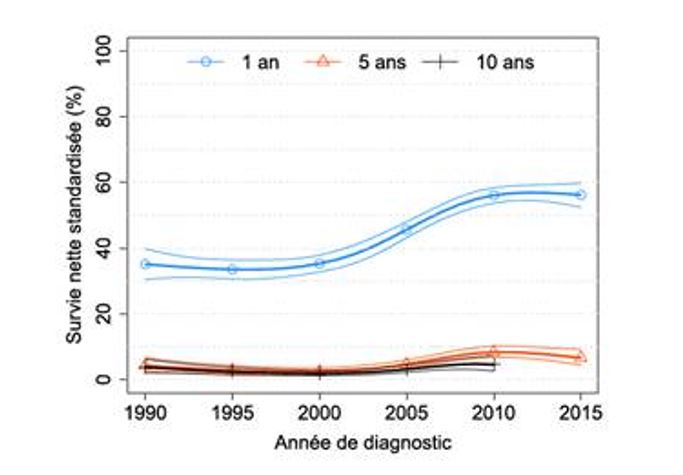
These results reveal situations that remain concerning for the four high-risk cancers studied. Between 1990 and 2015, 1-year net survival increased by 11 to 21 percentage points depending on the cancer; however, 5-year net survival has changed very little (+1 to 4 percentage points depending on age for glioblastomas), with the exception of esophageal adenocarcinomas, which has recently improved (+10 percentage points, including 7 points between 2005 and 2015).
Trends in 1.5- and 10-year age-standardized net survival by year of diagnosis and 95% confidence interval, CNS – Glioblastoma
The improvements in 5-year net survival observed for the other 10 cancers (+6 to 18 percentage points between 1990 and 2015) should, however, be viewed with caution, as these gains do not apply to all age groups (gains are more pronounced among younger patients). Furthermore, survival disparities to the detriment of men persist for cancers affecting both men and women, with up to 18 percentage points lower 5-year net survival among men than among women for anal cancer during the 2010–2015 period.
Download

enquêtes/études
20 October 2021
thematic dossier
Les cancers représentent en France la première cause de décès chez l’homme et la deuxième chez la femme. Santé Publique France copilote la surveillance épidémiologique et participe à leur prévention.












