

2014 Health Barometer in the Overseas Departments: Alzheimer's Disease
Do residents of France’s overseas territories feel better or less informed than those in mainland France? How much fear of the disease exists? What are the relationships between patients and their loved ones? Santé publique France has published a new chapter of the 2014 DOM Health Barometer survey on Alzheimer’s disease, whose findings highlight the unique characteristics of these territories in terms of knowledge, perceptions, and attitudes toward the disease.

Alzheimer's disease is the most common neurodegenerative disorder, with significant implications for care, both for the patient and their loved ones. More than one million people in France suffer from Alzheimer's disease and other forms of dementia. Considered a global public health priority by the World Health Organization, the number of dementia cases worldwide could double by 2030 and triple by 2050.
Knowledge, perceptions, and attitudes regarding Alzheimer’s disease
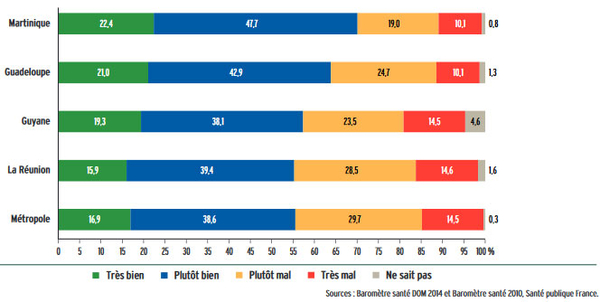
People in the French West Indies feel better informed about Alzheimer’s disease than those in metropolitan France, French Guiana, and Réunion. However, across all French overseas departments, just as in metropolitan France, a poor financial situation is associated with a lower level of knowledge about the disease.
Perceived level of information about Alzheimer’s disease in the French overseas departments and mainland France: “Do you personally feel informed about Alzheimer’s disease?” (in percentages)
Memory clinics* are not widely known in the French overseas departments: 17% of people in Martinique, 13% in Guadeloupe, 15% in French Guiana, and 11% in Réunion know where the nearest memory clinic is located. People aged 55–75 are more familiar with these clinics than younger people.
The view that “a person with Alzheimer’s disease should be cared for within the family, provided the caregiver is not exhausted” is shared by about one in two people in the French overseas departments.
Knowledge, Attitudes, and Health Status of Caregivers for People with Alzheimer’s Disease
One-third of respondents from Martinique, Guadeloupe, and Réunion report knowing someone with Alzheimer’s disease, a proportion higher than that in metropolitan France (27%) and French Guiana (18%).
Among them, half of those in the Antilles, 40.5% of those in French Guiana, and 45% of those in Réunion are or have been caregivers for people with the disease. These proportions are higher than in metropolitan France (33%).
The specter of the disease frightens the majority of the population: among those who report not knowing anyone with the disease in their circle, 73% of people in Réunion, 70% of people in Martinique and Guadeloupe, and 58% of people in French Guiana say they fear Alzheimer’s disease for themselves or their loved ones.
These results—particularly the higher proportion of caregivers as well as of people who know someone with Alzheimer’s—reflect sociocultural disparities between the French overseas departments and mainland France, with family solidarity being more deeply rooted in the overseas departments, but likely also structural disparities, given the lack of alternatives for patient care in certain territories.
Four dimensions studied regarding Alzheimer’s disease:
level of knowledge about the disease;
fears regarding the disease;
perception of the appropriate living environment for a person with the disease;
the relationship with a person living with Alzheimer’s disease.
For more information:
Léon C., Pin S., Carcaillon-Bentata L., Beltzer N. DOM Health Barometer 2014. Alzheimer’s Disease. Saint-Maurice: Santé publique France, 2016: 16 p.
2014 Overseas Territories Health Barometer (methodology, questionnaire, initial results, regional analyses).
* Memory clinics are facilities dedicated to the diagnosis and care of patients with memory and cognitive disorders.