

11th European Cervical Cancer Prevention Week
Cervical cancer affects approximately 3,000 women each year. To mark the 11th European Cervical Cancer Prevention Week, from January 22 to 28, 2017, Santé publique France is highlighting the importance of screening and vaccination and releasing the latest available data.
Cervical Cancer: A Deadly but Largely Preventable Disease
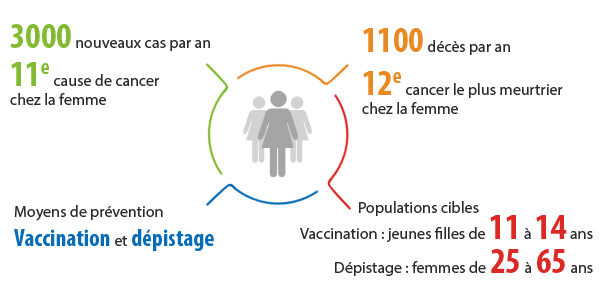
About 3,000 new cases of cervical cancer are diagnosed and 1,100 women die from it each year.
Cervical cancer is caused by a sexually transmitted virus. Contraceptive methods (such as condoms, for example) are only partially effective against infection with human papillomavirus (HPV). Prevention relies on HPV vaccination and screening via Pap smears.

HPV vaccination is recommended in France for all girls aged 11 to 14, with catch-up vaccination for girls aged 15 to 19 who have not yet been vaccinated. Vaccination coverage is very low: less than 20% of girls are vaccinated.
Cervical smear screening is recommended every three years for all women aged 25 to 65: 17 million women are affected.
Toward the widespread implementation of organized cervical cancer screening in 2018
40% of women have not had a Pap smear in the past 3 years.
The implementation of a national organized cervical cancer screening program is a priority of the 2014–2019 Cancer Plan. The goal is to ensure that all women aged 25 to 65 have access to regular cervical cancer screening and to address inequalities in access. A pilot program was conducted over three years in 13 departments. The full results of this pilot were published in 2016. They are the subject of an article in the Weekly Epidemiological Bulletin published today. The rollout of this cervical cancer screening program nationwide is scheduled for 2018. Santé publique France will oversee the evaluation.
Learn more
Hamers F, Beltzer N. Toward the nationwide rollout of organized cervical cancer screening. Bull Epidemiol Hebd 2017;2-3.
Duport N, Beltzer N. Organized cervical cancer screening. Evaluation of organized cervical cancer screening in the four permanent departments and the nine pilot departments. Pilot program 2010–2014. Saint-Maurice: Santé publique France; 2016. 46 p.
Persistent social inequalities in cervical cancer
The Health and Social Protection Survey conducted by IRDES in 2012, whose vaccination data were analyzed by Santé publique France1, shows that women who do not participate in cervical smear screening (FCU) and young women who are not vaccinated against HPV tend to belong to the lowest socioeconomic categories. Furthermore, unvaccinated young girls tend to have mothers who do not participate in Pap smear screening and are therefore at risk of not benefiting from either of the two cervical cancer prevention measures.
The goal of expanding screening nationwide and facilitating access to HPV vaccination—two objectives outlined in the 2014–2019 Cancer Plan—should help reduce these inequalities in access to cervical cancer prevention measures.
See also
Organized cervical cancer screening. Feature.
1 Guthman JP, Pelat C, Célant N, Parent du Chatelet I, Duport N, Rochereau T, Lévy-Bruhl D. Socioeconomic inequalities in access to vaccination against Human Papillomavirus in France: results of the Health, Health Care and Insurance Survey, 2012. RESP 2017 (in press).