




Hepatitis Delta: Monitoring Screening and Diagnostic Activities
Health Insurance Reimbursement Data
Nationwide
Number of anti-VHD antibody tests reimbursed in the public and private sectors
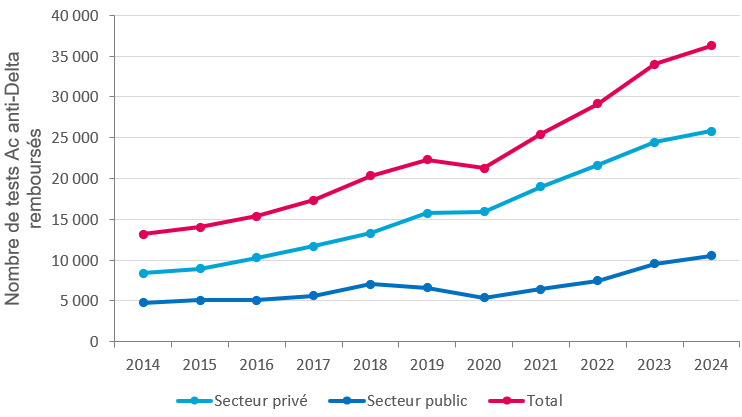
In 2024, more than 36,000 anti-VHD antibody (Ab) tests (procedure code 1740 in the Nomenclature of Medical Laboratory Procedures) were performed and reimbursed across all health insurance plans.
Between 2014 and 2019, the number of anti-VHD Ab tests increased annually by between 6% and 17%, then decreased in 2020 (-5%) due to the COVID-19 pandemic. Starting in 2021, the annual increase was more significant (20% between 2020 and 2021, 15% between 2021 and 2022, and 17% between 2022 and 2023), likely due to recent therapeutic advances (European marketing authorization for Bulevirtide in the third quarter of 2020). This increase is less pronounced between 2023 and 2024 (+7%).
Between 2014 and 2019, the annual number of reimbursed tests increased more sharply in the private sector (+87%) than in the public sector. This trend has reversed since 2020, with a larger increase in the public sector (+96%) than in the private sector (+62%). Note: Screening tests performed during hospitalization in a public facility are not included in the public sector data.
Annual trend in the number of anti-VHD antibody tests performed in the private and public sectors and reimbursed by Medicare, 2014–2024, France (data from all insurance plans)
Number of people tested for anti-VHD antibodies
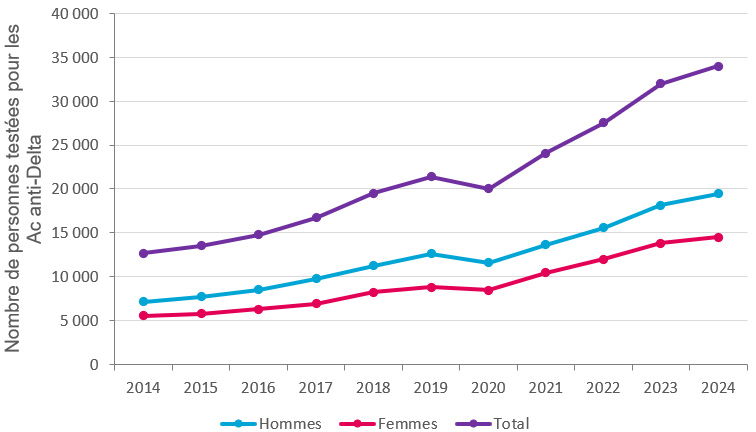
Between 2014 and 2019, the number of people tested for anti-VHD antibodies increased annually by between 7% and 17%, then decreased by 6% in 2020, in connection with the COVID-19 pandemic. Starting in 2021, it began to rise again annually (+20% between 2020 and 2021, +14% between 2021 and 2022, +16% between 2022 and 2023, and +8% between 2023 and 2024).
The majority of those tested were men (57%). This proportion remained stable over the period.
Annual trend in the number of people tested for anti-VHD antibodies, by sex, 2014–2024, France (data from all health insurance schemes)
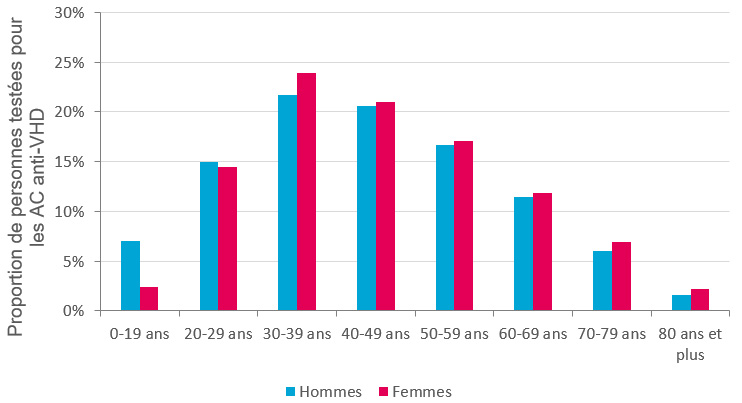
Among those tested in 2024, the most represented age group was 30–49, both among men (42%) and women (45%).
Distribution of individuals tested for anti-VHD antibodies in 2024, by sex and age group, France (data from all health insurance schemes)
At the regional and departmental levels
Screening rate for anti-VHD antibodies
In 2024, the screening rate for anti-VHD antibodies (total number of tests relative to the number of people living in France) was 0.53 tests per 1,000 inhabitants in France. It was higher in mainland France (0.53 tests per 1,000) compared to the overseas departments and regions (DROM) (0.45 tests per 1,000).
In mainland France
The rates of anti-VHD antibody screening tests were higher in Île-de-France (1.05/1,000) and in Provence-Alpes-Côte d’Azur (PACA) (0.61/1,000). The Hauts-de-France (0.30/1,000), Brittany (0.36/1,000), and Bourgogne-Franche-Comté (0.36/1,000) regions had the lowest rates.
At the departmental level, Paris (1.43/1,000), Seine-Saint-Denis (1.39/1,000), and Val-de-Marne (1.31/1,000) had the highest rates, while Pas-de-Calais (0.16/1,000), Allier, and Lozère had the lowest rates (0.17/1,000).
Compared to 2023, screening rates recorded in 2024 showed an upward trend in all regions, except in Provence-Alpes-Côte d'Azur (-6%). The largest increases were recorded in the regions of Brittany (17%), Corsica (15%), and Pays de la Loire (15%).
Increases at the departmental level were particularly significant in Côtes-d'Armor (+82%), Calvados (+58%), Lot (52%), and Meurthe-et-Moselle (52%).
In the Overseas Territories
The screening rate for anti-VHD antibodies was highest in French Guiana (0.99/1,000) and Guadeloupe (0.93/1,000). It was lowest in Mayotte (0.21/1,000). It was 0.25/1,000 in Martinique and 0.22/1,000 in Réunion.
Rate of people tested for anti-VHD antibodies
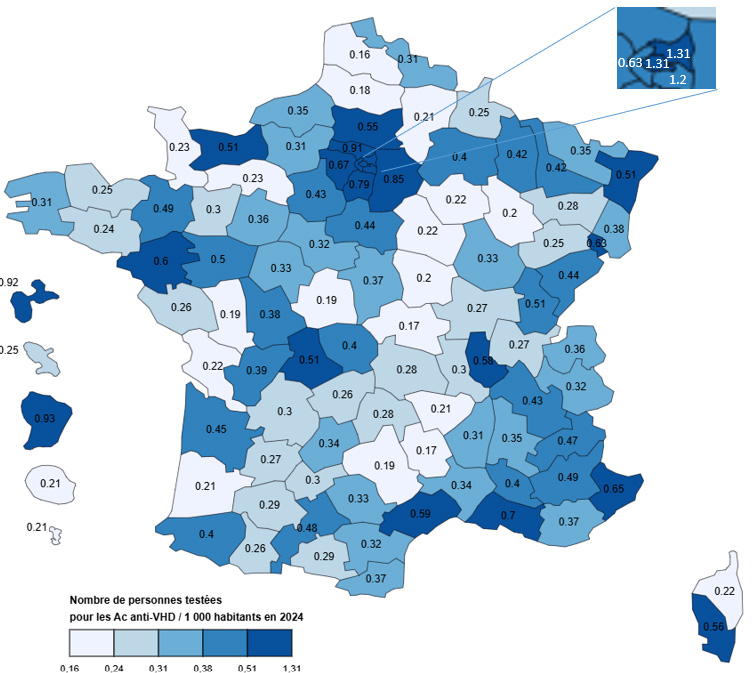
In 2024, the rate of people tested for anti-VHD antibodies (number of people tested relative to the number of people living in France) was 0.50 people per 1,000 inhabitants. This rate was higher in mainland France (0.50/1,000) than in the overseas departments and regions (0.43/1,000).
In mainland France
The rates of people tested in 2024 were highest in the Île-de-France (0.98/1,000) and PACA (0.57/1,000) regions. The Hauts-de-France (0.28/1,000), Brittany (0.30/1,000), and Bourgogne-Franche-Comté (0.34/1,000) regions had the lowest rates.
The departments of Seine-Saint-Denis (1.31/1,000), Paris (1.31/1,000), and Val-de-Marne (1.20/1,000) had the highest rates of people tested. The lowest rates were observed in Pas-de-Calais (0.16/1,000), Allier (0.17/1,000), and Lozère (0.17/1,000).
In the Overseas Territories
The rate of people tested was highest in French Guiana (0.93/1,000) and Guadeloupe (0.92/1,000). Mayotte and Réunion had the lowest rate: 0.21/1,000. In Martinique, it was 0.25/1,000.
Number of people screened for anti-VHD antibodies (per 1,000 inhabitants), by region, France, 2024 (all health insurance plans)
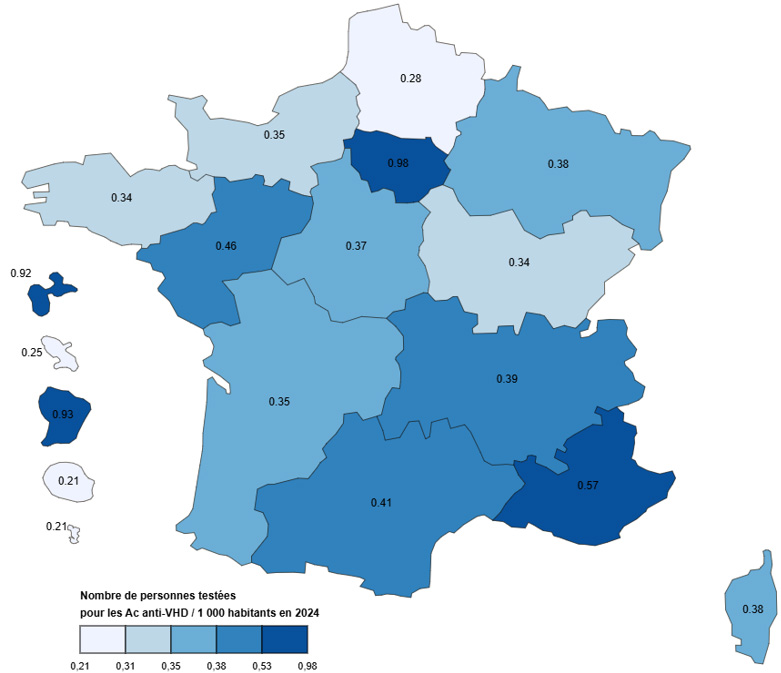
Number of people screened for anti-VHD antibodies (per 1,000 inhabitants), by department, France, 2024 (all health insurance plans)
GEODES
Track the spread of hepatitis D in France and in your region
In relation to

Hepatitis C
thematic dossier
Hepatitis C is a viral infection primarily transmitted through blood. Screening for the disease is crucial to ensuring that infected individuals receive the treatments that can now lead to a cure.

HIV/AIDS
thematic dossier
HIV, or Human Immunodeficiency Virus, is a sexually transmitted human retrovirus. It weakens the immune system, and if left untreated, leads to AIDS.

Vaccination
thematic dossier
Contagious diseases most often affect children at a very young age. Because children are particularly vulnerable, they are a priority target for vaccination programs.