

Factors Associated with the Presence of at Least One Probable Mental Health Disorder Among School-Aged Children Aged 6 to 11: Results from the 2022 Enabee Study in Metropolitan France
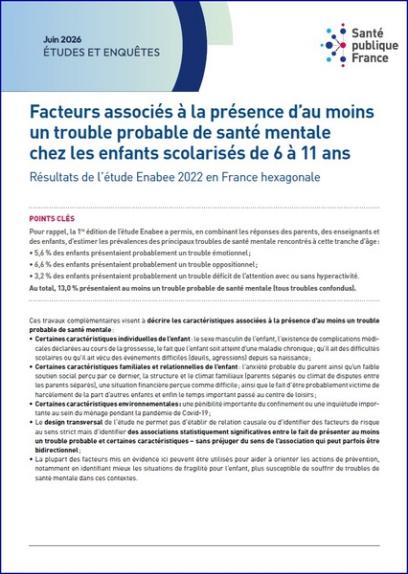
As a reminder, the first edition of the Enabee study—by combining responses from parents, teachers, and children—was able to estimate the prevalence of the main mental health disorders found in this age group: 5.6% of children likely had an emotional disorder; 6.6% of children likely had an oppositional defiant disorder; 3.2% of children likely had an attention-deficit/hyperactivity disorder. In total, 13.0% had at least one probable mental health disorder (all disorders combined). This follow-up study aims to describe the characteristics associated with the presence of at least one probable mental health disorder: Certain individual characteristics of the child: the child’s male gender, the presence of reported medical complications during pregnancy, whether the child has a chronic illness, whether the child has academic difficulties, or whether the child has experienced difficult events (bereavement, abuse) since birth; Certain family and relational characteristics of the child: the parent’s probable anxiety as well as their perception of low social support, the family structure and atmosphere (separated parents or a climate of conflict between parents), a financial situation perceived as difficult; as well as the likelihood of being bullied by other children and, finally, the amount of time spent at the recreation center; Certain environmental characteristics: significant distress caused by lockdown measures or significant anxiety within the household during the COVID-19 pandemic; The cross-sectional design of the study does not allow for establishing a causal relationship or identifying risk factors in the strict sense, but rather for identifying statistically significant associations between having at least one probable disorder and certain characteristics —without prejudging the direction of the association, which may sometimes be bidirectional; Most of the factors highlighted here can be used to help guide prevention efforts, particularly by better identifying situations of vulnerability for children, who are more likely to suffer from mental health disorders in these contexts.
Author(s): Decio Valentina, Motreff Yvon, Sentenac Mariane, Regnault Nolwenn, Monnier-Besnard Stéphanie, Cachia Arnaud, Delorme Richard, Galera Cédric, Gatecel Anne, Hazo Jean-Baptiste, Kovess-Masfety Vivianne, Melchior Maria, Paccard Caroline, Rouquette Alexandra, Thierry Xavier, Wendland Jaqueline
Publishing year: 2026
Pages: 22 p.
Collection: Studies and Surveys
In relation to
Our latest news

news
Seniors, pregnant women, and nursing home staff: What is the status of their...

news
Winter Illnesses: A Dynamic and Accessible Way to Track the Spread of...

news