What are social-emotional skills?
What are the three main categories of CPS? How are they classified? What are the health effects?
Psychosocial skills (PSS) are a set of psychological skills (cognitive, emotional, and social) that help maintain mental well-being. Thus, developing these skills promotes overall health and positive mental health, defined by the WHO in 2004 as “a state of well-being in which an individual can realize their potential, cope with the normal stresses of life, work productively and fruitfully, and contribute to their community.”
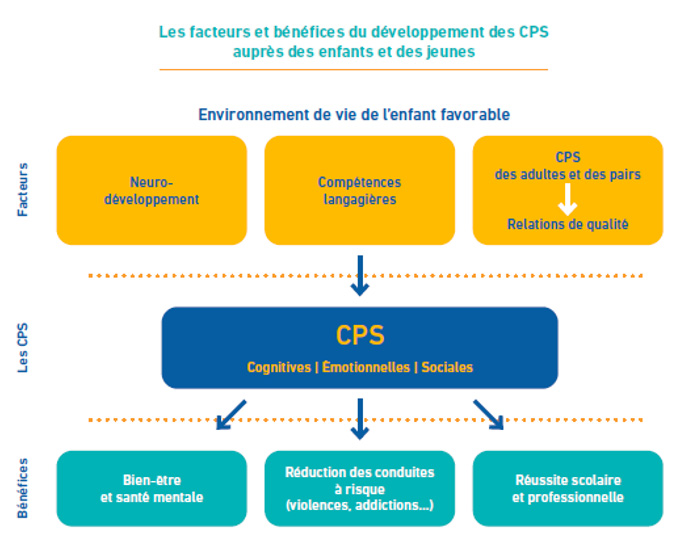
SOCs can be strengthened through psychoeducational interventions. Thus, even though their development is greatly influenced by individual factors (such as executive functions or language skills) and relational and social factors (such as interactions with family, friends, and adults in educational roles, as well as economic and cultural environments), CPS can evolve and be strengthened through formal and informal learning.
What are the three main categories of social and emotional skills?
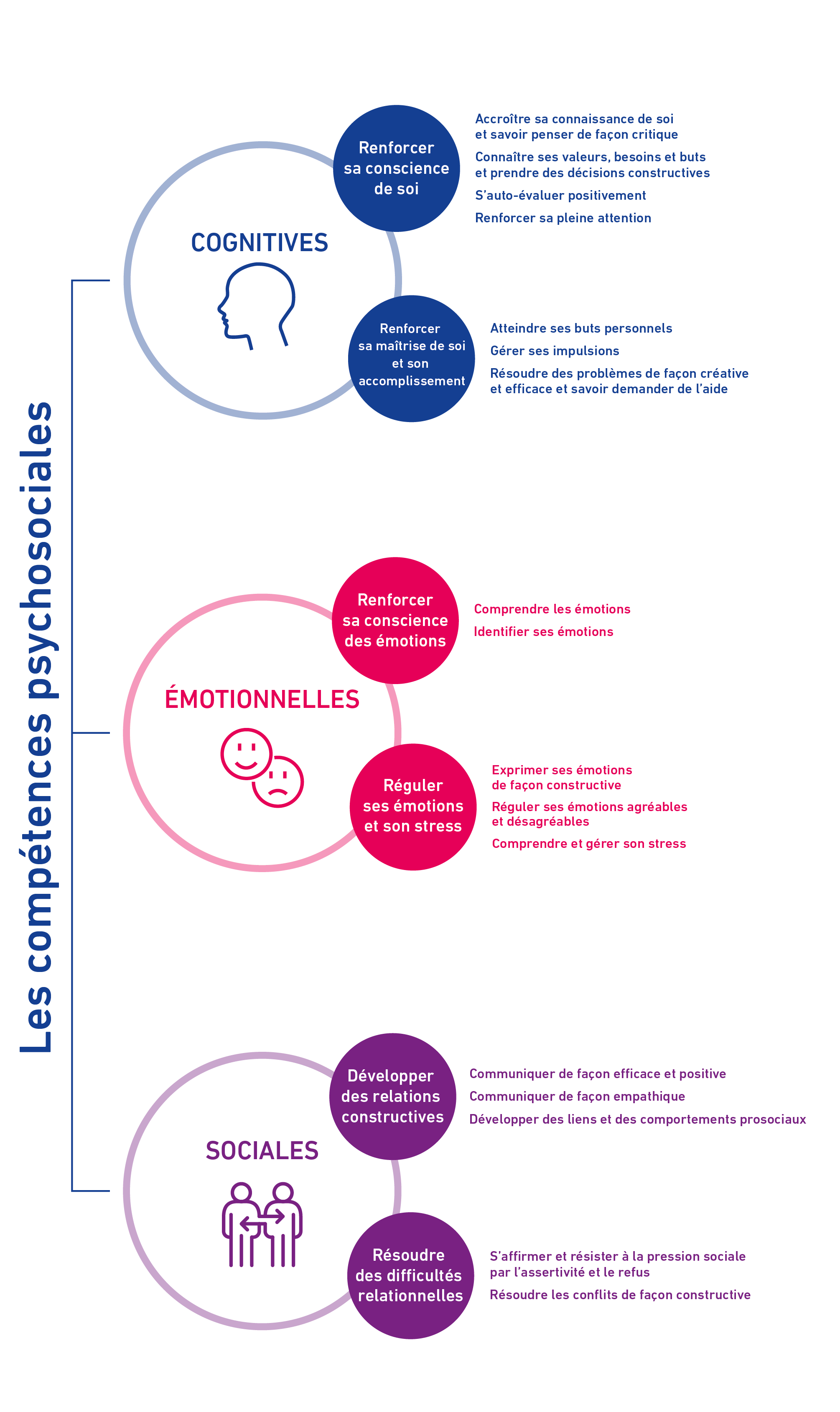
Psychosocial skills are grouped into three categories: cognitive skills, emotional skills, and social skills. Each category includes two general psychosocial skills and several specific psychosocial skills.
Cognitive skills
Cognitive skills strengthen mental capacities related to self-awareness, decision-making, self-esteem, self-regulation, goal attainment, and problem-solving; they are grouped around two general skills:
strengthening self-awareness;
strengthening self-control and self-fulfillment.
Emotional skills
Emotional skills enable the understanding, expression, and regulation of emotions and stress; they are grouped around two general skills:
strengthening emotional awareness;
regulating emotions and stress.
Social (or interpersonal) skills
Social skills enable the development of constructive communication and relationships and the resolution of conflicts in a positive manner; they are grouped around two general skills:
developing constructive relationships;
resolving relationship difficulties.
A schematic representation of psychosocial skills
How are social and emotional skills classified?
Classifications of psychosocial skills have evolved over the past 30 years. The 2022 Santé publique France framework is based on international standards (WHO, CASEL, OECD) and focuses on the “key” psychosocial skills mentioned in the literature and present in effective psychosocial skills programs. They result from a literature review supported by a committee of researchers and professionals in prevention and health promotion. This first edition of the framework provides an overview of the scientific knowledge with the aim of building a common and shared culture regarding CPS. It served as an initial theoretical reference framework, which has recently been supplemented by a new framework published in 2025 that retains the 2022 classification but presents it in a more operational manner to facilitate adoption and the progressive nature of learning.
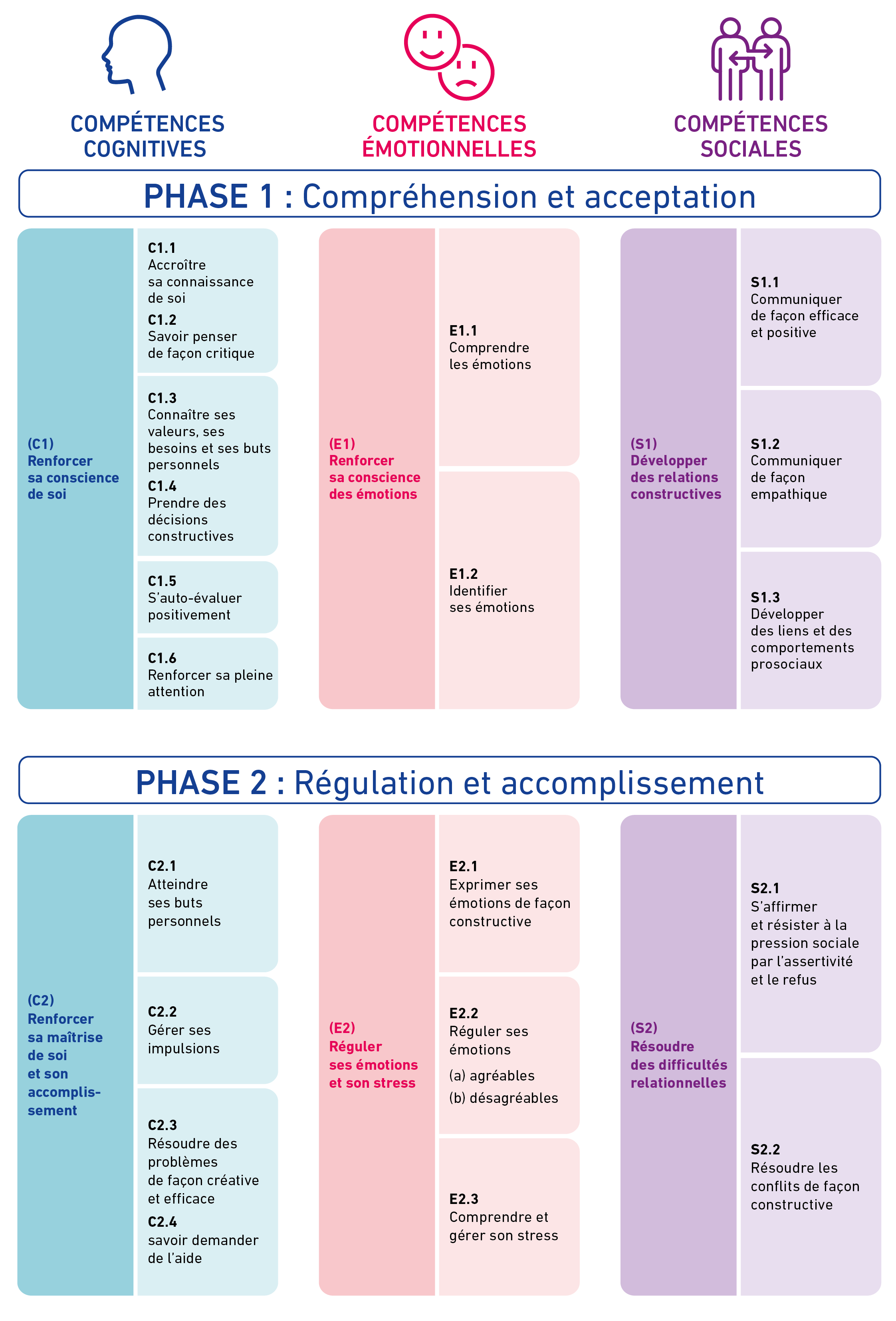
In 2025, the Operational Framework, Volume 1, established a progressive learning pathway for each category of ECS (cognitive, emotional, social). For each of these, a preliminary phase of understanding and accepting psychological functioning (first cognitive CPS, first emotional CPS, first social CPS) is necessary before seeking to strengthen regulatory and achievement skills (second cognitive, emotional, and social skills). It is also important to improve one’s relationship with oneself by strengthening intrapsychic skills (cognitive and emotional CPS) before seeking to modify one’s relationship with others through the development of interpersonal skills (social CPS).
There are two distinct phases of learning:
Phase 1: development of the capacity to understand and accept cognitive, emotional, and social experiences (starting with oneself and moving toward others).
Phase 2: development of cognitive, emotional, and social regulation and fulfillment skills.
Operational classification of psychosocial competencies structured around two stages of development
What are the health effects and benefits of CPS?
Based on 40 years of evaluative research on CPS programs, several literature reviews conducted over the past 10 years indicate that certain psychoeducational CPS programs for children have demonstrated significant benefits for health and educational and social success:
Well-being and mental health: reduction in emotional and behavioral disorders, psychological distress (anxiety, stress, depression), and improvement in well-being and positive mental health.
Risk-taking behavior: reduced use of psychoactive substances (tobacco, alcohol, drugs), violence and bullying, and risky sexual behaviors.
Academic and professional success: increased engagement and academic performance, reduced academic failure, and better professional integration.
But also, a better relationship with oneself and others, development of personal resources, and improvement in the school climate and relationships.
The development of CPS therefore helps increase psychological well-being, improve individual and relational functioning, build healthy and positive relationships, adopt health-promoting behaviors, and reduce risky behaviors.
As a protective factor for overall health (physical, mental, and social), mental health, well-being, and educational and social success, the development of social and emotional skills is a strategic avenue to pursue in public health, education, and social services. Highlighted by the WHO as early as the 1980s, within the framework of the Ottawa Charter, the development of HSCs represents one of the five action areas of health promotion and a major prevention strategy (particularly in the fields of addiction, mental health, sexual health, and generally to prevent risky behaviors).
Factors and Benefits of Developing Social-Emotional Skills in Children and Youth