Teen Mental Health: An All-Digital Campaign to Encourage Them to Talk About It
CP_campagne ados santé mentale_110621.pdf
Download (PDF - 704.43 KB)
Press Contacts
Santé publique France
presse@santepubliquefrance.fr
Stéphanie Champion: 01 41 79 67 48
Marie Delibéros: 01 41 79 69 61
Camille Le Hyaric: 01 41 79 68 64
The COVID-19 pandemic and the various measures it has necessitated have impacted the mental health of the entire population, including that of children and adolescents. Following the implementation of the second lockdown and as the health crisis has dragged on, certain signs of deteriorating mental health among adolescents (demotivation, dropping out of school, withdrawal, and anxiety-driven refusal to attend school) have been observed by professionals in the National Education System, pediatricians, and child psychiatrists.
These trends have been confirmed nationwide by Santé publique France’s surveillance system, with the situation worsening in early 2021 (an increase in emergency room visits for mental health reasons among 11- to 17-year-olds). That is why Santé publique France and the Ministry of Solidarity and Health are launching today the “Teens” component of the mental health awareness campaign, which began in April 2021. Entirely digital, this campaign aims to encourage open discussion—the first step toward seeking help—and to encourage struggling teens to reach out to Fil Santé Jeunes.
Deterioration in the mental health of 11- to 17-year-olds since the first lockdown
Since the start of the health crisis, as with the general population, a significant decline in adolescents’ mental health has been observed—particularly since November—in terms of anxiety and depression, as noted by both National Education professionals and pediatricians and child psychiatrists. In late December 2020 and during the first quarter of 2021, surveillance data confirmed a decline in the mental health of young people under 18.
Surveillance data on emergency room visits from the Oscour® 1 network show, compared to previous years:
an increase in emergency room visits for mood disorders (including depressive disorders) observed since the start of the 2020–2021 school year and continuing into May 2021, with an intensification since the beginning of 2021;
a marked increase in emergency room visits for suicidal acts and suicidal ideation since the beginning of 2021;
to a lesser extent, an increase in visits for eating disorders has also been observed since the beginning of 2021.
For these three indicators, the increase concerns children and adolescents aged 11 to 17, particularly those aged 11–14.
Furthermore, Santé publique France, in collaboration with Avicenne Hospital in Bobigny, Sorbonne Paris Nord University, and their partners,2 conducted the CONFEADO study to better understand how children and adolescents aged 9 to 18—including those in the care of Child Welfare Services—experienced the first lockdown and how it may have impacted their well-being.
The initial findings highlight disparities in mental health, typically observed by age and gender, with mental health more severely impacted among adolescents (13–18 years old) than among children (9–12 years old) and also more severely impacted among girls than among boys.
The results also reveal a clear social divide. Children and adolescents from more vulnerable families (single-parent families, families with lower educational attainment, more blue-collar or white-collar workers, or those born abroad), facing more difficult living conditions (financial and food insecurity, overcrowded housing, or lack of access to the outdoors), and experiencing social isolation reported greater psychological distress. A lack of activities, increased time spent on social media and screens, a feeling of being overwhelmed by schoolwork, a close relative’s COVID-19 infection, and hospitalization due to COVID-19 were also factors associated with distress.
Enhanced monitoring of the population’s mental health from the start of the health crisis enabled action to be taken during the first lockdown through the dissemination of prevention messages. Following the increase in anxiety and depression observed during the second wave of the pandemic (October 2020), a national awareness campaign titled “Talking about it is already part of the healing process,” aimed at those over 18, was launched in April 2021. Today, in response to the deterioration in adolescents’ mental health observed in recent months, it appears necessary to launch a campaign specifically dedicated to this target group.
A 100% digital campaign to encourage adolescents to speak up and use remote support services
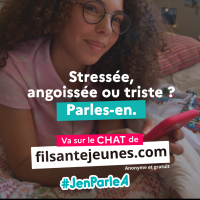
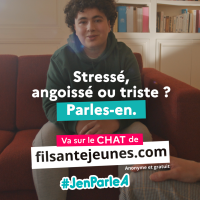
The communication initiative aimed at adolescents aged 11–17, launched by Santé publique France and the Ministry of Solidarity and Health, builds on the “Talking about it is already part of the healing process” campaign.
This campaign aims to limit the impact of the health crisis on adolescents’ mental health by encouraging them to talk to a trusted adult and to use the Fil Santé Jeunes remote support service, with a particular focus on its online services. This anonymous and free service for young people aged 12 to 25 offers a helpline at 0 800 235 236, available 7 days a week from 9 a.m. to 11 p.m., and a website providing information, a forum, a chat feature, and referrals to support services (drop-in centers and counseling centers, youth centers, community organizations, professionals, and healthcare facilities). These services are provided by professionals (doctors, psychologists, educators, and counselors).
In addition, some twenty influencers and celebrities have joined the #JenParleA campaign. This strong mobilization demonstrates the importance of the issue for young people. The goal is to encourage open dialogue and freedom of expression regarding mental health issues by launching the #JenParleA movement. Teenagers are thus invited to share who they talk to and to use the Fil Santé Jeunes service if they are feeling unwell.
In addition to this service, a partnership with NomadEducation, a study app, has been established to support young people’s mental health during the period leading up to the high school and middle school exams.
Campaign Overview
3 Questions for Enguerrand ROLLAND DU ROSCOAT, Head of the Mental Health Unit at Santé publique France
What measures will you implement to reach teenagers?
To reach teenagers (ages 11–17), we’ve chosen an entirely digital campaign to stay as close as possible to their preferred way of communicating. You’ll see banners on their favorite websites, as well as 15-second videos on social media, including TikTok, Snapchat, Facebook, and Instagram.
The concept behind these videos is that each teenager featured names the person they turn to when they’re feeling down. This could be a family member, a friend, a therapist… or Fil Santé Jeunes. The goal is to encourage them to speak up—which is the first step toward seeking help—and to invite teenagers in distress to reach out to Fil Santé Jeunes.
What messages do you want to convey to this target audience?
The message of this campaign, aimed at 11- to 17-year-olds, is twofold. If a teenager feels that something is wrong—whether it’s feelings of sadness, stress, or anxiety—it’s important to talk about it. And if they don’t know who to confide in or don’t want to talk to people in their immediate circle, they can visit the Fil Santé Jeunes chat to discuss it. Counselors trained in these issues are there to listen, provide answers, and, if necessary, refer teens to appropriate support or care.
Can you explain the partnership with NomadEducation?
To round out the program, we have indeed formed a partnership with NomadEducation. During the campaign period—which coincides with exam prep for the baccalaureate and middle school diploma—this academic review app will send three text messages inviting middle and high school students to visit Fil Santé Jeunes if they experience signs of distress such as sadness, stress, or anxiety. These text messages will include a direct link to the Fil Santé Jeunes website.
1 Organization of Coordinated Emergency Surveillance, Health Surveillance System.
2 INSERM, University of Tours, CN2R, EHESS, Lab School Network, CNRS, with support from the FHF Fund and UNICEF.
surveys/studies
The CONFEADO Study
Santé publique France, in partnership with other institutions, is launching a major national study on how children and adolescents aged 9 to 16 experienced lockdown during the COVID-19 pandemic.
Mental Health Monitoring Reports
Check out the weekly mental health syndromic surveillance reports produced by Santé publique France.
Stay informed about the COVID-19 pandemic in France and around the world
Updates, Q&As, expert interviews... everything you need to know about the novel coronavirus (SARS-CoV-2) and COVID-19 in France and around the world
Our latest news

news
Call for Nominations for the Renewal of the Scientific Advisory Board of the...

news
Growing Up with Screens. A special report in *La Santé en action* No. 474,...

news