The November 13 Attacks: Five Years Later, What Impact Have They Had on the Mental Health of the Victims, Their Loved Ones, and the Professionals Involved?
CP_Espa2_16112020.pdf
Download (PDF - 750.02 KB)
Press Contacts
Santé publique France
presse@santepubliquefrance.fr
Stéphanie Champion: 01 41 79 67 48
Marie Delibéros: 01 41 79 69 61
Camille Le Hyaric: 01 41 79 68 64
Assessing the impact of major events, such as terrorist attacks, on mental health is one of Santé publique France’s core missions. In 2016, following the attacks of November 13, 2015, Santé publique France launched the ESPA November 13 study among those affected by the events (the injured, those targeted, threatened, or who witnessed the attacks, law enforcement and emergency responders, government officials, and those who lost a loved one). The results of this first wave highlighted the significant psychological and traumatic impact and, for some, a lack of access to care. Five years later, what is the situation? To answer this question, Santé publique France is launching a second wave of the survey. Unprecedented in its scope, it will provide valuable insights to guide and improve the care provided to these individuals.
A study to measure and understand the psychological impacts of the attacks
The ESPA November 13 survey aims to assess the psychological impact and identify the support and care services available to those affected. It is part of a broader research program funded by the General Secretariat for Investment through the ANR and led by the CNRS and Inserm: the November 13 Program.
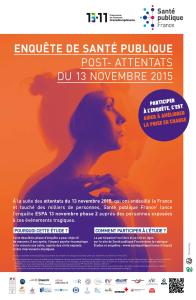
This two-phase survey will shed light on the long-term consequences for people who have experienced an attack, particularly post-traumatic stress disorder (PTSD), a condition that can emerge or persist in the years following the traumatic event. These findings are all the more valuable given that research on PTSD following terrorist acts remains limited.
The second phase of the Santé publique France ESPA 13 November study begins on November 16, 2020, and will last four months. It is open to all individuals exposed to the attacks of November 13, 2015, regardless of whether they participated in the first wave.
The objectives of this second wave of the survey, eagerly awaited by victims and frontline workers, will be:
to assess the psychological and traumatic impact five years after the attacks, as well as, for those who have already participated, how this impact has evolved since 2016,
to describe these individuals’ use of healthcare services since the events and to identify the associated factors.
“According to the results of the first wave conducted a few months after the attacks, nearly 37% of the civilians who responded were suffering from post-traumatic stress. Some did not seek care, particularly eyewitnesses. With this second wave, we will be able to see if the use of care has increased over time and describe the evolution of their mental health. This applies to civilians as well as first responders,” adds Dr. Philippe PIRARD, Medical Epidemiologist and Coordinator of the ESPA November 13 study.
To participate in the second wave of the ESPA survey on November 13:
The questionnaire is available online on the Santé publique France portal (https://www.santepubliquefrance.fr/espa2). It can be completed in several sessions and takes 20 to 45 minutes to finish. A telephone psychological support service is available to those who need it while completing the questionnaire.

Post-traumatic stress
thematic dossier
Terrorist attacks have a profound and lasting psychological impact on exposed civilians and first responders, particularly on civilians who were directly threatened or have lost loved ones, but...
Our latest news

news
Call for Nominations for the Renewal of the Scientific Advisory Board of the...

news
Growing Up with Screens. A special report in *La Santé en action* No. 474,...

news