


Tuberculosis in France: 2020 Statistics
Santé publique France has released its annual tuberculosis surveillance data for France. The number of cases reported in 2020 fell by 10%, likely due to the COVID-19 pandemic.

Tuberculosis
thematic dossier
Tuberculosis: An Overview of the Disease
Tuberculosis is a disease caused by a bacillus (mycobacterium of the tuberculosis complex) that most commonly affects the lungs but can sometimes affect other organs as well. It is an airborne disease transmitted through the dispersion of droplets of bronchial secretions from an infectious patient, particularly when they cough. Tuberculosis has been a reportable disease since 1964.
Today in France, the rapid identification of tuberculosis cases (investigation, targeted screening) as well as the treatment of identified latent tuberculosis infections remain the main components of the fight against tuberculosis, supplemented by BCG (Bacille Calmette-Guérin) vaccination, which primarily protects against severe forms of the disease in children.
Tuberculosis in France: Key Figures and Results for 2020
Nationally
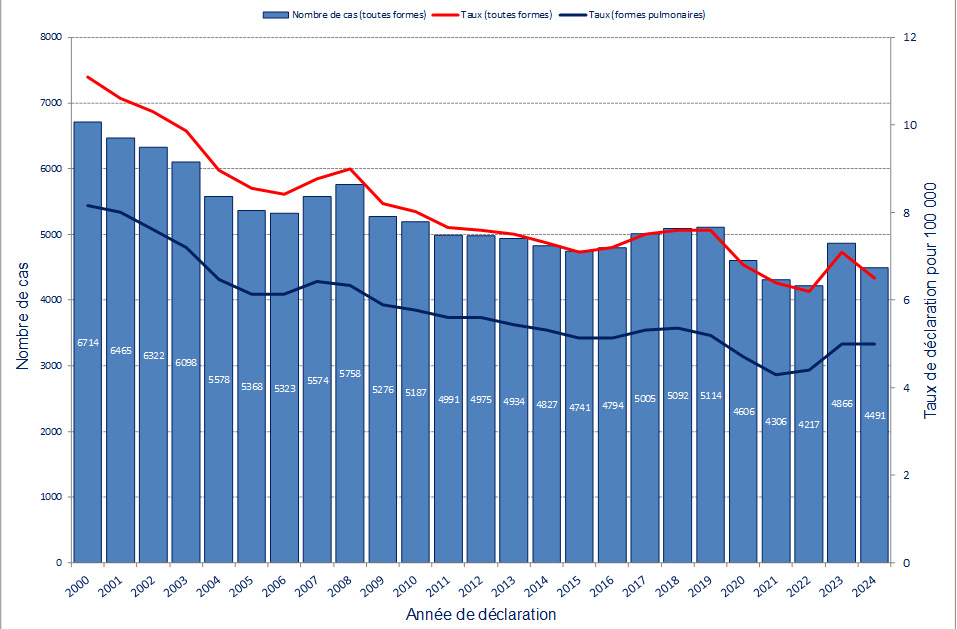
In 2020, 4,606 cases of tuberculosis were reported, representing a case rate of 6.8 per 100,000, compared to 5,116 cases and 7.6 cases per 100,000 in 2019. This incidence has been steadily declining for decades, but the annual decline is small, averaging -1.7% per year over the past 30 years.
Three population groups have been identified as the most affected by the disease and on which control and prevention efforts should focus:
homeless people (170 cases per 100,000 inhabitants);
people born outside France (34 cases per 100,000 inhabitants);
prisoners (64 cases per 100,000 inhabitants).
Decrease in the number of multidrug-resistant tuberculosis cases: 67 cases in 2020 compared to 75 in 2019.
The change in BCG vaccination policy in 2007 and the vaccine shortage over the past six years have not impacted the epidemiology of childhood tuberculosis. Tuberculosis reporting rates in this population group remain very low. Severe forms of the disease in children (meningeal or miliary) are stable (9 cases in 2020 compared to 10 in 2019) and consistent with predictions made when the mandatory BCG vaccination was suspended.
At the regional level
Geographical and population-based disparities are comparable to those observed in previous years. There is a heterogeneous distribution of tuberculosis across regions and populations.
The highest incidence rates remain in three regions:
French Guiana (22.5 cases per 100,000 inhabitants)
Mayotte (15.1 cases per 100,000 inhabitants)
Île-de-France (14.3 cases per 100,000 inhabitants)
The Ile-de-France region accounts for 38% of cases. Seine-Saint-Denis is the French department most affected by tuberculosis (23.8 cases per 100,000 inhabitants).
Total number of cases and tuberculosis notification rate, France, 2000–2024
Santé publique France’s Role in Tuberculosis Surveillance and Control
Monitoring the epidemiological trends of tuberculosis
Assessing the impact of the suspension of mandatory BCG vaccination on the incidence of tuberculosis
Informing healthcare professionals
Vaccination Information Service
What are vaccines for? How do they work? At what age should children be vaccinated? Vaccination-info-service.fr answers the most frequently asked questions about vaccination. A separate...
Odysseus
Santé publique France's open data portal, based on its 70 surveillance systems, surveys, and scientific expertise.