



Investigation into clusters of hemolytic uremic syndrome (HUS) and Shiga toxin-producing E. coli (STEC) infections linked to the consumption of Buitoni® brand Fraîch’Up pizzas. Update as of April 13, 2022.
Update as of April 13, 2022, on the cluster of cases of hemolytic uremic syndrome and infections caused by Shiga toxin-producing E. coli linked to the consumption of frozen pizzas from the Fraîch’Up line of the Buitoni® brand.

Pediatric hemolytic-uremic syndrome
thematic dossier
Hemolytic uremic syndrome is a primarily renal complication of infections caused by Shiga toxin-producing Escherichia coli. Although rare, it is a serious condition that primarily affects young...
Santé publique France and the National Reference Center (CNR) for E. coli and its associated laboratories (Institut Pasteur, Paris, and the Microbiology Laboratory at Robert Debré Hospital, Paris), in collaboration with the Directorate General for Food, the Directorate General for Competition, Consumer Affairs, and Fraud Control, and in coordination with the Directorate General for Health, have been investigating since February 10, 2022, an increase in the number of pediatric cases of hemolytic uremic syndrome (HUS) and infections caused by Shiga toxin-producing Escherichia coli (STEC).
Epidemiological, microbiological, and traceability investigations conducted since that date have confirmed a link between the occurrence of these clustered cases and the consumption of frozen pizzas from the Buitoni-brand Fraîch’Up line contaminated with STEC bacteria. On March 18, 2022, the company initiated a recall of all pizzas in the Fraîch’Up line, which had been on the market since June 2021, and authorities asked anyone in possession of these pizzas not to consume them and to dispose of them.
The total number of HUS cases linked to the consumption of these pizzas appears to have stabilized since the recall.
HUS Cases in France: Update as of April 13, 2022
As of April 13, 2022, 53 confirmed cases have been identified, 51 of which are linked to STEC O26 strains, and 2 to STEC O103 strains. Investigations are ongoing for 26 other cases of HUS and STEC infections reported to Santé publique France.
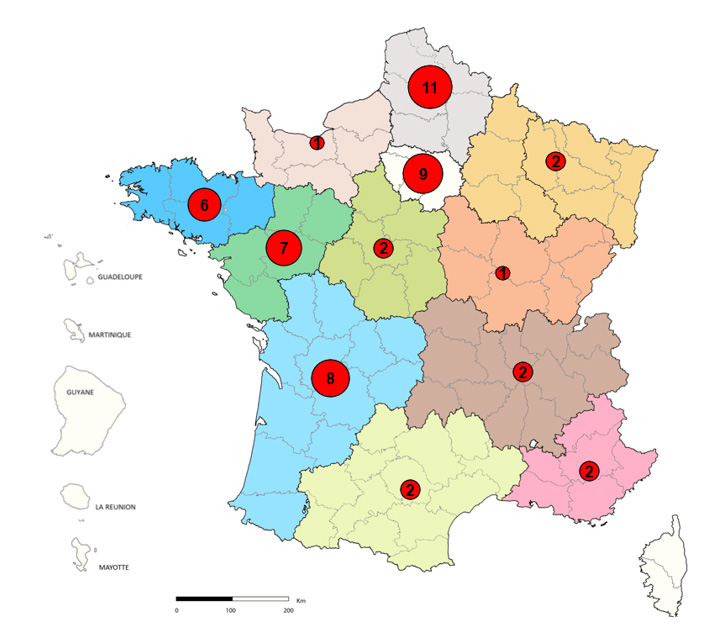
These 53 cases occurred in 52 children and 1 adult, who presented symptoms between January 18, 2022 (week 3) and March 16, 2022 (week 11) (Figure 1). The epidemic peak occurred in week 7 (February 14–20) and week 9 (February 28–March 6), with 10 cases in each of these weeks. These 53 cases occurred in 12 regions of metropolitan France: Hauts-de-France (11 cases), Île-de-France (9 cases), Nouvelle-Aquitaine (8 cases), Pays de la Loire (7 cases), Brittany (6 cases), Auvergne-Rhône-Alpes (2 cases) [-1 case since the update of April 6, 2022, following additional testing], Grand Est (2 cases), Occitanie (2 cases), Provence-Alpes-Côte d’Azur (2 cases), and Centre-Val de Loire (2 cases), Bourgogne-Franche-Comté (1 case) [-1 case since the update of April 6, 2022, following additional test results], Normandy (1 case) (Figure 2).
The 52 affected children are aged 1 to 17 years with a median age of 7 years; 23 (44%) are female; 46 (88%) developed HUS, and 6 (12%) had STEC gastroenteritis. Two children have died. The adult did not develop HUS [an adult previously reported in the update of 04/06/2022 was ultimately ruled out following additional testing].
Figure 1: Epidemic curve: number of confirmed cases of HUS and STEC infections (N=51), by week of symptom onset—mainland France, weeks 3–11, 2022
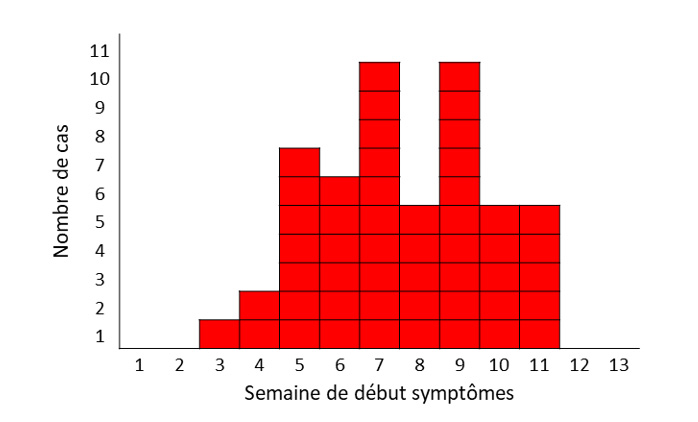
Figure 2: Geographic distribution of confirmed cases of HUS and STEC infections (N=53) linked to the consumption of Buitoni®-brand Fraîch’Up pizzas, by region of residence in mainland France, weeks 3–11, 2022
See the previous points
Severe cases of hemolytic uremic syndrome (HUS) in children: new cases reported; health authorities reiterate recommended precautions (press release dated 03/30/22)
Severe cases of hemolytic uremic syndrome (HUS) in children: preventive recall of batches of Buitoni® brand Fraîch’Up frozen pizzas due to possible contamination with Escherichia coli O26 bacteria (press release dated 03/18/22)
Update on ongoing investigations into severe cases of hemolytic uremic syndrome (HUS) in children. Reminder of food safety recommendations (press release dated 03/12/22)
Ongoing investigations into pediatric cases of hemolytic uremic syndrome (HUS) and health recommendations (press release dated 02/25/22)