



Colorectal Cancer Screening: Follow-up of Individuals with a Positive FIT Test from 2018 to 2020
Santé publique France has released follow-up data on positive screening results from the 2018–2019 period and preliminary data for 2020 as part of France’s organized colorectal cancer screening program.

Colorectal cancer
thematic dossier
Find the latest news and key information about colorectal cancer here.
As part of its mission to evaluate the national organized colorectal cancer screening program, Santé publique France has published on its website follow-up data on positive screening results from the 2018–2019 period, based on source data from the Regional Cancer Screening Coordination Centers. These new data confirm the effectiveness of the immunological test but highlight the continuing trend of longer wait times for colonoscopy following a positive test. Given the impact of COVID-19 on access to care, the Agency has also conducted an early analysis of the initial data received for 2020. It is important to remember that when detected early, this cancer can be cured in 90% of cases.
Colorectal cancer: better chances of cure if detected at an early stage
Colorectal cancer develops from the cells lining the inner wall of the colon or rectum. Most often, these malignant tumors originate from a benign tumor that grows slowly and eventually becomes cancerous.
Colorectal cancer can be detected at an early stage through screening for occult blood in the stool. An organized screening program is offered in France to all individuals aged 50 to 74. Those who test positive are invited to undergo a colonoscopy to detect the possible presence of precancerous lesions or cancer. Santé publique France is responsible for evaluating the performance of the screening program and publishes annual participation indicators at the national, regional, and departmental levels, as well as follow-up data every two years for those who test positive.
What is the purpose of these indicators?
These performance indicators, which include the quality of the screening test and the performance of a colonoscopy following a positive test result, are essential for evaluating the national organized colorectal cancer screening program. Shared with policymakers, Regional Cancer Screening Coordination Centers, and other screening stakeholders, they enable monitoring of the program’s progress toward its goals and help identify potential avenues for improvement.
Colorectal cancer: a more effective screening test, but the time to colonoscopy needs to be improved
Regarding screening tests: the immunological screening test continues to perform well
For the 2018–2019 period, the performance of the immunological test (introduced in 2015) remains significantly superior to that of the guaiac test (2013–2014 period), with:
a detection rate for advanced adenomas nearly three times higher (9.3‰ vs. 3.3‰);
a cancer detection rate nearly twice as high (2.1‰ vs. 1.2‰);
a higher positive predictive value (i.e., the probability of having the disease if the screening test is positive) for the detection of advanced adenomas (28.4% vs. 17.0%);
a higher positive predictive value for cancer detection (6.6% vs. 6.3%);
a higher percentage of invasive cancers detected at an early stage (Stage I): 43.9% vs. 37.7%.
However, the median time to colonoscopy following a positive test continues to increase: from 62 days in 2013–2014 to 80 days in 2018–2019. In 2020, the median time to colonoscopy following a positive test was 87 days (a result that needs to be consolidated as it was obtained from partial data*, affected by the onset of the COVID-19 pandemic).
Regarding follow-up of screened individuals: a possible decline in the number of colonoscopies performed since the start of the COVID-19 pandemic
At the national level, the follow-up indicators for individuals who tested positive remained in line with European benchmarks for organized colorectal cancer screening in 2018–2019:
percentage of colonoscopies performed after a positive test = 86.4%European benchmark: acceptable: ≥85% - desirable: ≥90%
Percentage of complete colonoscopies = 93.4%European benchmark: acceptable: ≥90% - desirable: ≥95%
However, an analysis of preliminary 2020 data tracking individuals who tested positive indicates a 76.5% rate of colonoscopies performed following a positive test (a result that needs to be consolidated as it is based on partial data*, influenced by the onset of the COVID-19 pandemic).
*Information is currently available for only about 80% of the positive tests performed.
Learn more
Key Takeaways
For the 2018–2019 period, the performance of the immunological test remains significantly superior to that of the guaiac test. However, the delay in scheduling colonoscopies following a positive FIT test continues to increase, including in 2020 during the COVID-19 health crisis.
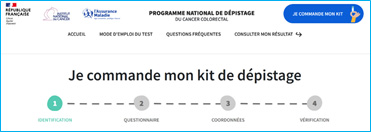
monkit.dépistage-colorectal.fr: Order and receive your colorectal cancer screening kit at home
Since March 1, men and women aged 50 to 74 who have received an invitation to participate in the organized colorectal cancer screening program can order the test online to have it delivered to their home: monkit.depistage-colorectal.fr.
Monkit.depistage-colorectal.fr is a website of the Ministry of Health and Solidarity, the National Health Insurance, and the National Cancer Institute. It aims to simplify and expand the ways patients can access the screening test (through their general practitioner, gynecologist, hepatogastroenterologist, etc.). Its goal is to encourage the target population to participate in this life-saving screening.
Santé publique France’s roles in the surveillance and prevention of colorectal cancer:
Monitoring epidemiological trends in colorectal cancer
Evaluating the national organized screening program at the national, regional, and departmental levels
Promoting efforts to combat preventable risk factors
FIT: a screening test that detects the presence of occult blood in stool (Fecal Immunological Test)












