

The Air and Health Monitoring Program (PSAS) is 25 years old
To mark National Air Quality Day on October 14, 2022, Santé publique France is highlighting key developments from the past five years in celebration of the 25th anniversary of the PSAS and is releasing the results of the latest quantitative assessment of the long-term impact on mortality at the regional and departmental levels as open data.

Air
thematic dossier
Air pollution affects the entire population. The levels of pollutants found in the atmosphere are linked to health risks, and any reduction in exposure to these pollutants would be beneficial.
The PSAS, a major program to help combat air pollution
Each year, nearly 40,000 deaths are attributable to exposure to fine particulate matter (PM2.5) among people aged 30 and older. Air pollution has proven health effects and remains the leading environmental risk factor in France and worldwide, particularly in the context of climate change and the energy crisis we are currently experiencing.
Through its work, Santé publique France demonstrates that implementing measures aimed at sustainably reducing air pollution would improve the health and quality of life of the population. Through the Air and Health Monitoring Program (PSAS) and the results it has produced since its launch in 1997, the Agency monitors and characterizes the short- and long-term health effects of air pollution and conducts quantitative health impact assessments (EQIS).
This year marks the 25th anniversary of Santé publique France’s PSAS. This is an opportunity to look back on the program’s history, the actions taken, and the studies published in collaboration with our national and regional partners.
Highlights of the PSAS
In 2017, Santé publique France created an interactive presentation (storymap) that traced the program’s history and highlighted key milestones from the past 20 years. Since then, Santé publique France has continued its surveillance activities and methodological developments. Below are the key highlights from the past five years.
EQIS-PA Training: A Key Focus of the PSAS
Training is essential to enable local stakeholders and communities to implement quantitative health impact assessments of air pollution (EQIS-PA), a highly useful tool for guiding actions aimed at reducing the impact of air pollution. These EQIS-PA assessments are designed to support decision-making regarding interventions intended to reduce pollution. They enable the estimation of achievable health benefits from scenarios for improving air quality.
Learn more:
Guides and educational tools
Santé publique France, in collaboration with its partners, has continued its commitment to developing and promoting the EQIS-PA approach.
To this end, guides and tools were developed by Santé publique France in 2019 to simplify their use by local stakeholders. These guides are based on a calculation tool developed by the World Health Organization (WHO), the AirQ+ tool, which has been adapted to the French context.
Customized training
Support for local authorities in implementing EQIS-PA, led by ADEME, has been established. Over two years, two successive waves of local authorities received customized EQIS-PA training. In 2022, this training is being led by EHESP with support from ADEME for a two-year pilot phase and is open to a broader audience of project managers and engineers (Regional Directorates for the Environment, Planning, and Housing (DREAL), Regional Health Agencies (ARS), Regional Health Observatories (ORS), Accredited Air Quality Monitoring Associations (AASQA), local governments (metropolitan areas, EPCI, etc.); decision-makers on air quality at the local and national levels; and consulting firms.
Multi-partner studies to assess health risks and the impacts of ambient air pollution
To advance scientific knowledge and as part of its mission to monitor the impact of air quality, Santé publique France is expanding the PSAS partnership network at the local/regional, national, and international levels. In collaboration with its partners, including ORS Ile-de-France, INERIS, the AASQAs, CITEPA, and the Aix-Marseille School of Economics (AMSE, Aix-Marseille University, AMU), PSAS has produced or contributed to various studies across France over the past five years:
Short-term impact of nitrogen dioxide (NO₂) on mortality in 18 French urban areas, 2010–2014
Ambient air pollution and mortality in France: new estimates of the economic impact and influence of the spring 2020 lockdown | AMSE (amse-aixmarseille.fr)
The PSAS is also actively involved in international scientific initiatives, notably by contributing to projects developed by the WHO to update the indicators and concentration-risk functions necessary for EQIS-PA calculations.
Impact of air pollution at the regional and departmental levels: new indicators available as open data on Géodes
Among its projects, the PSAS conducted an assessment of the impact of long-term exposure to fine particulate matter (PM2.5) and NO2 on mortality at the national level for the period 2016–2019.
The indicators derived from this work are available at the regional and departmental levels for the period 2016–2019: number of deaths and proportion of preventable deaths, and gain in life expectancy resulting from compliance with WHO guideline values.
Participation in research projects
The Psas contributes to research projects. The most recent one is the CEPEM project (characterization of pollution episodes and evaluation of implemented measures), funded by ADEME as part of the PRIMEQUAL call for projects #1862C0011 (inter-agency research program for better air quality), and coordinated by INSERM (UMR-S 1136). The objectives of the CEPEM project are:
Axis 1: to better understand the epidemiological characteristics of pollution episodes in France,
Axis 2: to evaluate policies to combat pollution during pollution episodes in Paris,
Axis 3: to evaluate measures on a longer time scale aimed at more sustainable urban changes, in particular by identifying measures implemented over time to reduce pollution linked to traffic and mobility in France.
The Psas participated in objectives 1 and 3.
An expansion of PSAS cities since its creation
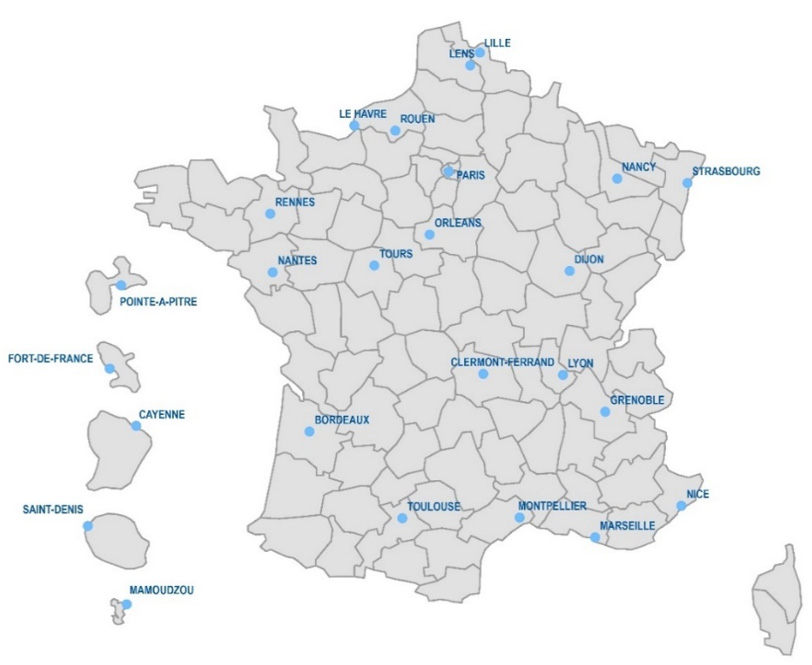
PSAS’s work is conducted throughout mainland France thanks to the development of exposure modeling by INERIS, as well as at the local level in collaboration with the AASQAs. PSAS thus began with 9 cities; today it includes 22 French cities, including two in overseas territories—representing more than 15 million residents—which allows for the diversity of air pollution exposure in France to be taken into account.
Cities participating in the PSAS
Future prospects for the PSAS
Due to climatic conditions, emission reduction policies, and potential changes in emission sources, the health risks associated with air pollution are likely to change. The PSAS will continue to monitor these developments and their impacts on health, in collaboration with other programs of interest to Santé publique France and elsewhere, to best meet societal expectations and protect the health of the population.
Notable upcoming work in 2023 includes conducting an EQIS-PA to estimate the impact of ambient air pollution on morbidity, and updating Santé publique France’s guidelines based on new knowledge developed through WHO projects.
Looking ahead, the Psas is moving toward an integrated approach to assessing health impacts linked to various environmental factors, including ambient air pollution, heat, noise, access to green spaces, and mobility. To this end, Santé publique France is coordinating a pilot study with the municipalities of Rouen, Lille, and Montpellier.
More information on the history of the PSAS
moreIn addition to the PSAS, upcoming research on the health impacts of indoor air quality
More recently, Santé publique France has expanded its activities to include the health impact of indoor environmental quality.
As part of the National Housing Campaign 2, a collaboration agreement was signed in 2019 between Santé publique France and the Scientific and Technical Center for Building (CSTB), acting as the scientific and technical operator of the Indoor Air Quality Observatory (OQAI). This campaign aims to assess air quality in French homes, particularly how it has changed since the first national campaign conducted in 2003–2005. A “health/perception” component, led by Santé publique France, has been added to this new campaign to better understand the link between indoor air quality and residents’ health. The first results are expected in 2023.
At the same time, work is underway to study the relevance and feasibility of applying the EQIS approach in and around schools. This work aims to identify the data needed to implement such an approach in schools, as well as to obtain an initial estimate of the benefits of improved indoor air quality in these settings on childhood asthma. An initial report on the subject will be published in early 2023.
The results of this work are particularly anticipated given that they come at a time when the health crisis linked to the COVID-19 pandemic has highlighted the importance of ventilating and airing out indoor spaces as a means of combating the spread of the virus. They will thus help reinforce the evidence showing that, beyond infectious disease concerns, ensuring good indoor air quality is essential for the health and well-being of everyone.