



Air Pollution: Long-Term Effects
Exposure to background pollution, both on a day-to-day basis and over the long term, leads to the most significant health effects, whether in terms of morbidity or mortality. The Psas monitors these long-term health effects of pollution.
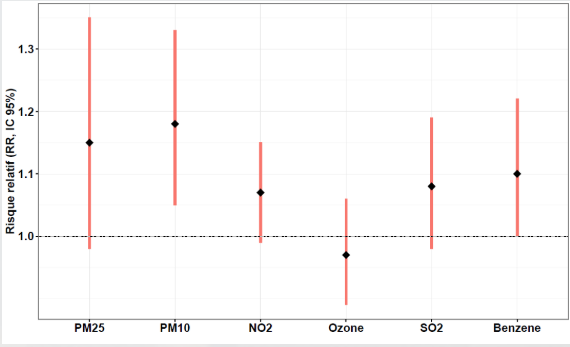
The Gazel-Air study used data from the Gazel cohort (coordinated by Inserm’s UMS 11 unit) to establish, for the first time in France, the link between 25 years of exposure to air pollution, mortality, and indicators of cardiovascular disease (CVD), respiratory disease, and diabetes in a study population of over 20,000 volunteer EDF-GDF workers followed from 1989 to 2015. An association was observed between long-term exposure to air pollution and mortality. Indeed, in this study, increased concentrations of PM, nitrogen dioxide (NO₂), and benzene were associated with an increased risk of all-cause non-accidental mortality. Thus, a 10 µg/m³ increase in PM2.5 was associated with a 15% increase in the risk of total non-accidental mortality (i.e., a relative risk of 1.15). This relative risk was subsequently used in the quantitative health impact assessment (EQIS) in mainland France (exposure-mortality illustration).
Association between exposure to each pollutant and non-accidental mortality (for a 10 µg/m³ increase—or a 2 µg/m³ increase for benzene)—1989–2008

A retrospective study of outdoor air pollution modeling at a fine spatial scale in France, 1989–2008.
Association between long-term exposure to air pollution and mortality in France: A 25-year follow-up study.
In relation to

Climate change
thematic dossier
Climate change is rapidly and profoundly altering the environment. The health impacts of climate change are numerous and varied.

Asthma
thematic dossier
Asthma is a chronic respiratory disease characterized by attacks, which are episodes of breathing difficulties (dyspnea). Asthma has a significant impact on patients’ quality of life.

thematic dossier
Cardiovascular disease and stroke
Les maladies cardio-neuro-vasculaires regroupent un ensemble de troubles affectant le cœur et les vaisseaux sanguins.